Property of the Albright-Knox Art Gallery
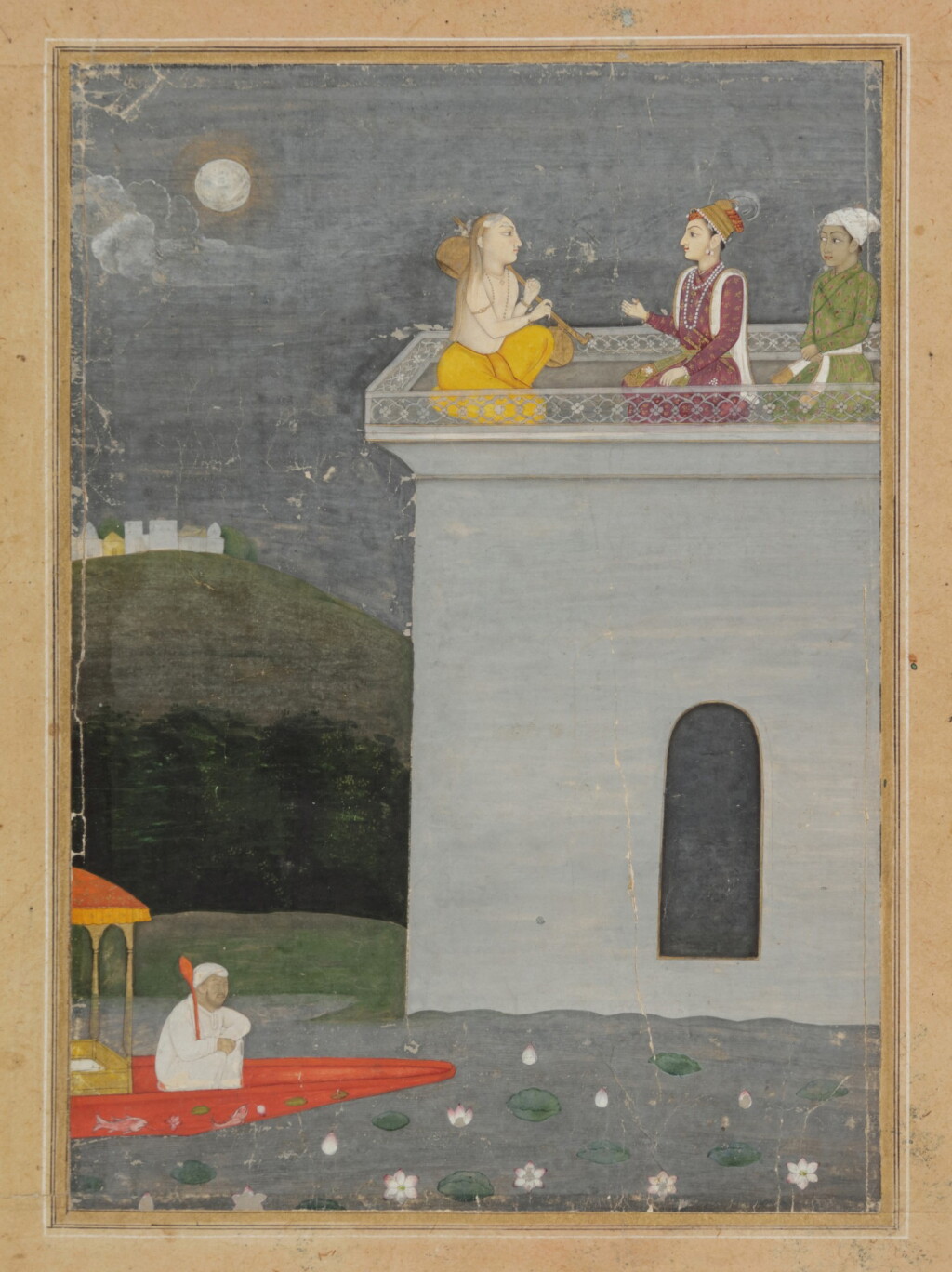
An Illustration to a Ragamala Series: Kedar Ragini, India, Provincial Mughal, mid-18th Century
Auction Closed
September 20, 05:33 PM GMT
Estimate
2,400 - 3,400 USD
Lot Details
Description
Property of the Albright-Knox Art Gallery
An Illustration to a Ragamala Series: Kedar Ragini
India, Provincial Mughal, mid-18th Century
Opaque watercolor on paper heightened with gold
Image: 7⅜ by 5¼ in. (18.7 by 13.3 cm)
Folio: 11 ¼ by 8¾ in. (28.6 by 22.2 cm), unframed
Sherman S. Jewett Fund, 1935.
Collection of Albright-Knox Art Gallery, Buffalo.
A musician with a tanpura entertains a lord on an open roof terrace under a clear bright moon in a secluded setting. In the foreground is a boat moored amidst lotus blooms in which a drowsy boatman waits. The perimeter of a hamlet can be seen atop a hillock at far left. Four lines of calligraphy in nasta’liq script on the verso.
The interpretation of Kedara depicting a youthful prince visiting an ascetic with a vina on the terrace of a high pavilion - above a river with waiting boatman - is seen generally in eighteenth century Provincial Mughal or Northern Deccani contexts. Rajasthani examples of the Ragini often depict Kedara as a young prince in conversation with an ascetic playing a vina seated on the terrace of a smaller pavilion or in a forest - usually at night.
A Murshidabad painting of Kedara Ragini from the Victoria and Albert Museum London, accession no. IS.19-1958, bears a strikingly similar composition but with a slightly different detail - two female musicians entertain the prince instead of an ascetic. In the background is the expansive and flat landscape of the Bengal alluvial plains.
The present work is an extremely refined example of Provincial Mughal Ragamala painting. A Provincial Mughal painting of Kedara Ragini in the Yale University Art Gallery, accession no. 1940.12, shows a similar interpretation to the present work also with calligraphy on the verso. Another is in the Brooklyn Museum collection, accession no. X689.8. See T. Falk and M. Archer, Indian Miniatures in the India Office Library, London, 1981, pp. 135-216 and pp. 435-496 for a discussion on Provincial Mughal paintings.
You May Also Like