Property From the Estate of Raymond Cheven
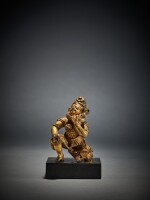
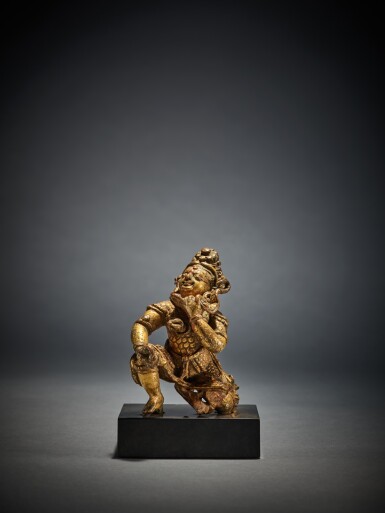
A Gilt Copper Figure Depicting a Demon Victim of Durga's Wrath, Nepal, circa 13th Century
Auction Closed
September 20, 05:33 PM GMT
Estimate
3,000 - 5,000 USD
Lot Details
Description
Property From the Estate of Raymond Cheven
A Gilt Copper Figure Depicting a Demon Victim of Durga's Wrath
Nepal, circa 13th Century
Height 3¼ in. (8.3 cm)
the kneeling attendant to the buffalo headed demon from a Mahishasuramardini group, his raised left hand holding a serpent, wearing a chainmail shirt, with a vajra impaling his chest, adorned with circular earrings and a crown topped with a rosette ornament
Himalayan Art Resources item no. 10121.
Collection of Raymond Cheven (1928-2011).
This demon victim of Durga would originally have been part of a larger sculptural group depicting Durga slaying Mashihasura, the buffalo demon. The full scene showing the dramatic event of the eighteen-armed goddess brandishing weapons and triumphantly standing on the back of the buffalo demon is fully illustrated in a Nepalese cast sculpture from the fifteen century located in the Rubin Museum of Art (C2005.16.11, HAR65433) (P. Pal, Nepal: Where the Gods are Young, The Asia Society, exh. cat., 1975, p. 130, cat. no. 73). At the edges of this composition are two of Mahisauras’s kneeling demonic companions, or as Lerner and Kossack indicate, possibly the demon brothers Sumbha and Nisumbha, one which is shown impaled by a vajra and the other a chakra (M. Lerner and S. Kossack, The Lotus Transcendent: Indian and Southeast Asian Art from the Samuel Eilenberg Collection, New York, 1991, p.148).
This pairing of kneeling demons relates to the present sculpture who bears a vajra at his chest and another demon showing a chakra piercing his chest located in the Metropolitan Museum of Art (acc. no. 1987.142.363) (M. Lerner and S. Kossack, ibid, 1991, p. 148, cat. no. 118). The parallel of styles between these two sculptures is almost uncanny as both figures are positioned in the same stance, wear chainmail vests and sashes falling in an identical manner across their thighs. In their raised left hand, they correspondingly wrestle a writhing snake. The styling of armbands and bracelets at the wrists, foliate tiaras as well as the anguished expressions reflected in their bulging eyes closely resemble one another. The plinth attached to the demon in the Metropolitan Museum of Art collection suggests that these two were not part of the same set, as the present sculpture was fashioned with tangs rather than a base. However, it is likely, based on the close stylistic similarities between these two sculptures, that they were fashioned in the same atelier.
You May Also Like


