
Property of a Lady 女史珍藏
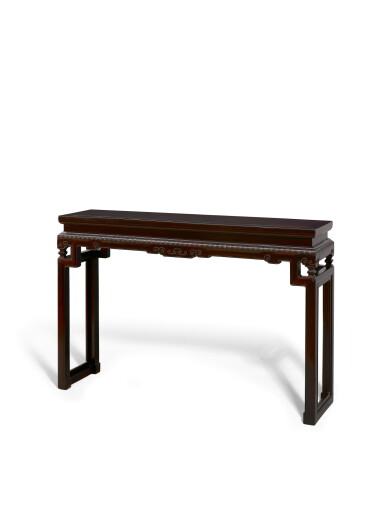
A zitan table, tiaozhuo Qing dynasty, early 18th century | 清十八世紀初 紫檀有束腰條桌
Auction Closed
April 22, 07:57 AM GMT
Estimate
1,500,000 - 2,500,000 HKD
Lot Details
Description
Property of a Lady
A zitan table, tiaozhuo
Qing dynasty, early 18th century
女史珍藏
清十八世紀初 紫檀有束腰條桌
with a single board set within a standard mitre, mortise and tenon construction, with a constricted waist surmounting a beaded-edge shaped apron carved with lappets and scrollwork, supported by open L-shaped brackets and four square-sectioned legs transitioning through baluster turnings and joined by stretchers at the top and base enclosing a plain beaded apron, all terminating in modified hoof feet
135.2 by 30.8 by h. 84.5 cm
Ho Cheung, Hong Kong.
Ji Ya Xuan collection.
Sotheby’s New York, 17th/18th September 2013, lot 259.
Ho Cheung,香港
Ji Ya Xuan 收藏
紐約蘇富比2013年9月17/18日,編號259
There is a closely related table in the Palace Museum Collection, Beijing, illustrated by Hu Desheng, A Treasury of Ming and Qing Dynasty Palace Furniture, vol. 1, Beijing, 2007, fig. 233. The author observes that the table shares some structural characteristics with Western architecture and presumably this refers to the turned finial at the top of each leg, a feature derived from the columns of classic antiquity. The adaptation of this Western motif is very successfully integrated with traditional Chinese archaistic references. The carved 'hooks' and 'scrolls' are design elements taken directly from early jades and bronzes.
Jonathon Hay in Sensuous Surfaces, The Decorative Object in Early Modern China, Honolulu, 2010, discusses 18th century taste for archaism and notes that zitan wood provided an ideal surface for the bold geometric lines of Chinese antique vernacular, describing it as a 'distinctly new form' (p. 161). It seems then, that this table embodies archaic features of both East and West harmoniously merged in a distinctive style that speaks to the expansive, multi-cultural imperial taste that simultaneously references the past, while pushing into the future with innovative design.