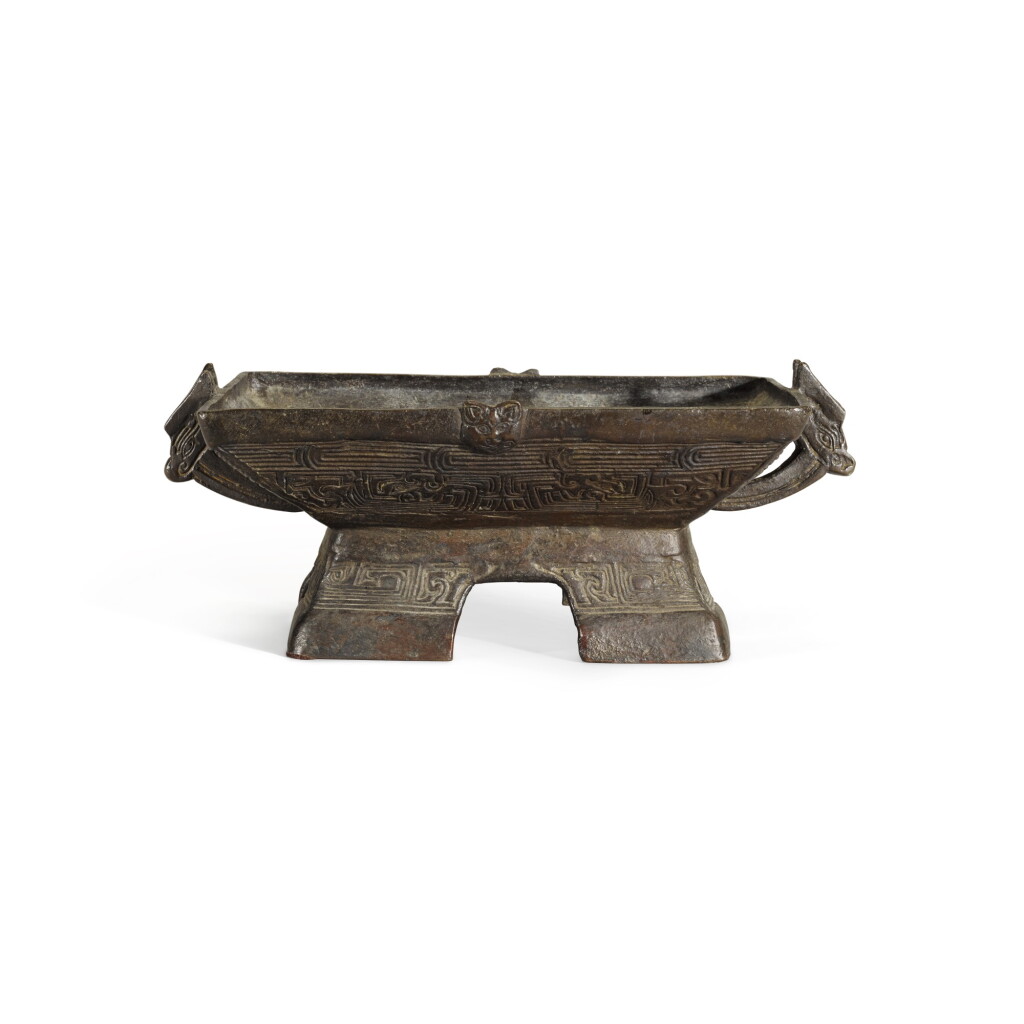
Formerly in the collection of Dr. David Ho (1911- 1986)
A rare inscribed and dated archaistic bronze vessel, fu Yuan dynasty, dated to the bingzi year of the Zhiyuan reign (1276 or 1336) | 元 1276或1336年 銅簠
Auction Closed
November 3, 05:23 PM GMT
Estimate
6,000 - 8,000 GBP
Lot Details
Description
Formerly in the collection of Dr. David Ho (1911- 1986)
A rare inscribed and dated archaistic bronze vessel, fu
Yuan dynasty, dated to the bingzi year of the Zhiyuan reign (1276 or 1336)
元 1276或1336年 銅簠
heavily cast of rectangular shape, with wide flared sides raised on a high splayed foot with a cut-out apron, the sides set with a pair of loop handles issuing from animal heads, decorated around the sides with bands of stylised geometric motifs, the sides with two small applied animal-mask tabs, the interior with a cartouche reading Wen chang shuyuan Zhiyuan bingzi cheng Guangping Zhang Yuanshan zhi
Length 34.1 cm, 13½ in
銘文:文昌書院志元丙子成廣平張元善置
Dr. David Ho (Chinese name Ho Hangchi 何昌熾) was born in Kanton in 1911. His father was a well-known dentist in Nanjing who counted Chiang Kai-shek among his patients. David Ho pursued an illustrious career in International Law. He first studied political sciences at the University of Shanghai (1930-1932) followed by comparative and international law studies at Suzhou University. After moving to France, in 1941 he obtained a PhD in law from the University of Paris. In 1962 he joined the Honourable Society of the Inner Temple in London. From 1949 until his retirement in 1971, David Ho worked as a legal officer at the United Nations Secretariat in New York. He relocated to Geneva in 1971 where he and his wife lived until his death in 1986.
Interested in Chinese history and art, David Ho was particularly fascinated by objects that were inscribed. His extensive archive and research suggest that it was during his time in New York that he began collecting and researching Chinese artefacts.
You May Also Like