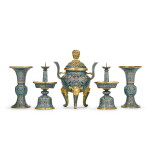
Property from an Important Collection 重要私人珍藏
A magnificent and extremely rare large cloisonné enamel 'peach' basin, Qing dynasty, Qianlong period | 清乾隆 掐絲琺瑯大桃盆
Auction Closed
October 13, 04:27 AM GMT
Estimate
1,000,000 - 1,500,000 HKD
Lot Details
Description
Property from an Important Collection
A magnificent and extremely rare large cloisonné enamel 'peach' basin
Qing dynasty, Qianlong period
重要私人珍藏
清乾隆 掐絲琺瑯大桃盆
superbly cast with a massive hollow body in the form of a peach borne on a leafy gilt branch issuing peach, pomegranate and finger citron, representing the 'Three Abundances', the exterior vibrantly decorated with the an baxian reserved on a dense multi-coloured ground of bats amid cloud scrolls, the interior with a classic ‘cracked ice’ design, all on a brilliant sky-blue turquoise ground
71.6 cm
Sotheby's New York, 23rd September 1997, lot 111.
紐約蘇富比1997年9月23日,編號111
It was during the reign of the Qianlong Emperor that the production of cloisonné enamel wares reached new heights. The technical mastery characteristic of Qianlong's reign and the significant increase in the number of palette used, which included more than twenty opaque colours, made it possible to manufacture pieces with elegantly crafted bodies and thick layers of enamel that made them solid and heavy. As Béatrice Quette mentions, 'all manner of forms were produced in unprecedentedly large sizes, especially in the case of imperial commissions'; see Quette, 'Cloisonné Form and decoration from the Yuan through the Qing dynasty', Cloisonné. Chinese Enamels from the Yuan, Ming and Qing Dynasties, New York, 2011, p. 56.
You May Also Like