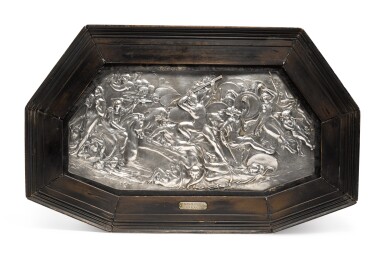
A George IV Silver Embossed Plaque, Probably a Study for a Monumental Shield, Attributed to William Pitts of London, dated 1828, later Hallmarked Hunt & Roskell, London, 1880
Lot Closed
October 20, 08:40 PM GMT
Estimate
3,000 - 5,000 USD
Lot Details
Description
A George IV Silver Embossed Plaque, Probably a Study for a Monumental Shield, Attributed to William Pitts of London, dated 1828, later Hallmarked Hunt & Roskell, London, 1880
curved rectangular panel, embossed and chased with a classical battle scene, in conforming wood frame with later? plaquette inscribed Elgin Marbles Silver Repoussé
back engraved Worked in Repoussé by William Pitts in 1828 for Storr & Mortimer- But not Hall Marked Until 1881; the back is also marked number 2 and 6
length 19 1/8 in.; length of frame 24 1/2 in.
48.5 cm; 62.3 cm
The distinctive shape indicates that this piece was intended for a larger composition, possibly a circular centerpiece base, but more likely a monumental display shield. The best known example of these shields, a popular form in the Regency and George IV eras, is the Shield of Achilles, modeled over several years by sculptor John Flaxman and executed by the Royal Goldsmiths Rundell, Bridge and Rundell. Examples were acquired by the Prince Regent, his younger brother the Duke of York, and several of the grandest patrons of the era.
Another example was the Wellington Shield, conceived as a presentation piece for the Victor of Waterloo. It was designed by sculptor Thomas Stothard, known for his silver designs and also for his ornamental work at Buckingham Palace, and was crafted by Benjamin Smith. Finished about 1822, the shield is still in the Wellington Collection at Apsley House in London.
William Pitts II (1790–1840), son of William Pitts of Pitts & Preedy, was an English silversmith, chaser and sculptor. A similar plaque, also attributed to William Pitts, was offered at Sotheby's, London, 6 April, 1989, lot 88. The description by John Culme reads as follows:
A George IV Silver Plaque, attributed to William Pitts, London, circa 1828, later marks for Hunt & Roskell, 1880, of octagonal form with repousse series of battle and Mucius Scaevola burning his hand in front of Lars Porsena King of Closium, all within a wooden frame, engraved on back "Worked in Repousse by William Pitts in 1828 for Storr Mortimer-But Not Hall Marked until 1881," 37 ozs. 14 dwts. gross. Length 25 1/4 in. (24 cm)
These plaques probably relate to William Pitts' unfinished "Shield of Aeneas", of which a copper version was exhibited at the Great Exhibition of 1851 (the Crystal Palace), and again at the London Exhibition of 1862. The design was derived from the description in Virgil's Aeneid of the shield Aeneas receives from Vulcan, god of fire, metalworking and the forge. It was decorated with scenes from the future history of Rome, the city Aeneas would found. Thus Pitt's "Shield of Aeneas" would have formed an artistic pendant with Flaxman's "Shield of Achilles", modeled following the description of that shield in Homer's Iliad.
The Journal of Design and Manufactures of 1850 described the Shield of Aeneas as "...the finest piece of modelling for metal-work which has ever been produced in England." Seen in its unfinished state, as Pitts had died by his own hand before completing the Shield, the Journal continued, "It is a sad loss for the country [Britain] that poor Pitts didn't live to complete this great national monument in silver, since the plaster model he left must be regarded as only an indication of what the finished work would have been... Under existing circumstances it is impossible to compart this work with that of the bronze gates of Madeline, but this rough sketch gave promise that had poor Pitts lived England wouldn't now have stood in the humiliating position of being obliged to confess that she had not a sculptor in metals fit to compare with Dietrichy." (The Journal of Design and Manufactures, 1850, p. 109)
You May Also Like