
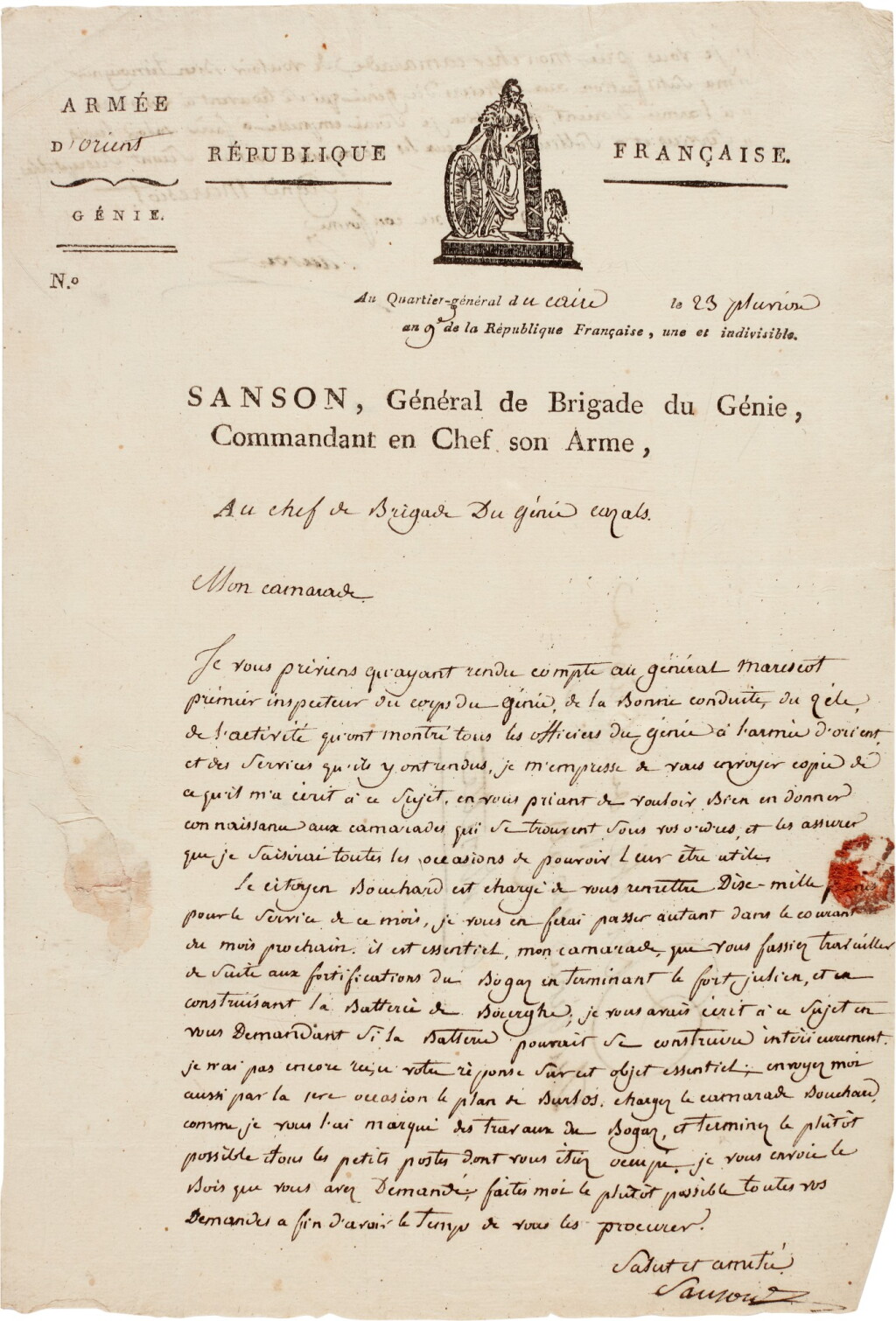
N.A. Sanson | Letter signed as Engineer-in-chief to the Army in Cairo, about Bouchard at Rosetta, 1801
Lot Closed
April 27, 02:44 PM GMT
Estimate
600 - 800 GBP
Lot Details
Description
Sanson, Nicolas-Antoine (1756-1824), as Engineer-in-chief of the "Armée d'orient"
Letter signed twice ("Sanson"), to General Cazals, the Chief Engineer at Rosetta, about Pierre-François Bouchard, 12 February 1801
in French, informing Cazals that Bouchard is arriving with ten thousand francs to finance his work on the fortifications of Fort Julien, including the sand bar ("Bogaz") and the artillery placements at Rosetta, at the mouth of the Nile, emphasizing the importance of completing the work as soon as possible
"...Le citoyen Bouchard est chargé de vous remettre Dix-mille [francs] pour le service de ce mois, je vous en ferai passer autant dans le courant du mois prochain. Il est essential, mon camarade, que vous fussiez travailler de suite aux fortifications du Bogaz en terminant le Fort Julien, et en continuant la Batterie du Bourghe..."
1 page, folio, Sanson's printed stationery featuring a vignette-seal of Marianne ("Armée d'orient/Génie...Sanson, Général de Brigade du Génie, Commandant en Chef son Arme"), signed by him also on the address panel to verso, Cairo, 23 pluviose an 9 [12 February 1801]
It was at Rosetta (present-day Rashid) in the Nile Delta that the celebrated Rosetta Stone was discovered in 1799 by the French engineer, Pierre-François Bouchard (1771-1822). He recognized at once the significance of its parallel Egyptian and Greek texts, which eventually led to the deciphering of hieroglyphics by Champollion in 1822.
Unfortunately for Bouchard, he was captured by the Ottoman Army and only just escaped being executed. After a few months, he was released and returned to Rosetta, the subject of this letter. He was then captured by the British, along with his famous Stone, when Fort Julien eventually surrendered on 8 April 1801. The Rosetta Stone has been in the British Museum ever since.
LITERATURE:
Jonathan North, 'The Man who Discovered the Rosetta Stone' (https://www.jpnorth.co.uk/research)