Tête, Tshogo Sango, Gabon | Tshogo Sango Head, Gabon
Auction Closed
November 30, 04:53 PM GMT
Estimate
30,000 - 50,000 EUR
Lot Details
Description
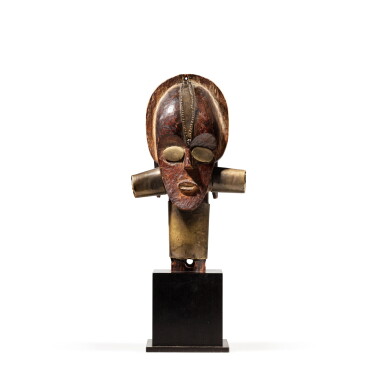
Tête, Tshogo Sango, Gabon
haut. 23 cm ; 9 in
Christie's, Paris, 3 décembre 2015, n° 75
Collection privée, Paris
Par Bertrand Goy
Un Mbumba-Bwiti
La figure de reliquaire pourrait servir d’emblème au Gabon. Du Nord au sud du pays, chez les Fang, les Kota, Sango, Tsogho et autres Lumbo, elle accompagne les réceptacles contenant les dépouilles des ancêtres conservées et honorées pour servir aux générations suivantes. Les officiants du bwiti, culte et organisation sociale né chez les Tsogho, dévoilent exceptionnellement ces icones dites Mbumba aux jeunes impétrants pour les soutenir moralement lors de leur rude voyage initiatique jalonné d’inquiétantes visions hallucinatoires produites par la prise d’iboga.
Le remarquable exemplaire de métissage artistique présenté ici montre à l’évidence combien il est réducteur et irréaliste d’enfermer une œuvre d’art africaine dans le carcan d’une seule ethnie. Les interrelations et les influences croisées sont la règle dans cette province de la Ngounié, au sud du Gabon, où se côtoyaient dans les mêmes villages des habitants de toutes origines. En témoignent les récits de Paul du Chaillu, premier occidental à pénétrer dans cette région enclavée, ou le recensement effectué par l’administrateur Georges Bruel pour les factoreries régionales au début du XXe siècle. De fait, si le profil du personnage et l’étroite bande de cuivre rehaussant son front appartiennent au registre stylistique tsogho, la structure générale de ce mbumba et ses oreilles en tronc de cône revêtues de métal empruntent aux Sango, groupe vivant un peu plus au sud. Là s’arrête leur contribution dans la mesure où est absente la base de bois en forme de losange reposant sur le panier de reliques caractéristique du groupe. Les percements pratiqués dans le cou indique, en revanche, un système d’attache d’une poche à ossements en cuir ou en feuillage plus fréquemment utilisée par les Tsogho. L’influence des voisins kota est reconnaissable à l’ovale très pur et allongé de la face rehaussée d’une manière de diadème. L’élégante coiffe à tresses est en revanche inusitée dans la Ngounié et, si leurs créateurs n’étaient pas si lointains, pourrait rappeler celle de quelques têtes fang célèbres, chères à Paul Guillaume ou Helena Rubinstein.
L’extrême et très esthétique stylisation du visage ne gomme toutefois pas les traits symboliques essentiels du mbumba. Les rondelles de cuivre figurant les yeux, sans doute dument polis en leur temps pour en rehausser le brillant, évoquent le regard halluciné des novices mbanzi ; l’importance donnée aux oreilles rappelle que les rites du bwiti sont rythmés par le son lancinant et ininterrompu des percussions mosomba et de la harpe à huit cordes ngombi. Quelques restes de blanc du kaolin et du rouge du padouk sur fond d’une profonde patine rappellent les peintures faciales des initiés.
A Mbumba-Bwiti
The reliquary figure could stand as an emblem of Gabon. From North to South, throughout the country, among the Fang, the Kota, the Sango, the Tsogho or even the Lumbo, it is linked to vessels containing the remains of ancestors, preserved and honoured to serve the following generations. The officiants of the Bwiti - a cult and social organization founded by the Tsogho - unveil these Mbumba icons to the young aspirants in exceptional occasions, to support them morally during their difficult initiation journey, marked as it was by disturbing hallucinatory visions induced by the iboga they ingested.
This remarkable exemplar of artistic intermingling clearly shows how reductive and unrealistic it is to confine an African work of art to the confines of a single ethnic group. Interrelationships and cross-influences are the rule in this province of the Ngounié, in the south of Gabon, where people of all origins live side by side in the same villages. This is evidenced by the accounts of Paul du Chaillu, the first Westerner to set foot in this landlocked region, or by the census taken by administrator Georges Bruel for the regional trading posts in the early 20th century. Indeed, whilst the profile of the figure and the narrow copper band on its forehead belong to the Tsogho stylistic register, the general structure of this Mbumba and its metal-covered truncated cone ears are borrowed from the Sango, a group that lives a little further south. This is the extent of their contribution, since the diamond-shaped wooden base resting on the basket of relics, which is characteristic of the group, is not present. The perforations in the neck, on the other hand, reveal a system for attaching a leather or foliage bone pouch more frequently used by the Tsogho. The influence of the Kota neighbors is evident in the very pure and elongated oval of the face, which is emphasized by a diadem-like design. Yet the elegant, braided coiffure is unusual for the Ngounié, and, if their creators were not so far away, it would bring to mind certain famous Fang heads so dear to Paul Guillaume or Helena Rubinstein.
The extreme and highly aesthetic stylization of the face does not, however, overshadow the essential symbolic features of the Mbumba. The copper discs figuring the eyes, probably dutifully polished in their time to intensify their shine, recall the hallucinated gaze of the mbanzi novices; the emphasis on the ears reminds us that Bwiti rituals are set to the throbbing, uninterrupted sound of the mosomba drums and the eight-stringed ngombi harp. A few remnants of white kaolin and red padouk against the background of a deep patina echo the facial paintings of the initiates.