
Avatars and Allegories: Property from the Estate of Pierre M. Schlumberger
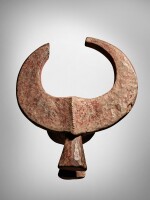
Kantana (Mama) Headcrest, Nigeria
Lot Closed
May 18, 06:48 PM GMT
Estimate
6,000 - 9,000 USD
Lot Details
Description
Avatars and Allegories: Property from the Estate of Pierre M. Schlumberger
Kantana (Mama) Headcrest, Nigeria
Height: 18 3/4 (47.5 cm)
Pierre M. Schlumberger, Houston, acquired from the above on October 30, 1971
The distinctive flat horns present here, evoking those of a bushcow, are emphasized by the richly patinated, burnt orange color of this piece. Red ocher was widely used as a pigment by Kantana communities, often with spiritual associations. The central element present on this mask, consisting of a median incised ridge flanked left and right by the horns, produces an alluring geometric design. The line of incisions along the center of the crest suggests a hybrid human-animal identity. A snout and open jaw project downward. The horns and snout surmount a concave dome, hollowed out to accommodate the head of the wearer.
Such masks were reportedly used in connection with a masquerade called Mangam by groups such as the Kantana, the Mada, Rindre, the Kulere, and the Ron of Sha. A description of the social impact of Mangan in Kantana villages is provided by Ames: “An important social institution of the tribe is one known as Mangam, who may possibly be a supernatural being of which the institution is its natural agent. Although the theoretical aspect of Mangam is curiously indefinite, in practical effect it is a social club and a very exclusive one and yet members of it are alone able to deal with leprosy and skin complaints and sometimes fevers. Membership is obtained by paying two goats and forty-eight pots of beer and carries rank and honour in the village. It sets up a healthy rivalry in farming amongst the young generation of men so that they can obtain the necessary funds to qualify for election. There are periodical banquets and, whenever a new member is admitted, his entrance fee is consumed by the other members. Each village has its own Mangam with its special meeting-place, but such places have no stone or other sign of religious activity. In many villages, in fact in all outside the Kwarra [Kantana] group, it is the supreme political body in the village and maintains order and effects arrests of malefactors. In the old days, when it used to pass sentences on offenders, all the elders were as a rule members, and there were men garbed as Dodos [i.e. masquerades] in suitable costumes with which they impressed the general public in obedience to their dictates.” (C. G. Ames, Gazetteer of the Plateau Province, Jos, 1934, pp. 273-274).
You May Also Like


