Property from a Swiss private collection | 瑞士私人收藏
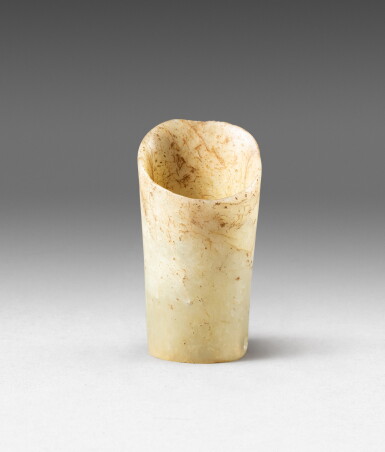
A celadon jade horse-hoof ornament Possibly neolithic | 或為新石器時代 玉馬蹄形器
Auction Closed
December 9, 03:41 PM GMT
Estimate
5,000 - 7,000 EUR
Lot Details
Description
Property from a Swiss private collection
A celadon jade horse-hoof ornament
Possibly neolithic
of characteristic circular tapered form hollowed in the centre
H. 9.2 cm, 3⅝ in.
__________________________________________________________________________
Collection particulière suisse
Ornement en jade céladon en forme de sabot de cheval, possiblement néolithique
__________________________________________________________________________
瑞士私人收藏
或為新石器時代 玉馬蹄形器
This distinct shape of jade has been labeled 'horse hoof' or mati by Chinese archaeologists excavating Hongshan cultural sites in Liaoning and northern Hebei provinces. The working of the jade tends to be thinner at the upper walls of the tube. They are now thought to be hair ornament, as they have been found under or next to the head of the occupants of Hongshan tombs. A photograph of Tomb 4 at Liaoning, Niuheliang, area 11, showing a hoof-shaped jade beneath the head of the deceased, is illustrated by J. Rawson, Chinese Jade from the Neolithic to the Qing, British Museum, 1995, p. 116, fig. 1. One of these ornaments from a tomb at Liaoning, which appears to be of similar color to the present piece, and which has two holes drilled on either side above the lower edge, is illustrated by Xiaoneng Yang, ed., in The Golden Age of Chinese Archaeology: Celebrated Discoveries from the People's Republic of China, National Gallery of Art, Washington, 1999, pp. 83-4, no. 11.
Two ornaments of this type in the Winthrop Collection, are illustrated by M. Loehr, Ancient Chinese Jades, Fogg Art Museum, Harvard University, 1975, no. 323, a shorter version that has a similar scooped shape to the top rim and appears to be of similar stone, and no. 324, which has a more even upper edge. See, also, two others illustrated by Yang Boda in Chinese Archaic Jades from the Kwan Collection, Art Gallery, The Chinese University of Hong Kong, 1994, nos. 8 and 9, both of which have a similar upper edge.
You May Also Like