Hubert Robert
An architectural capriccio of the ruins of a grand palace with 'Le Retour du Bétail'
Auction Closed
July 7, 10:53 AM GMT
Estimate
25,000 - 35,000 GBP
Lot Details
Description
Hubert Robert
Paris 1733 - 1808
An architectural capriccio of the ruins of a grand palace with 'Le Retour du Bétail'
Pen and brown ink and wash, heightened with white, over black chalk
unframed: 283 by 362 mm
framed: 490 by 560 mm
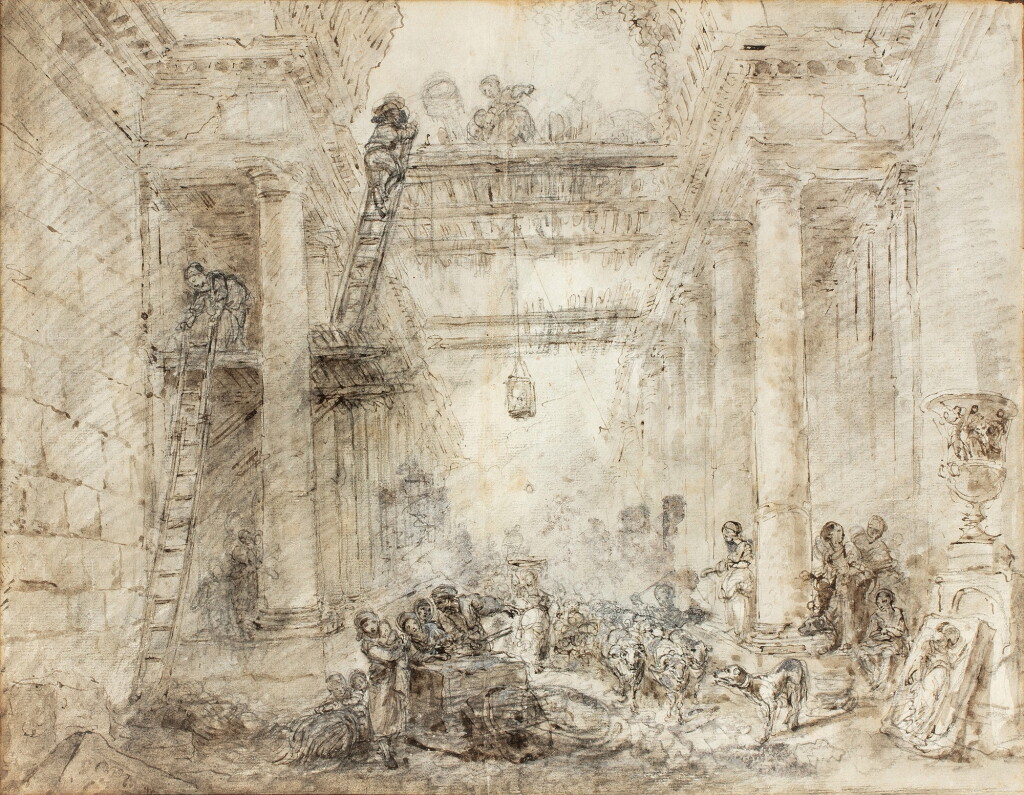
As described in the note to lot 39, Robert was famous for his depictions of ruins and this grand and impressive drawing is another splendid example that showcases the artist’s successful formula of combining ancient ruins with everyday life. Here, Robert’s setting is a grand, ruined palace, its beautiful remains populated with many figures and animals, all seemingly in motion. The manner of execution, using rapid strokes and looser penwork, heightens the sense of movement and serves to capture the fleeting moment, as modern life bustles through the historic Roman columns and artefacts, the figures picking their way through the vases and tombstones that are strewn in the foreground.
While this drawing does not directly relate to any of Robert’s painted compositions, it does contain elements and motifs that appear in many of his works (painted and drawn; see also lot 39). The ladders leaning against the decaying framework of the ruins, ready for his figures to clamber up, are evident in so many of his narratives, particularly those depicting Le Fenil (The Hayloft). The lantern that hangs in the centre of the present sheet also recurs in many others. The magic of this particular scene is perhaps generated by the great sense of movement in the livestock being herded down the central colonnade, cleverly juxtaposed with the stillness of the ruins. Both the lantern and the livestock are to be found, in rather similar form, in Robert’s painting, Le Retour du Bétail, in the Metropolitan Museum, New York1, while the penmanship and handling can be compared with the drawing of Christ Driving the Traders out of The Temple, dated to circa 1760-1763, now in the Louvre.2
There appears to be an indication of a faint inscription, discernible but not legible, on a large stone in the lower left corner of the drawing. Robert often signed his more elaborate depictions of classical ruins in the form of a fictive carved inscription, but the letters that can be identified here do not seem to fit with his name, and it seems more likely that the inscription was simply meant to simulate writing carved into the ancient stone.
The sketchier manner of this drawing, in comparison to lot 39, could suggest that it was made in preparation for a painting, but regardless of its original function and purpose, its scale, original composition and bravura handling all confirm its status as a marvelously powerful, autonomous work of art.
1. J. de Cayeux, Les Hubert Roberts de la Collection Veyrene, Valence 1985, p. 250. fig. 90
2. Hubert Robert. Drawings and Watercolours, exh. cat., Washington, D.C., National Gallery of Art, 1978, pp. 60-61, no. 17, reproduced p.61
You May Also Like