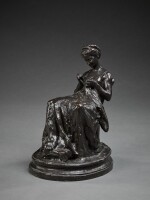

Aimé-Jules Dalou
La brodeuse (The Embroiderer)
Lot Closed
December 15, 01:25 PM GMT
Estimate
12,000 - 18,000 GBP
Lot Details
Description
Aimé-Jules Dalou
French
1838 - 1902
La brodeuse (The Embroiderer)
signed: DALOU, and stamped: CIRE PERDUE A.A. HEBRARD
bronze, dark brown patina
28cm., 11⅛in.
La Brodeuse was the first fully fledged expression of Dalou's interest in simple, modern life and would define the stylistic and thematic direction of his work for a decade. The seated seamstress became the sculptor's first public success when a life-size plaster version was lauded by the critics at the 1870 Salon and was subsequently purchased by the state.
The composition is full of beautifully observed informal detail. Perhaps the most charming motif, as Hunisak noted, is the sense of tension created by the woman's hands, which implies a taut thread. Gautier, a contemporary critic, wrote that the Brodeuse possessed 'in the naiveté of her attitude, in the straightforwardness of her features, in the purity of her forms, a penetrating attractiveness.'
This bronze cast of a plaster sketch model made in preparation for the Salon Brodeuse exemplifies Dalou's vivid hand modelling. It is cast after one of the large group of esquisses Dalou reserved for the Orphelinat des Arts in his will. The proceeds of the casts taken from these models were to enable the Orphelinat to care for Dalou's daughter Georgette after his death. The income from the small sculptures would finance the orphanage for decades.
RELATED LITERATURE
J. M. Hunisak, The Sculptor Jules Dalou. Studies in his Style and Imagery, New York/ London, 1977, pp. 53-68 and 106-107; The Romantics to Rodin. French Nineteenth-Century Sculpture from North American Collections, exh. cat. Los Angeles County Museum of Art, Los Angeles, 1980, p. 185; A. Simier and M. Kisiel, Jules Dalou, le sculpteur de la République. Catalogue des sculptures de Jules Dalou conservées au Petit Palais, exh. cat. Petit Palais, Paris, 2013, p. 345, no. 280
The composition is full of beautifully observed informal detail. Perhaps the most charming motif, as Hunisak noted, is the sense of tension created by the woman's hands, which implies a taut thread. Gautier, a contemporary critic, wrote that the Brodeuse possessed 'in the naiveté of her attitude, in the straightforwardness of her features, in the purity of her forms, a penetrating attractiveness.'
This bronze cast of a plaster sketch model made in preparation for the Salon Brodeuse exemplifies Dalou's vivid hand modelling. It is cast after one of the large group of esquisses Dalou reserved for the Orphelinat des Arts in his will. The proceeds of the casts taken from these models were to enable the Orphelinat to care for Dalou's daughter Georgette after his death. The income from the small sculptures would finance the orphanage for decades.
RELATED LITERATURE
J. M. Hunisak, The Sculptor Jules Dalou. Studies in his Style and Imagery, New York/ London, 1977, pp. 53-68 and 106-107; The Romantics to Rodin. French Nineteenth-Century Sculpture from North American Collections, exh. cat. Los Angeles County Museum of Art, Los Angeles, 1980, p. 185; A. Simier and M. Kisiel, Jules Dalou, le sculpteur de la République. Catalogue des sculptures de Jules Dalou conservées au Petit Palais, exh. cat. Petit Palais, Paris, 2013, p. 345, no. 280


