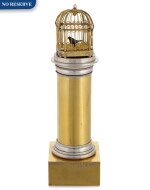

AN UNUSUAL MINIATURE SINGING BIRD IN CAGE ON A PILLAR, CHARLES BRANDT, LONDON, CIRCA 1810/15
This lot has been withdrawn
Lot Details
Description
AN UNUSUAL MINIATURE SINGING BIRD IN CAGE ON A PILLAR, CHARLES BRANDT, LONDON, CIRCA 1810/15
the pearl-set gold cage containing a feathered automaton bird, the associated silvered and gilt-metal column containing the movement, signed: C. Brandt / London, in wooden case for: Desoutter / Hanover Square
16.8cm., 6 5/8. in high
The Sir David Salomons Collection, cat. no. 175
L. A. Mayer Memorial Institute, Jerusalem, inventory number BO 21-70
George Daniels & Ohannes Markarian, Watches and Clocks in the Sir David Salomons Collection, 1980, p. 292
There are several questions revolving around the maker or finisher of this extremely unusual singing bird on a pillar. A watchmaker by the name of Charles Brandt of Jermyn Street, London, was declared bankrupt in 1823 and seems to have only been recorded sparsely prior to this date. His name can, however, be found in close reference to a number of Breguet timepieces, among them the ‘La Sympathique’ clock, made for the Prince Regent in 1814, and now located in the Queen’s Gallery in Buckingham Palace (Royal Collection Trust, RCIN 2861), which Brandt cleaned and repaired in 1829-30. There is the possibility that this watchmaker is in fact the same person as Charles Clement Brandt who was born in La Chaux-de-Fonds, Neuchâtel, on 14 December 1789. In 1810, he married Marguerite Amez-Droz, and it is not impossible that the couple moved to London to open a workshop, given that London was at the time one of the main trade centres for watches, automata and objects of vertu for a number of foreign markets at the time, among them the Ottoman and the Far Eastern Market. Charles Clemens Brandt died at Cornaux, Neuchâtel on 21 January 1838.
This lot has been withdrawn from the sale.