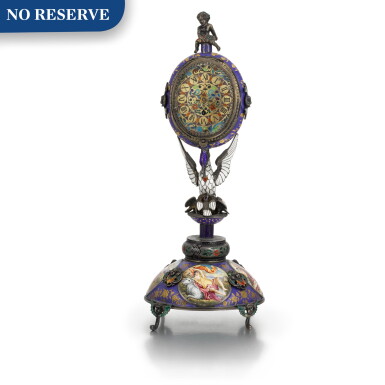
A SILVER AND ENAMEL TIMEPIECE, VIENNA, CIRCA 1900
This lot has been withdrawn
Lot Details
Description
A SILVER AND ENAMEL TIMEPIECE, VIENNA, CIRCA 1900
the movement surmounted with a seated young boy wearing a vine leaf wreath, supported on a maternal pelican pecking her breast, her three fledglings at her feet, blue enamel ground with gold paillon floral ornaments, the sides and domed base applied with putti heads, the reverse and base further painted with vignettes of mythological subjects, the inside painted with an interior in front of a window with a young woman holding a wreath for which a winged putto is reaching, four scrolling supports in the shape of winged putti, apparently unmarked, the pierced grille-covered movement signed 'Le Roy, Paris'
19.8cm., 7¾in. high
The L.A. Mayer Memorial Institute, Jerusalem, inventory no. CL 44-06
It comes as no surprise that the Viennese goldsmiths chose medieval symbols to complement the abundance of Renaissance, Rococo and Classical symbols and references combined in one single objet de fantaisie. The figure of the maternal pelican pecking her own chest, used as a support for the dial and watch movement in this lot, may be seen as a reference to the Medieval Ages, when the pelican drawing blood from her own chest in order to feed her fledglings in times of hardship was used a symbol for utmost compassion, or even the sacrifice of Christ, and had equally become a relatively well-known symbol used in architecture or artworks. The timely difference between different symbols and styles, and initial religious meanings were of very little relevance to the Viennese enamellers like Hermann Böhm, Hermann Ratzersdorfer, Karl Bank etc., whose fantastical objects can be understood in the spirit of a counter-movement to Neoclassicism or Classical Art in itself, resulting in an individual, symbol-heavy, detail-rich and distinctly Viennese style during the course of four decades, its effect being ‘gorgeous without being barbaric, as the harmonies of colour are well preserved’ (The Jeweller and Metalworker, review of the Paris Exhibition, 1889).