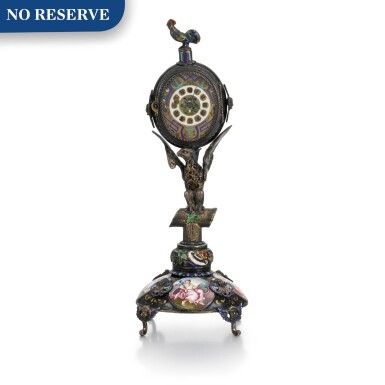
A SILVER AND ENAMEL TIMEPIECE, HERMANN BÖHM, VIENNA, LATE 19TH CENTURY
This lot has been withdrawn
Lot Details
Description
A SILVER AND ENAMEL TIMEPIECE, HERMANN BÖHM, VIENNA, LATE 19TH CENTURY
the earlier movement crowned by a cast rooster finial and signed 'Caspar Kaufmann in Wien', circa 1800, with a colourfully enamelled dial with Roman numerals, on a stem in the form of an eagle with spread wings perched on a log, black enamel ground with gold ornaments, the inside painted with a rural landscape, the circular base and the reverse with classical subjects, maker's mark, Vienna control mark
18cm., 7⅛in. high
L.A. Mayer Memorial Institute, Jerusalem, inventory no. CL 47-06
‘When we begin to examine the best work in the Austrian Court, we find ourselves carried back to the arts of the middle ages. Böhm, of Vienna, indeed, counts it his chief glory to give perfect reproductions of grand medieval pieces, rich (…) in enamels of many colours, while even his modern specimens of the goldsmith’s and jeweller’s art are so quaint and old-world in time and feeling that they must have all the charms of heirlooms in wear.’ This observation by a reporter for the London-based periodical The Jeweller & Metalworker, made during his visit to Hermann Böhm’s booth at the Paris Exhibition in 1889, still seems somewhat appropriate today. Böhm’s Viennese workshop existed from 1866 to 1922, by which point he was employing twelve fulltime workers to fulfil the increasing demands for these whimsical and eclectic Historismus works of art. Apart from the aforementioned, Böhm was represented at several international exhibitions, among them the one in Vienna in 1873 where he had shown ‘shields and armour in the Antique style, various ‘Rococoes’, as well as bijouterie in Limoges enamel’ (Waltraud Neuwirth, Wiener Gold- und Silberschmiede und ihre Punzen, 1867-1922, Vienna, 1976, p. 116), demonstrating that Vienna had become as much an important 19th century centre for revival enamel as Paris and Limoges.