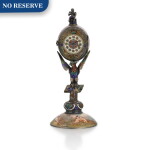

A SILVER AND ENAMEL TIMEPIECE, HERMANN BÖHM, VIENNA, CIRCA 1870
This lot has been withdrawn
Lot Details
Description
A SILVER AND ENAMEL TIMEPIECE, HERMANN BÖHM, VIENNA, CIRCA 1870
the movement supported by a colourfully-enamelled eagle with spread wings, perched on a log supported by a brightly enamelled silver collar, the white enamel dial with Roman numerals within floral basse-taille enamel, surmounted by a bearded winged man, the sides enamelled in a lilac amphorae pattern, the reverse painted with Hera and Zeus, enamelled domed circular base, maker's mark, Vienna town mark
16.5cm., 6½in. high
The L.A. Mayer Memorial Institute, Jerusalem, inventory no. CL 81-19
Interestingly, the underside of the domed base of this timepiece is painted in a pale pink vermiculated pattern, which resembles a distinct style of enamel that was hugely popular for gold boxes made in Paris between 1781 and 1783. Although the trailblazer for this short-lived fashion was probably Joseph-Etienne Blerzy, one of the most prolific and accomplished late eighteenth century Parisian bijoutiers (see for example Serge Grandjean, Catalogue des tabatières, boîtes et étuis des XVIIIe et XIXe siècles du musée du Louvre’, Paris, 1981, no. 37, p. 54), this type of decoration was first used at the porcelain factory of Sèvres. One of the earliest examples is a jardinière from 1760, now located in the Petit Palais in Paris, its sides covered in a delicately ‘bleu lapis vermiculé on a pink ground (Marcelle Brunet, Tamara Préaud, Sèvres. Des origins à nos jours, Fribourg, 1978, nr. 106, p. 159, inv. Tuck 96). The fashion did not last particularly long for Sèvres pieces either, yet it is another example of the exchange of ideas between the category of ceramics and objects of vertu in the 18th century, partially fuelled by painters working in both materials. Although merely used as a decorative layer for a barely visible part in this 19th century timepiece, Hermann Böhm demonstrated a considerable knowledge of different types and styles of enamel across periods, combining vermiculé with basse-taille and en plein enamel techniques, once more resulting in the eclectic appearance which had become so typical for late 19th century Viennese enamel.