
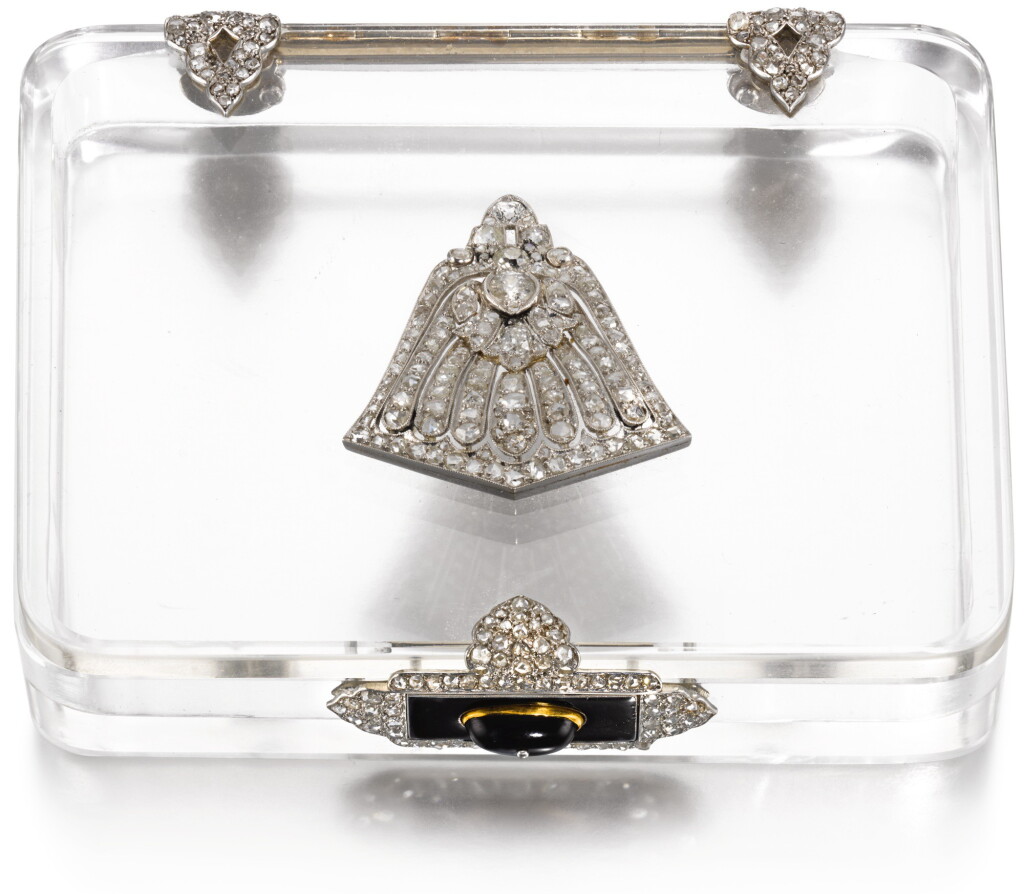
A JEWELLED ROCK-CRYSTAL ART DECO CIGARETTE CASE, PROBABLY CARTIER, PARIS, CIRCA 1925
Auction Closed
July 14, 12:35 PM GMT
Estimate
12,000 - 15,000 GBP
Lot Details
Description
A JEWELLED ROCK-CRYSTAL ART DECO CIGARETTE CASE, PROBABLY CARTIER, PARIS, CIRCA 1925
rectangular with rounded corners, the lid applied with a diamond-set stylised bell, the hinges with elegant ogee-shaped platinum clasps to either side, the black onyx cabochon pushpiece within black enamel surrounded by rose-diamond set mounts, indistinctly signed Cartier Paris London New York, post-1919 French control mark, platinum control mark
9.5cm., 3¾in. wide
The classic colour combination of black and white, also seen in one of Cartier’s most famous designs, the Panthère, had been used by the French jeweller since the early 20th century for a number of different objects made of onyx or black enamel and white diamonds. According to the notebooks of Louis Cartier (1875-1942), the combination was first used for mourning jewellery, but from 1910 it was referred to as daytime jewellery (Judy Rudoe, Cartier 1900-1939, London, 1997). Unsurprisingly, this somewhat muted, yet chic, colour combination was still en vogue in the difficult years following the First World War, when it was mostly to be seen on wrist watches or pocket watches, often combined with black silk ribbon. During ‘Les Années Folles’, the following decade, another material was added: rock crystal. The water-clear crystalline quartz was esteemed for its transparency, providing a ‘neutral’ backdrop for elaborate designs. It could be carved, polished or matted, and for Cartier it was the perfect base for large brooches, as well as for the body of luxurious cigarette cases: ‘Crystal and onyx beads are a vogue of the moment, and many chains of glass beads are joined by chain work in gold or silver. Pearls are being worn again, in three-quarter length chains; and crystal cigarette cases are the craze of the moment.' (Perthshire Advertiser, Perth, Wednesday, 11 March 1925, p. 24d).