
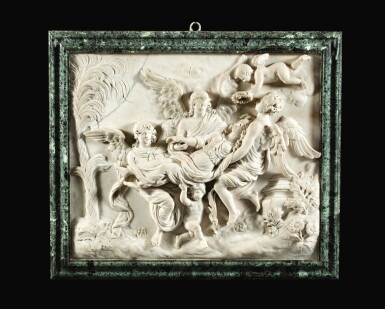
FLEMISH, 18TH CENTURY | APOTHEOSIS OF MARY MAGDALENE
Auction Closed
December 3, 07:24 PM GMT
Estimate
10,000 - 15,000 EUR
Lot Details
Description
FLEMISH, 18TH CENTURY
APOTHEOSIS OF MARY MAGDALENE
marble in high relief; in a verde antico marble frame
96,5 x 83,5 cm; 27 1/4 by 33 in.
__________________________________________________________________
FLANDRES, XVIIIE SIÈCLE
L'APOTHÉOSE DE MARIE MADELEINE
haut-relief en marbre ; dans un cadre en marbre vert antique
96,5 x 83,5 cm ; 27¼ by 33 in.
Sotheby's London, 7 July 2006, lot 142;
Collection from a distinguished Château in the South of France.
__________________________________________________________________
Sotheby's Londres, 7 juillet 2006, lot 142 ;
Collection d’une grande demeure du Sud de la France.
The Apotheosis of Mary Magdalene (or the ‘Rapture’) is an apocryphal episode related in the Golden Legend by Jacobus de Voragine in 1399. According to this account, the saint had retired at the end of her life to live in penitence as a hermit in the mountains, when she was summoned by God in a mystical apotheosis. This moment of ecstasy has been depicted by many of the greatest artists, including Albrecht Dürer in around 1505, José de Ribera in 1636 and Simon Vouet in 1640 (Musée de Besançon, inv. no. 896-1-138). The present work shows Mary Magdalene in ecstasy before being transported to the heavens, in a natural setting, supported by three angels and crowned by two cherubim. The sculptor has paid particular attention to the saint’s last moment of religious abandon, her head thrown back and her body carried gently by the angels. The marble is carved in particularly high relief, enabling a detailed rendering of the figures. The densely pleated drapery wraps sensuously around the bodies, creating a dynamism that skillfully evokes the upward movement of the figures. The treatment of the white marble relief, and especially the tightly packed draperies, implies a work of Flemish origin. Its large size suggests that it was intended for the decoration of an altarpiece, probably in an institution dedicated to Mary Magdalene, such as a Madelonnettes convent.
__________________________________________________________________
L’Apothéose de Marie-Madeleine (ou le « Ravissement ») est un épisode apocryphe relatée dans la Légende dorée de Jacques de Voragine de 1399. Selon ce récit, la Sainte retirée à la fin de son existence en ermite et en pénitence dans les montagnes, est rappelée par Dieu dans une apothéose mystique. Cet épisode d’extase a fait l'objet de représentations par les plus grands peintres, comme Albrecht Dürer vers 1505, José de Ribera en 1636 ou Simon Vouet en 1640 (Musée de Besançon, inv. no. 896-1-138). L’œuvre que nous proposons illustre Marie-Madeleine dans une extase en pleine nature, transportée par trois anges et couronnée par deux chérubins avant de rejoindre les cieux. On remarque l'attention particulière avec laquelle le sculpteur a tenu à représenter le dernier instant d'abandon religieux de la sainte, la tête rejetée en arrière et le corps délicatement soutenu par les anges. Le travail du marbre dont le relief est particulièrement profond permet un rendu précis des figures. La densité des drapés plissés enveloppant avec sensualité les corps crée un dynamisme qui traduit avec habileté l'élévation des figures. Le traitement du relief en marbre blanc et particulièrement des drapés très serrés laisse supposer une origine flamande de l’œuvre. Ses dimensions impressionnantes suggèrent qu’il fut destiné à l’ornementation d’un retable, probablement d’une institution consacrée à Marie-Madeleine comme un couvent de Madelonnettes.