
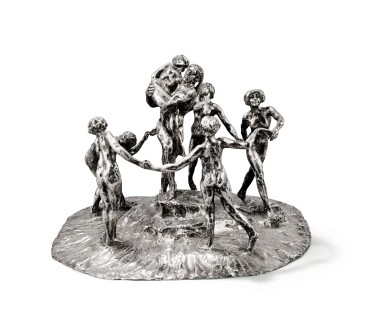
A SILVER CENTRAL ELEMENT OF A SURTOUT DE TABLE REPRESENTING L'ENLÈVEMENT, MARIE BERNIÈRES-HENRAUX, STAMPED WITH THE MARK OF CLAUDE VALSUANI, PARIS, 1911 | ELÉMENT CENTRAL DE SURTOUT DE TABLE EN ARGENT REPRÉSENTANT L'ENLÈVEMENT PAR MARIE BERNIÈRES-HENRAUX, POINÇON DE CLAUDE VALSUANI, PARIS, 1911
Lot Closed
June 4, 12:33 PM GMT
Estimate
3,000 - 5,000 EUR
Lot Details
Description
A SILVER CENTRAL ELEMENT OF A SURTOUT DE TABLE REPRESENTING L'ENLÈVEMENT, MARIE BERNIÈRES-HENRAUX, STAMPED WITH THE MARK OF CLAUDE VALSUANI, PARIS, 1911
resting on a terrace, the center of the scene representing a man abducting a woman surrounded by five naked women leading a farandole, the terrace stamped C. VALSUANI CIRE PERDUE
---------------------------------------------------------------------------
ELÉMENT CENTRAL DE SURTOUT DE TABLE EN ARGENT REPRÉSENTANT L'ENLÈVEMENT PAR MARIE BERNIÈRES-HENRAUX, POINÇON DE CLAUDE VALSUANI, PARIS, 1911
reposant sur une terrasse chantournée, le centre de la scène représentant un homme enlevant une femme entouré de cinq femmes nues menant une farandole, la terrasse estampée du cachet du fondeur C. VALSUANI CIRE PERDUE
Long. 43 cm ; length 17 in.
Due to the various measures taken to deal with the Covid-19 epidemic, property collection and shipment of this lot will be delayed until the offices where it is located are able to reopen. Please refer to the “auction details” tab. Thank you for your understanding
Please contact FRpostsaleservices@sothebys.com for any shipping inquiries.
[En raison des circonstances actuelles liées au COVID-19, la livraison de ce lot ne pourra intervenir qu’après la réouverture des locaux de Sotheby’s dans lesquels il se trouve. Nous vous remercions de votre compréhension et nous vous invitons à consulter l’onglet « auction details ».
Pour toute demande concernant le transport, veuillez contacter FRpostsaleservices@sothebys.com.]
F. Roches, Marie Bernières-Henraux, Revue de l'Art décoratif, janvier-juillet 1911 (t. XXV), pp. 269-274 ;
E. Jaloux, "La sculpture de Madame Bernières-Henraux", in L'art et les artistes, juillet 1923, pp. 389-392 ;
A. Rivière, Dictionnaire des sculptrices, 2018, p. 75
F. Roches, Marie Bernières-Henraux, Revue de l'Art décoratif, January-July 1911 (t. XXV), pp. 269-274 ;
E. Jaloux, "La sculpture de Madame Bernières-Henraux", in L'art et les artistes, juillet 1923, pp. 389-392 ;
A. Rivière, Dictionnaire des sculptrices, 2018, p. 75
Born in China in Tien-Tsin in 1876, Marie Bernières-Henraux married Jean Bernard Sancholle Henraux in 1897, who came from an Italian family with marble quarries in Carrara. This is the starting point for Marie's career, with the discovery of marble making her want to sculpt. She was then a student of Auguste Rodin, whose advices will influence her work, as is the case in our Enlèvement. During her short career, stopped in 1932, she exhibited at the Salon des Tuileries between 1924 and 1931, and at the Salon des Indépendants from 1928 to 1930.
Originally, around twenty statuettes were composed, mainly in the form of a surtout de table, and L'Enlèvement is the only piece listed and rediscovered today. The traditional subjects such as the kidnapping of the Sabines or the kidnapping of Proserpine by Pluto, sculpted as much by Le Bernin as Giambologna, are reinterpreted in our piece. As for its style, it recalls the artist's master, Auguste Rodin, in its unfinished aspect. However, Marie Bernières-Henraux adds her personal touch, in the softness of the faces, the vigorous movement of the round and the vibrant material worked with fingers. This work is also presented in the Revue de l'Art décoratif in 1911 and described in these terms by Fernand Roches : "this surtout de table is a considerable decorative work where nothing evokes the practical virtuosities of the practitioner, but where everything is attendance and construction".
This element in particular is stamped with mark of Claude Valsuani which started in 1909 (CV, a violet). Curiously, the mark used here is the one of silversmith, in a lozenge. Next to it is another mark which looks similar to the Minerva head frame but apparently empty.
---------------------------------------------------------------------------
Née en Chine à Tien-Tsin en 1876, Marie Bernières-Henraux épouse Jean Bernard Sancholle Henraux en 1897, lequel était issu d'une famille italienne possédant des carrières de marbre à Carrare. Là est le point de départ de la carrière de Marie, la découverte du marbre lui donnant l'envie de sculpter. Elle est ensuite élève d'Auguste Rodin, dont les conseils marqueront son oeuvre, comme c'est le cas dans notre Enlèvement. Pendant sa courte carrière, arrêtée en 1932, elle exposa au salon des Tuileries entre 1924 et 1931, et au salon des Indépendants de 1928 à 1930.
A l'origine, une vingtaine de statuettes ont été composées, sous la forme d'un surtout de table, et L'Enlèvement est la seule pièce répertoriée et redécouverte aujourd'hui. Les sujets traditionnels tels que l'enlèvement des Sabines ou l'enlèvement de Proserpine par Pluton, travaillés autant par Le Bernin que Giambologna, sont réinterprétés dans notre pièce. Quant à son style, il rappelle le maître de l'artiste, Auguste Rodin, dans son aspect inachevé. Pourtant, Marie Bernières-Henraux y ajoute sa touche personnelle, dans la douceur des visages, le mouvement vigoureux de la ronde et la matière vibrante travaillée aux doigts. Cette oeuvre est d'ailleurs présentée dans la Revue de l'Art décoratif en 1911 et décrite en ces termes par Fernand Roches : "ce surtout de table est un travail décoratif considérable où rien n'évoque les virtuosités commodes du praticien, mais où tout est assiduité et construction".
Cet élément de surtout est insculpé du poinçon d'orfèvre de Claude Valsuani qui apparait dès 1909 (CV, une violette). Curieusement, le poinçon ici utilisé est celui de l'argent, dans un losange. A côté se trouve un autre poinçon dont le cadre est similaire au poinçon Minerve mais apparemment vide.