
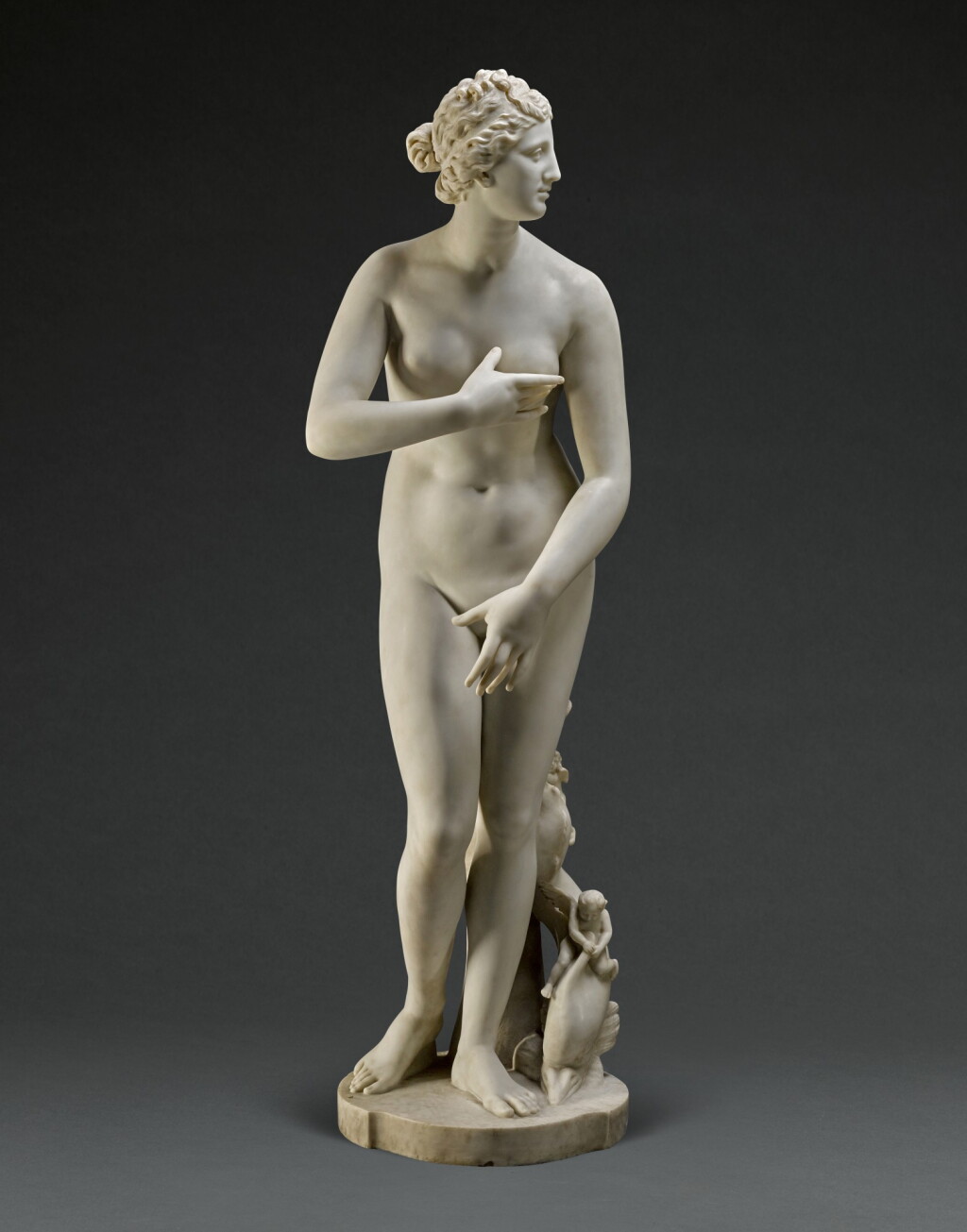
Louis Royer (1793-1868), Belgian, circa 1825 | Venus de' Medici
Lot Closed
December 5, 04:05 PM GMT
Estimate
30,000 - 50,000 GBP
Lot Details
Description
Louis Royer (1793-1868)
Belgian, circa 1825
Venus de' Medici
signed: Royer
white marble
160cm., 63in.
The discovery of Willem van Tetrode’s bronze reduction of the Venus de’ Medici revealed that this most iconic of antique marble Venuses was known as early as the mid-16th century. By 1638, the Venus was certainly located in the Villa Medici in Rome, from which she acquired her name. In 1677 she was sent to Florence and installed in the Tribuna of the Uffizi, where she remains to this day, having been briefly replaced by Antonio Canova’s Venus Italica during her sojourn in France between 1803 and 1815. Thought to be a Graeco-Roman adaptation of the fabled Aphrodite of Knidos by Praxiteles, the Venus de’ Medici counts among the most glorified and controversial statues from antiquity. Every inch of the marble has been scrutinised in her long reception history, from Lord Byron’s gushing 'description of the indescribable' to the Duke of Shrewsbury’s criticism of her arms. It is perhaps partly because of her illustrious position and provenance that the Venus de’ Medici is the most famous of several ancient marbles depicting the goddess in the alluring pudica pose, notably the Capitoline Venus. The statue’s notorious beauty inspired countless copies throughout the centuries, including plaster casts, full-size marbles and reductions in bronze.
Louis Royer was a Flemish sculptor born in Malines who went on to become one of the most prominent sculptors in the Netherlands in the 19th century, becoming Court sculptor to The Hague. Royer was trained in Paris where he was a pupil of Jan Frans van Geel and Jean Baptiste de Bay. He won the Dutch Prix de Rome and studied in the Eternal City in the 1820s in the milieu of Bertel Thorvaldsen. His early works are examples of the Neoclassical style, exemplified by his Ecce Homo in the Rijksmuseum, Amsterdam (inv. no. BK-B-44). His later works are in a historicising style: he executed numerous statues of figures from Dutch history including the Statue of William the Silent in The Hague.
RELATED LITERATURE
F. Haskell and N. Penny, Taste and the Antique. The Lure of Classical Sculpture 1500-1900, New Haven/London, 1982, pp. 325-328