Album of Max Kalbeck, including musical quotations by Brahms, Puccini, Strauss, Grieg, Saint-Saëns and others, 1873-1900
Lot Closed
December 1, 02:01 PM GMT
Estimate
20,000 - 30,000 GBP
Lot Details
Description
ALBUM OF MAX KALBECK (1850-1921)
The fine musical album of Max Kalbeck, the Viennese music critic and biographer of Brahms, containing musical quotations, drawings, poems and inscriptions, around eighty items in all, c.1873-1900, including:
1) around thirty autograph musical quotations by Brahms, Puccini, Johann Strauss and others, most inscribed to Kalbeck:
GRIEG: quotation from Violin Sonata no.3, three bars notated on a hand-drawn stave, signed and inscribed, ("3t Violinsonate...Edvard Grieg, Zur fr. Erinnerung an den verhängnissvollen Mittagstisch an 24/3/96"),
MASSENET: quotation from Werther, signed and inscribed in violet ink, with Kalbeck's German translation of Werther's opening aria:
("O natur! Den Himmel hienieden
Hast Du den Sterblichen beschieden!
'Werther', erste act, à notre remarquable collaborateur Max Kalbeck, J. Massenet, Wien Janvier 1892.");
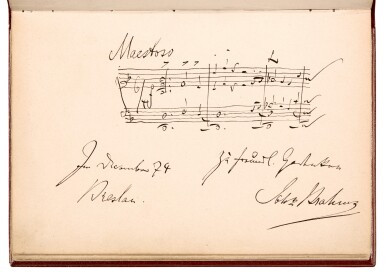
BRAHMS: quotation of the opening 3 bars of Piano Concerto no.1 in D minor, notated in dark brown ink on two staves, signed and inscribed ("Im December 74 Breslau, zu freundl. Gedenken Johs Brahms"),
CLARA SCHUMANN: quotation of the first 4 bars of Piano Trio in G minor op.17, signed and inscribed in violet ink ("...Zu freundlichem Erinnern, Clara Schumann. München im Lenz 1878"),
SAINT-SAENS: quotation of the main theme from Piano Concerto no.4, notated on two staves, signed and inscribed ("20 Nov. 1877. C. Saint-Saëns");
JOHANN STRAUSS II: quotation of (four bars from Die Fledermaus, signed and inscribed ("für Max Kalbeck...zur freundlichen Erinnerung, Wien 1. Februar 85, Johann Strauß"),
PUCCINI: quotation of the aria 'Manon Lescaut mi chiamo' from Act 1 of Manon Lescaut, inscribed in violet ink on three staves, signed ("...all Illmo Sig Kalbeck, Giacomo Puccini"), undated but possibly c.1897
and other autograph quotations by Joseph Joachim, Carl Goldmark ("Fata Morgana" op.37 no.6), Max Bruch (the chorus 'Willkommen Fremdling', from Odysseus), Robert von Hornstein, Hermann Scholtz, Hermann Levi (4-part Canon for women's voices), Sarasate ("Zapateado"), Ignaz Brüll, Anton Rubinstein (Breslau, 1879), Bernhard Scholtz, Julius Stockhausen (from Schubert's Greisengesang D.778), Eugen d'Albert ("Allemande" from the Suite op.1), George Henschel, Carl Reinecke (a puzzle canon), Julius Röntgen, Giuseppe Buonamici and the Heckmann Quartett (at a concert with Brahms on 14 November 1884: Robert Heckmann, Otto Forberg, Theodor Allekotte und Robert Bellmann);
2) drawings by Franz Defregger, Franz Lenbach, Ludwig Neustätter, Theodor Ethoffer and one unsigned, and
3) poems, aphorisms and inscriptions by Hans von Bülow (signed "...Zukunftsmusiker a.D."), Philipp Spitta (a quotation from Goethe's Wilhelm Meisters Lehrjahre), Emanuel Geibel, Paul Heyse, Carl Lemcke, Moriz Carriere, Ludwig Schneegans, Oscar Blumenthal, Carl Fuchs, Theodor Kirchner, Ferdinand Freiligrath, Otto Brahm, Julius Stuttenheim and others
74 leaves, 8vo (c.20 x 13.5cm), c.80 items, mainly rectos only, in gatherings of up to 12 leaves each, modern brown morocco elaborately gilt, retaining old binding-label (F.W. Papke of Vienna), mainly Breslau, Munich and Vienna, 1873-1897, where dated
This is one of the richest musical albums from the last quarter of the nineteenth century to have appeared at auction. Max Kalbeck was a music critic and the first important biographer of Brahms. The album traces his career in Breslau, Munich and (from 1880) Vienna, where he joined the Wiener allgemeine Zeitung at the instigation of Brahms's supporter, Eduard Hanslick. He was an influential music critic and became a close friend of the composer. His enduring accomplishment was the four-volume biography that established Brahms as an icon of traditional German liberal values, amidst growing religious nationalism in Austria. Kalbeck's Brahms is akin to Boswell's Johnson and, though dated, remains indispensable. Brahms's quotation from the First Piano Concerto was written in Breslau in 1874, probably marking the occasion when he and Kalbeck first met, at the conferral of a doctorate on the composer by the University of Breslau.
Max Kalbeck translated opera librettos for the Hofoper in Vienna, most notably Massenet's Werther, which received its world premiere, sung in his version, on 16 February 1892. Massenet's dedication, essentially quoting Kalbeck's words back to him, was evidently written during the rehearsals. Werther was not performed in the original French until it was given in Geneva on 16 December 1892. The dedication to Puccini is undated, but may have been written when Puccini attended the première of La boheme on 5 October 1897. Kalbeck translated Puccini's Tosca into German, but not La bohème or Manon Lescaut. However he wrote about Puccini's operas in his Wiener Opernabende in 1898 and, although not overly enthusiastic about verismo, he evidently relished Puccini's lyricism in his earlier opera.
In 1881 Hans von Bülow added a long inscription explaining how he was happy to live out his days with Bach, Beethoven and Brahms, signing himself as a (retired) "musician of the future", without disavowing his former "worship of Berlioz-Liszt-Wagner"; Kalbeck later included Bülow's striking self-assessment in his biography of Brahms:
"Mit Bach, Beethoven und Brahms denkt für das eventuelle letzte Viertel seines Lebens reichlich auszukommen...Im Übrigen erhebt derselbe auf die sogen[annte] Apostatenglorie so wenig Anspruch daß er nach wie vor jede--der Mühe der Abwehr lohnende--ungerechte Verkleinerung seiner vormaligen worship Berlioz-Liszt-Wagner nach besten Kräften bekämpfen wird..." (Vienna, 23 February 1881: cf Kalbeck, Johannes Brahms. Eine Biographie in vier Bänden, volume 3, p.248n)
The album is naturally strong in contributions from musicians in Brahms's circle of friends, notably Clara Schumann, Joseph Joachim, Carl Goldmark, Hans von Bülow, Philipp Spitta, Johann Strauss, Julius Stockhausen, Hermann Levi, Eugen d'Albert, George Henschel, Otto Brahm and Theodor Kirchner.