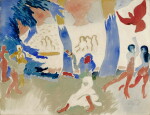
A Sense of Form: Property from a Private British Collection
Keith Vaughan
VILLAGE
Lot Closed
November 17, 03:27 PM GMT
Estimate
8,000 - 12,000 GBP
Lot Details
Description
A Sense of Form: Property from a Private British Collection
KEITH VAUGHAN
1912 - 1977
VILLAGE
signed Vaughan (lower right); dated 24 April 64 and inscribed (verso)
oil on card
unframed: 43 by 49cm.; 17½ by 15¾in.
framed: 59 by 55.5cm.; 23¼ by 21¾in.
Executed in 1964.
Marlborough Fine Art, London
Lord Gordon Lennox
Private Collection
Sale, Sotheby's, London, 12 July 2013, lot 174, where acquired by the present owner
Anthony Hepworth & Ian Massey, Keith Vaughan, The Mature Oils 1946-1977, Sansom & Company Ltd., Bristol, 2012, no. AH458, illustrated p. 162
Village was painted the year Vaughan bought a row of derelict cottages, opposite Michael Ayrton’s house, in the heart of the Essex Countryside. Having renovated them, he spent his weekends and summers at what became known as Harrow Hill Cottage. On the upper floor he built a studio and proceeded to paint the surrounding landscape and villages. The present work was one of the first he made.
Vaughan’s visual distillations of the Essex landscape, purposefully reduce it to something concentrated and visually persuasive. His picture-making process entailed immersing himself in nature and familiarizing himself with it to the point that its memory entered his nervous system sufficiently to coalesce into a painting. He took lengthy walks and recorded features of the terrain along the way in his sketchbooks. He also drove around local villages, pulling over in his car to make preparatory drawings and studies…Without resorting to the deceptions of linear or aerial perspective, Vaughan achieved a sense of pictorial depth and an illusion of receding space, while managing to retain the integrity of the picture plane. By tilting, flattening and layering coloured planes he created air, space and distance between his landscape forms…In a relatively short space of time his paintings became so formalized that it is increasingly challenging to locate his abstracted shapes in nature. This stylistic reorganization manifests itself in various ways. For example, contours are more hard-edged and precise than before, while compositions are compressed, significantly abstracted and, at times, difficult to decipher.
Blocked-in shapes and narrow, tilting strips of pigment help to regularize the layout of the subjects. We are reminded of the proliferation of tiny, quadrangular windows and elongated brick chimney stacks in nearby Essex villages such as Finchingfield. (Gerard Hastings, Paradise Found and Lost: Keith Vaughan in Essex, Pagham Press, 2016)
You May Also Like