
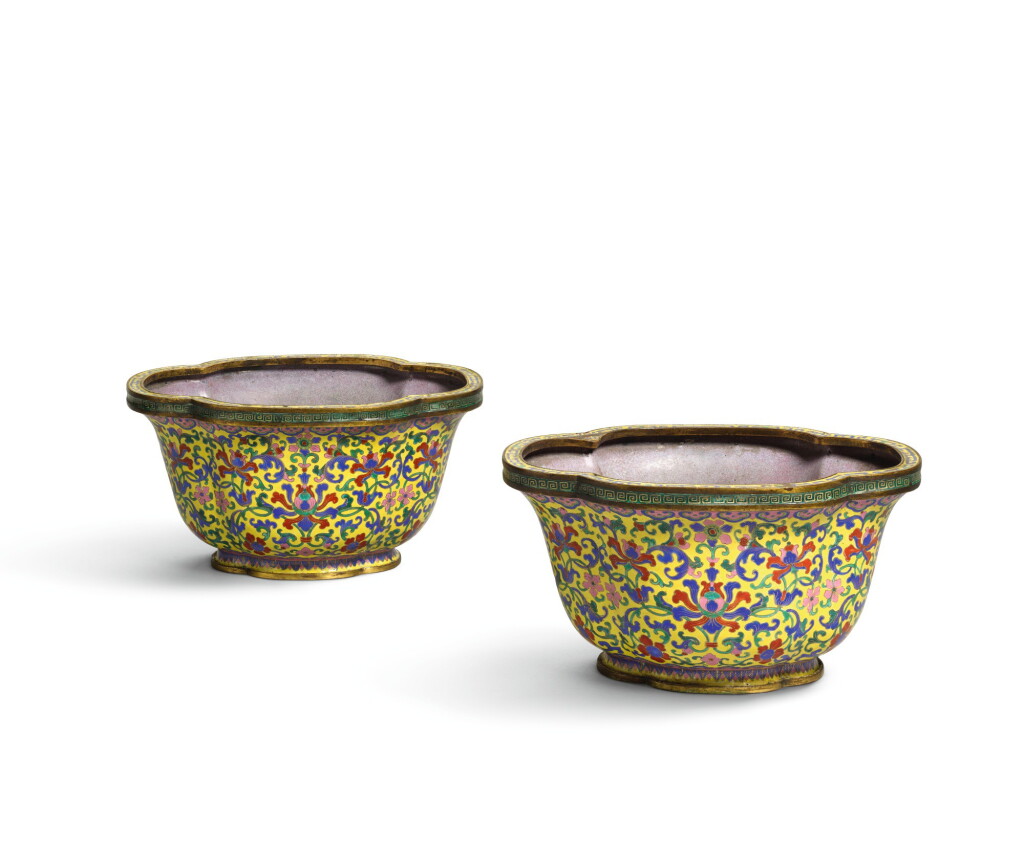
A PAIR OF PAINTED ENAMEL JARDINIERES, QIANLONG MARKS AND PERIOD | 清乾隆 黃地銅胎畫琺瑯蓮紋海棠式花盆一對 《乾隆年製》款
Auction Closed
November 4, 07:52 PM GMT
Estimate
15,000 - 20,000 GBP
Lot Details
Description
A PAIR OF PAINTED ENAMEL JARDINIERES
QIANLONG MARKS AND PERIOD
清乾隆 黃地銅胎畫琺瑯蓮紋海棠式花盆一對 《乾隆年製》款
each of quatrefoil section, painted around the exterior with large stylised lotus blooms amongst dense foliate scrolls and flowers, the base painted with a four-character reign mark within a double-square
(2)
Widths 17.4 and 17.2 cm, 6⅞ and 6¾ in.
Formally from a private collection in Colchester, England
英格蘭科爾切斯特私人舊藏
Painted enamel wares began to be produced in China during the Kangxi reign (r. 1662-1722), as the technique for making these wares was introduced to artists in Guangzhou by Jesuit missionaries. The removal of the ban on overseas trade in 1684 had exposed Guangzhou artists to wares and techniques from Europe, and they were thus the first to master the foreign techniques, including painting enamels on metal. While the Palace Workshop in Beijing began to employ painters who excelled in this art form and produce some of the finest wares of the period, Guangzhou remained an important manufacturing centre. The output of Guangzhou workshops who created painted enamel wares peaked during the reign of the Qianlong Emperor, when they were commissioned an increasing number of tribute gifts to be sent to the imperial court.
Painted enamel wares of this period either followed designs found on contemporary imperial porcelain, such as this pair of jardinière, or displayed the influence of European motifs. The exuberant floral scroll on these jardinières and the vivid yellow ground, a colour closely associated with imperial authority, represent a classic style developed at the imperial kilns in Jingdezhen in the 18th century. See a yellow-ground and famille-rose porcelain jardinière with a similar design, in the Nanjing Museum, is illustrated in Treasures in the Royalty. The Official Kiln Porcelain of the Chinese Qing Dynasty, Shanghai, 2003, pl. 256.
For examples of painted enamel jardinières, see three examples potted with plants made of precious materials, in the Palace Museum, Beijing, the first against a blue ground, accession no. 00126687, and the second and third of barbed form, accession nos 00126265 and 00126259.