
Property from the Estate of Andrew Hartnagle
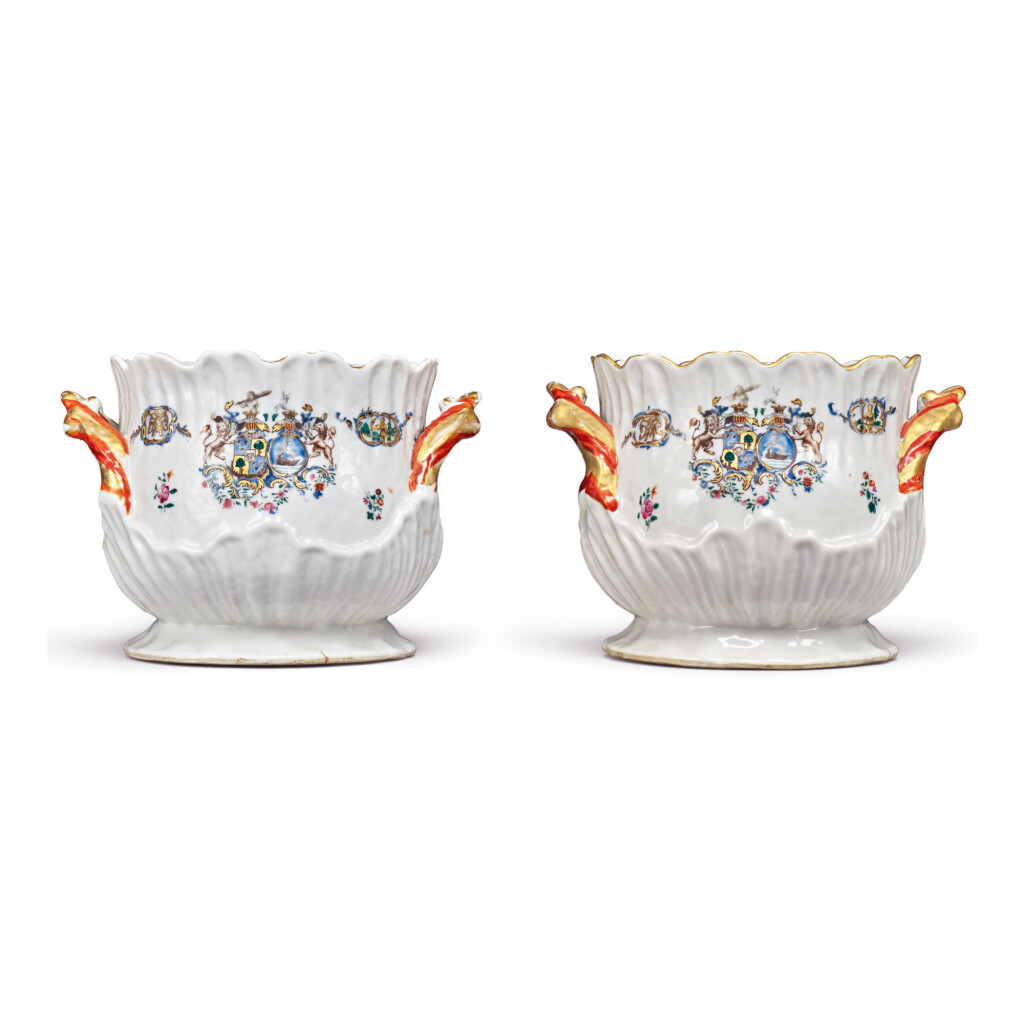
A RARE PAIR OF CHINESE EXPORT ARMORIAL ROCOCO-STYLE WINE COOLERS FOR THE DUTCH MARKET, QING DYNASTY, QIANLONG PERIOD, 1767-69 | 清乾隆 1767-69年 粉彩紋章圖洛可可風格酒桶一對
Auction Closed
January 26, 08:38 PM GMT
Estimate
6,000 - 8,000 USD
Lot Details
Description
A RARE PAIR OF CHINESE EXPORT ARMORIAL ROCOCO-STYLE WINE COOLERS FOR THE DUTCH MARKET
QING DYNASTY, QIANLONG PERIOD, 1767-69
清乾隆 1767-69年 粉彩紋章圖洛可可風格酒桶一對
each molded around the lower body with rocaillerie and the center painted with the arms of Van Tets and Hartingh accolleé, and flanked by two shaped panels on either side and floral sprigs, set on either side with an iron-red and gilt scroll handle
height 6⅜ in.; 16.2 cm
Christie's New York, January 30th, 1992, lot 26
Christie's New York, January 29th, 1994, lot 47
For the arms, see Dr. Jochem Kroes, Chinese Armorial Porcelain for the Dutch Market, Zwolle, 2007, pp. 345-346, cat. no. 266. The author notes that the five surviving examples of wine coolers from this service are of particular interest. He states that the form is quite rare and can be found in a French armorial service probably made for the Breton families of Hévin and Leissègues. Another pair of wine coolers from the same service is illustrated in Anthony du Boulay, Christie's Pictoral History of Chinese Ceramics, Oxford, 1984, p. 282, fig. 4. The author discusses the current examples which he notes are modeled after Swedish Marieberg faience examples, and were thought to have been made for the Swedish market, as stated by a catalogue note on a pair of examples first offered in these rooms, February 24th, 1967, lot 336. This attribution was later altered when select pieces were illustrated in Elinor Gordon, Collecting Chinese Export Porcelain, New York, 1977, p. 34, color pl. II, where the author indicated that these were pieces from a large service made for the Dutchman Adrianus van Tets and his second wife, Wilhelmina Jacoba Hartingh.