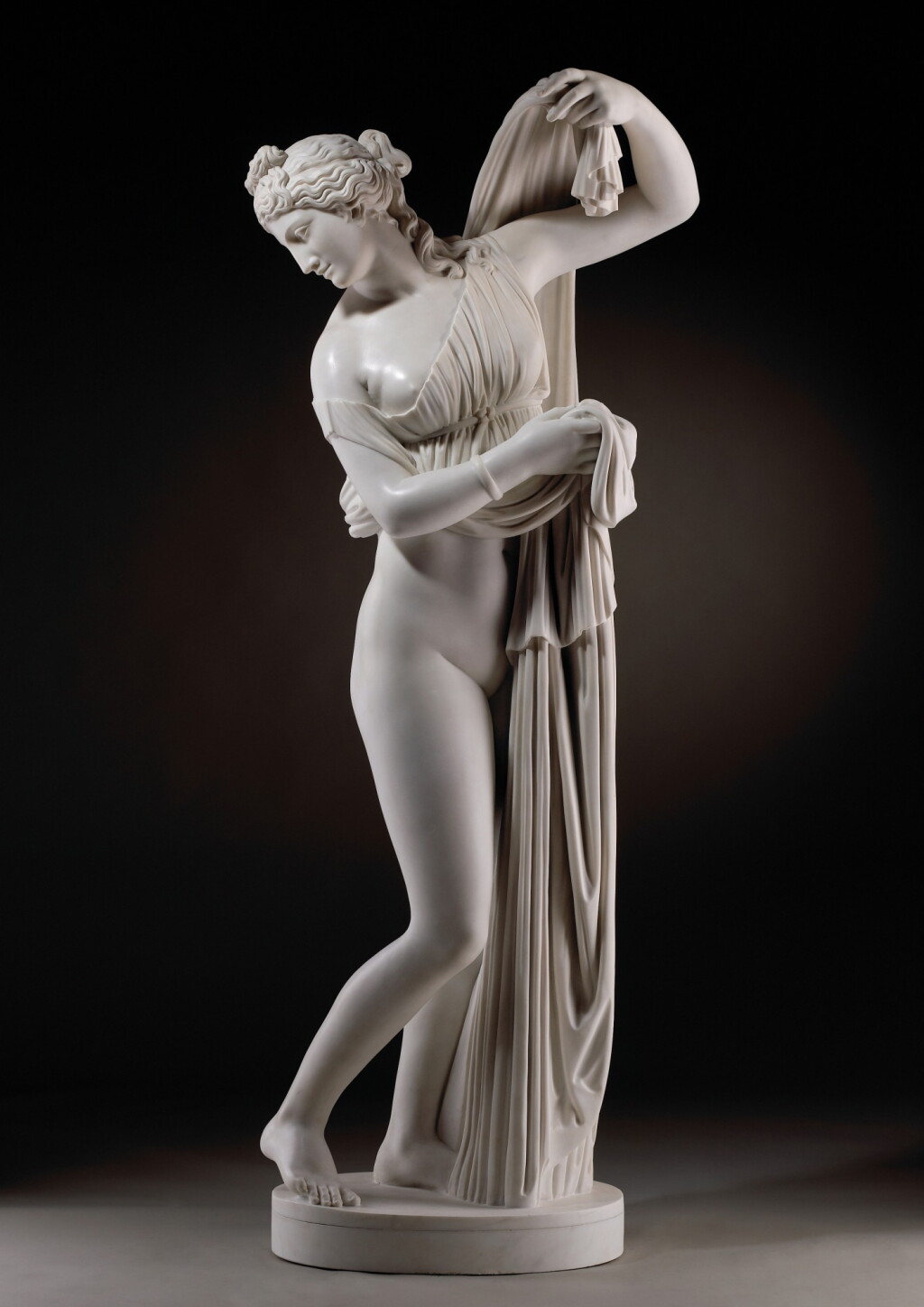
ITALIAN, 19TH CENTURY, AFTER THE ANTIQUE | THE CALLIPYGIAN VENUS
Lot Closed
June 18, 01:47 PM GMT
Estimate
26,000 - 35,000 GBP
Lot Details
Description
ITALIAN, 19TH CENTURY
AFTER THE ANTIQUE
THE CALLIPYGIAN VENUS
white marble
163cm., 64⅛in.
To view Shipping Calculator, please click here
This beautifully carved and well-preserved marble is carved after one of the most celebrated ancient sculptures from the Farnese collection: the Callipygian Venus (literally 'Venus of the beautiful buttocks'). The Farnese marble is believed to be a restored copy of a Hellenistic original, possibly associated with the shrine of Aphrodite Kallipygos at Syracuse (Robertson, op. cit., p. 553). The surviving antique sculpture was first recorded as being in the Farnese collection in 1594, first in the Camerino Secreto (1568) and later in the Sala dei Filosofi (1697) and the Farnesina (1767). During the late 18th century it was taken first to Rome for restoration by Carlo Albacini, and then to Naples by 1792. By May 1802 it was in its present location in the Museo degli Studi (later Museo Borbonico, now Museo Nazionale) in Naples.
Throughout the 17th and 18th centuries, the statue was often referred to as Venus leaving the bath, or Venus drying herself. The more common titles for it was 'la Bergère Grecque' or 'La Belle Victorieuse', which refer to an episode related by Athenaeus in the late 2nd/early 3rd century. In the story, two daughters of a peasant settle an argument over who has the most attractive buttocks by calling upon a stranger to judge. He was rewarded with the girl he chose, while his brother chose the other girl and thus won her, leading to a double marriage. The girls, thus rescued from a life of poverty, later dedicated a temple to Venus Callipygos at Syracuse.
The statue was much admired from the 16th to the 18th century. The earliest known copy is a bronze statuette in the Ashmolean Museum, Oxford, attributed to the Flemish sculptor, Hans Mont, who left Rome in 1571. In the 17th century Clérion and Barois made marble copies for Louis XIV. In the 18th century, it was widely copied. In the 1780s, Gustavus III of Sweden commissioned Sergel to copy the statue for the Hall of Mirrors in the Royal Palace, Stockholm. Sergel's Venus was modelled with the features of the royal mistress, Countess Ulla van Hopken. The Venus was also copied in miniature on Wedgwood pieces.