
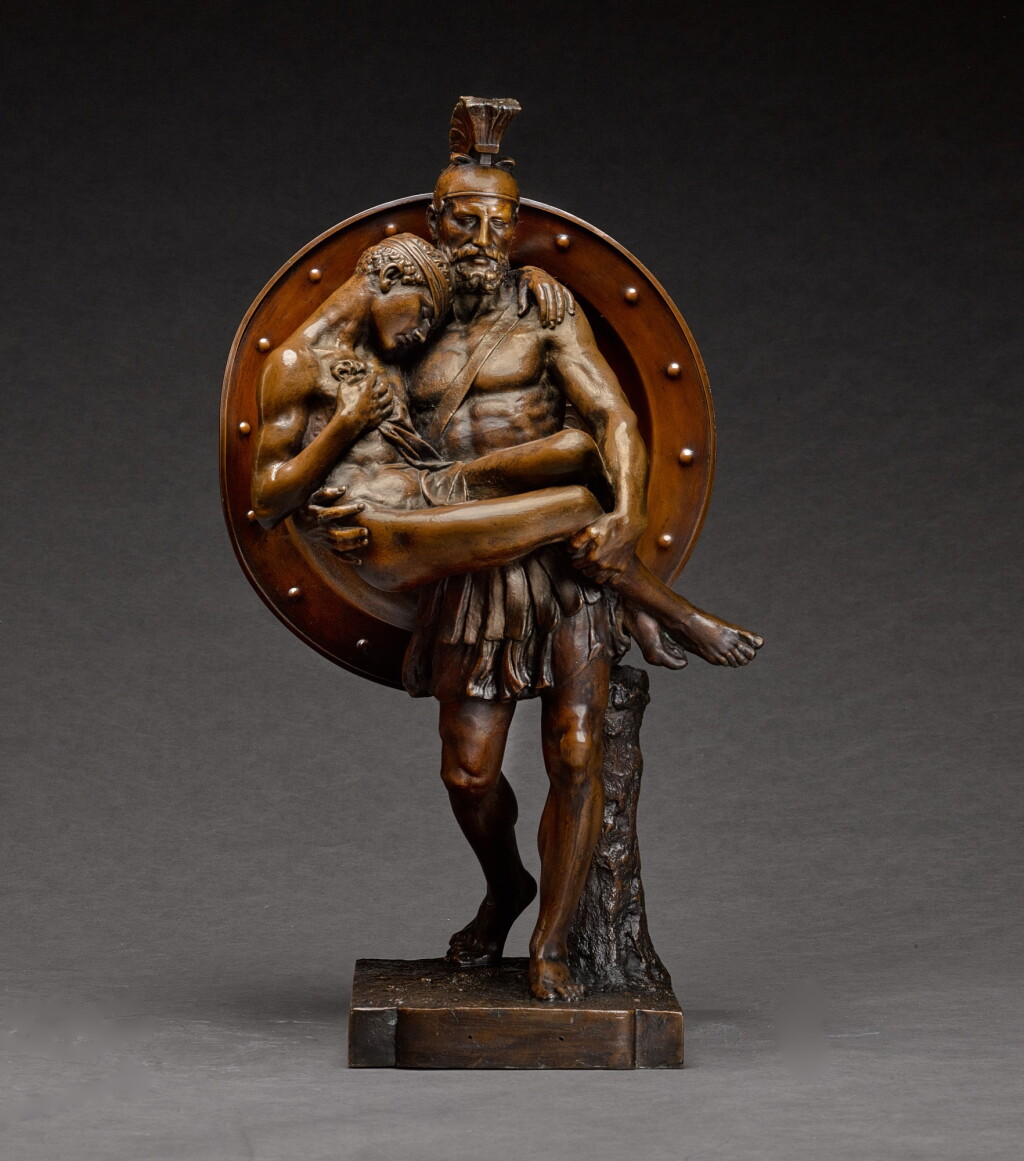
AFTER SIR WILLIAM HAMO THORNYCROFT | WARRIOR BEARING A WOUNDED YOUTH FROM THE FIELD OF BATTLE
Lot Closed
June 18, 01:51 PM GMT
Estimate
4,000 - 6,000 GBP
Lot Details
Description
AFTER SIR WILLIAM HAMO THORNYCROFT (1850-1925)
ENGLISH, CIRCA 1876
WARRIOR BEARING A WOUNDED YOUTH FROM THE FIELD OF BATTLE
copper electrotype
71cm., 28in.
Please note: Condition 11 of the Conditions of Business for Buyers (Online Only) is not applicable to this lot.
To view Shipping Calculator, please click here
Sotheby's Belgravia, 6 September 1978, lot 115;
with The Fine Art Society, London;
acquired from the above by Malcolm S. Forbes;
his posthumous sale, Christie's London, 19 February 2003, lot 141
Thornycroft's Warrior is a key work from the formative years of the New Sculpture movement. In 1875 it won the Royal Academy's biennial Gold Medal for the 'Best Work of Sculpture,' in competition with Alfred Gilbert. The latter sculptor later admitted that he 'had been beaten by the best man.'
The Warrior shows the influence of Thornycroft's visits to France and Italy in 1871, and the group was guaranteed a prominent place in the history of the New Sculpture when the Art Union of London purchased the rights to the group after it was exhibited at the Royal Academy in 1876. The Art Union Journal considered that 'there is nothing from the hand of an academician to be at all compared with Hamo Thornycroft's Warrior.' The following year, the Art Union began to issue reduced casts of the model, and it has been suggested that this encouraged the young Thornycroft in his interest in bronze reductions and small scale sculpture generally, which so characterised the developing movement. The original bronze group is today housed at Leighton House, London. The present group is a copper electrotype version.
RELATED LITERATURE
E. Manning, Marble and Bronze. The Art and Life of Hamo Thornycroft, London, 1982, pp. 55 and 212; S. Beattie, The New Sculpture, New Haven and London, 1983, p. 183