Test auction
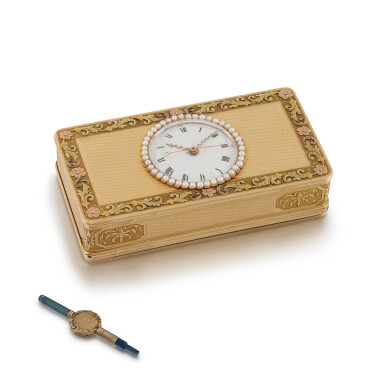
A PEARL-SET FOUR-COLOUR GOLD AND ENAMEL MUSICAL WATCH SNUFF BOX, THE MOVEMENT ATTRIBUTED TO PIGUET & MEYLAN, GENEVA, CIRCA 1820,
Auction is live
Waiting for auctioneer to open lot
Estimate
50,000 - 70,000 GBP
Lot Details
Description
A PEARL-SET FOUR-COLOUR GOLD AND ENAMEL MUSICAL WATCH SNUFF BOX, THE MOVEMENT ATTRIBUTED TO PIGUET & MEYLAN, GENEVA, CIRCA 1820,
rectangular, the case with diaper engine-turning within varicolour chased floral scrolling borders on a sablé ground, the lid centred with a pearl-framed aperture revealing a watch dial which forms the centre of an automaton scene on a colourfully enamelled ground, the seated gold figures of a female and a male musician playing a harp and lyre in a classical interior flanked by Doric columns, apparently unmarked, with two keys
8.2cm., 3¼in. wide
(3)
The Sir David Salomons Collection, cat. no. 96
Vera Bryce Salomons
L.A. Mayer Memorial Institute, Jersualem, inventory no. WA 7-70
L.A. Mayer Memorial Institute, Jerusalem
Alfred Chapuis & Edouard Gélis, Le Monde des Automates. Paris, 1928, vol. ii, fig. 308, p. 42-43, illustrated and mentioned as belonging to Sir David Salomons;
George Daniels & Ohannes Markarian, Watches and Clocks in the Sir David Salomons Collection, 1980, no. 96, pp.162-163
Chapuis links the present box which is unmarked on case and movement with the previous example in Le Monde des Automates (fig. 307). The images of the box, which is decorated on the lid with an enamel painting of The Necromancer, were supplied by Gustave Loup from whom it was evidently later acquired by Sir David Salomons and remains in the collection today (Daniels & Markarian, no. 70, BO 6-70). There are certainly similarities as both have very similar chased gold figures playing the harp and a guitar or lyre, set against painted enamel backgrounds. In the Necromancer box, the watch dial is used to simulate a mantel clock as part of the painted scene whereas in the present example it takes the central role. The Necromancer box movement is signed by Piguet & Meylan and was dated by Chapuis around 1820. He felt that the similarities, the 'quality of the décors and the technique of the mechanisms, permitted [him], despite the absence of any inscription or mark, to situate [the box] at the same date and to attribute it to the same artists'.