
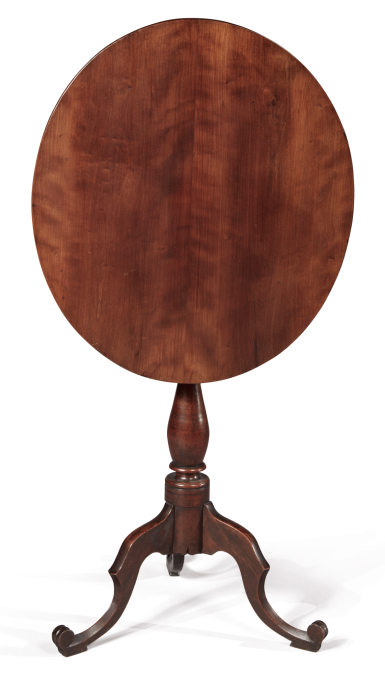
EXCEPTIONAL AND VERY RARE FEDERAL CARVED CHERRYWOOD TILT-TOP CANDLESTAND, BY NATHAN LUMBARD, SUTTON, MASSACHUSETTS, CIRCA 1801
Auction Closed
January 25, 06:44 PM GMT
Estimate
15,000 - 30,000 USD
Lot Details
Description
EXCEPTIONAL AND VERY RARE FEDERAL CARVED CHERRYWOOD TILT-TOP CANDLESTAND, BY NATHAN LUMBARD, SUTTON, MASSACHUSETTS, CIRCA 1801
appears to retain its original brass hardware and spring lock.
Height 42 in. by Width 17 ½ in. by Depth 17 ⅜ in.
Sotheby’s New York, Fine Americana, October 1998, sale 7195, lot 268;
Marguerite Riordan Antiques, Stonington, Connecticut.
Christie Jackson, Brock Jobe, Clark Pearce, Crafting Excellence: The Furniture of Nathan Lombard and His Circle, (Winterthur, DE: The Henry Francis du Pont Winterthur Museum, Inc., 2018), p. 234-35, pl. 51, 51A and 51B
A rural New England interpretation of the Federal style, this tilt-top candlestand is attributed to Nathan Lumbard (1777-1847), a cabinetmaker working in the Sturbridge and Sutton areas of Massachusetts. Born in 1777 in Brimfield, this highly-skilled and creative craftsman apprenticed to Oliver Wight (1765-1837) in Sturbridge before establishing a business there in 1798. He moved to nearby Sutton circa 1803. He employed numerous journeymen and apprentices in his shop including his oldest son, Alanson A. Lumbard, who acquired the business after Nathan died in 1847. Today, the furniture documented and attributed to Lumbard is all in the early Federal style and most pieces date from the first decade of the nineteenth century.
The stand survives in excellent condition and retains its original brass hardware and brass latch beneath the top. It is illustrated in the most recent scholarship on Lumbard published by Christie Jackson, Brock Jobe and Clark Pearce in Crafting Excellence: The Furniture of Nathan Lumbard and His Circle (New Haven and London: Yale University Press, 2018), no. 51, p.234, 235 and 240. With its oval top, this stand represents a special commission for Lumbard in which he adapted his usual practice to suit the customers taste while also retaining several trademarks of his work. He mounted cleats of similar shape to those on his other stands beneath the oversize top. He installed a larger version of his dovetailed box and drawer at the top of the pillar. He finished the underside of the box with the same careful chamfering seen on his most decorative pieces. At the base, he repeated the leg and foot profile seen on the firescreen made for Ezra Allen (1773-1866) and Polly Marcey Needham (1782-1811) of Holland, Massachusetts and on a tilt-top stand in the collection of the Yale University Art Gallery.
A remarkably similar stand by Lumbard is included in Two Women, a watercolor of an interior painted by Eunice Pinney (1770-1849) circa 1815. The watercolor is in the collection of the Fenimore Art Museum in Cooperstown, New York (acc. N0077.1961). Eunice Pinney is the earliest known American primitive watercolorist artist and she was active in the towns of Windsor and Simsbury, Connecticut from 1809 to 1826.