
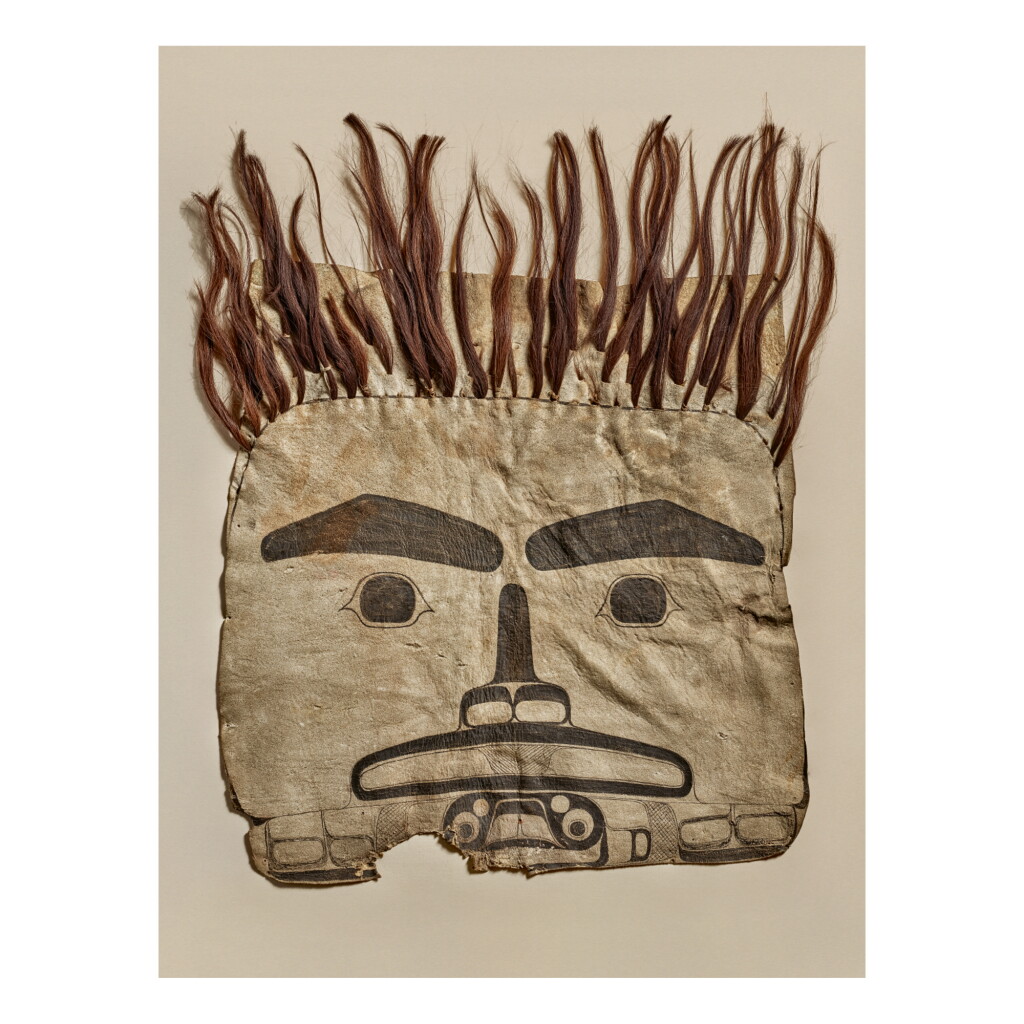
TLINGIT OR TSIMSHIAN SHIRT OR ARMOR
Auction Closed
November 19, 09:20 PM GMT
Estimate
40,000 - 60,000 USD
Lot Details
Description
TLINGIT OR TSIMSHIAN SHIRT OR ARMOR
Circa 1800-1830
Height: 28 ⅞ in (76 cm)
Tanned hide, probably elk, pigment, hair
Private Museum Collection, Virginia
James Economos, Santa Fe, acquired fom the above
Private Collection, acquired from the above
Will Channing, Santa Fe, acquired from the above
George Terasaki, New York, acquired from the above in 2008
Painted hide garments have been used as ceremonial regalia and as warrior’s armor for untold generations on the Northwest Coast. The kinds of hides employed included deer, elk, moose, seal, and sea lion, each with their own characteristics that made them appropriate for particular uses. Precisely which type of hide this object is made of is uncertain, although it appears to be elk hide. Regalia items in animal hide often took the forms of robe or blanket-like rectangles that draped over the shoulders, sleeveless tunics, or poncho-type garments, which were usually made for shamans. Warrior’s armor took many different forms. Thick hide was cut and sewn into a shirt or tunic shape, sometimes fully protecting one shoulder while leaving the other, for the weapon-hand, freer. Hide garments were sometimes worn in conjunction with wood or bone slat-armor and, if thick enough, were otherwise worn on their own.
This painted hide section is apparently a portion of the original garment, and was once attached to an under-tunic, which had another similarly painted panel on the opposite side. The other face panel and tunic were once in the collection of the Oakland Museum. It’s probable that the two painted sides were once part of a one-piece, thicker garment, and at some point this face panel was separated from the original.
If this scenario is true, the original garment may have been made as protective armor, a tradition that survived into the early nineteenth century, after which the spread of firearms pushed the old-style armor out of use. As is the case with some of the early carved-wooden war helmets, which were another integral part of the traditional warrior’s outfit, armor and weapons, such as the helmets, large daggers, clubs, etc., sometimes became important pieces of clan property, known as at’oow, which were passed down from one generation to another. This painted hide panel and its mate may have followed that pattern, reconstructed from a stiff, heavy piece of armor into a lighter, more wearable ceremonial garment that carried with it the history of the clan and the warriors who may have worn it in battle.
The large and striking face painted on this panel is remarkably simple in form, and yet the wide-open design field is the perfect frame for the technical refinement displayed in the overall composition. The rows of human hair across the top of the face add to the lively quality of the painting. The painting of the face itself, like all the linework in the object, is masterfully designed and precisely executed. The mask-like structure of large eyebrows, small eyes, nose, and mouth is similar to some of the small faces seen in detail areas of bent-corner boxes and chests, housefronts and interior screens, box drums, and other related paintings. These hide panels are some of the largest examples of such a face known to have been created.
Below the mouth of each face, a symmetrical formline composition spans the breadth of the hide panel. These are made up of a nonrepresentational complex of bold formlines just below the mouth, and much lighter formlines and fine line work to either side. These designs are similar on the two face panels, but differ a great deal as well. The roundness of the ovoids in the center formline complexes and the thinness of the lips suggest that this could well be a Tsimshian rather than a Tlingit painting, though some cross-cultural influences are found in both these design styles.
Steven C. Brown