
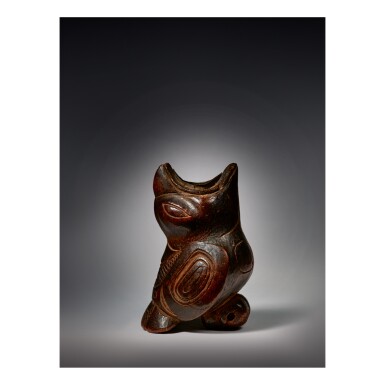
TLINGIT BIRD EFFIGY PIPE
Auction Closed
November 19, 09:20 PM GMT
Estimate
30,000 - 50,000 USD
Lot Details
Description
TLINGIT BIRD EFFIGY PIPE
Circa 1800-1840
Height: 4 ⅞ in (12.5 cm)
Walnut, copper
George Wehry, New York
George Terasaki, New York, acquired from the above in 1966
Steven C. Brown, Transfigurations: North Pacific Coast Art. George Terasaki, Collector, Seattle, 2006, n.p., pl. 3
The detail and craftsmanship displayed in this finely carved bird pipe suggest that it was meant to be handled and observed from all angles. It likely served as a conversation starter, thus creating important initial connections between people. The bird's wings are outlined in a stylized design and cross-hatched motifs pattern the back of the bird, as well as its tail. Even the curled claws on the underside of the piece are carefully carved. It fits comfortably in the hand, its smooth surface soft to the touch. As Palmer Jarvis writes, "there is a monumentality in the simplicity of the forms [of early pipes], and at times an unparalleled formal clarity." (Jarvis, "Objects of Ceremony, Commerce and Art", Native American Art, No. 23, October and November 2019, p. XX).
While many pipes represent crests and emblems in the form of complex interweavings of symbolic animal and human forms, others depict animals or objects in a highly realistic manner. Pipes were often carved from the walnut stocks of mass-produced muskets, which by the late 19th century were ubiquitous on the Northwest Coast. Prior to the introduction of pipe smoking, a local species of tobacco was mixed with lime made from burned and pulverized clamshells and chewed or used as snuff. The practice of smoking was quickly incorporated into shamanic ceremonies: smoke was used as a diagnostic tool to examine sick patients, as well as a vehicle with which to bestow a blessing or protection.
A very closely related bird pipe, quite possibly carved by the same hand, is in the collection of the Museum of Anthropology, University of British Columbia, Vancouver (inv. no. 3260/34).