
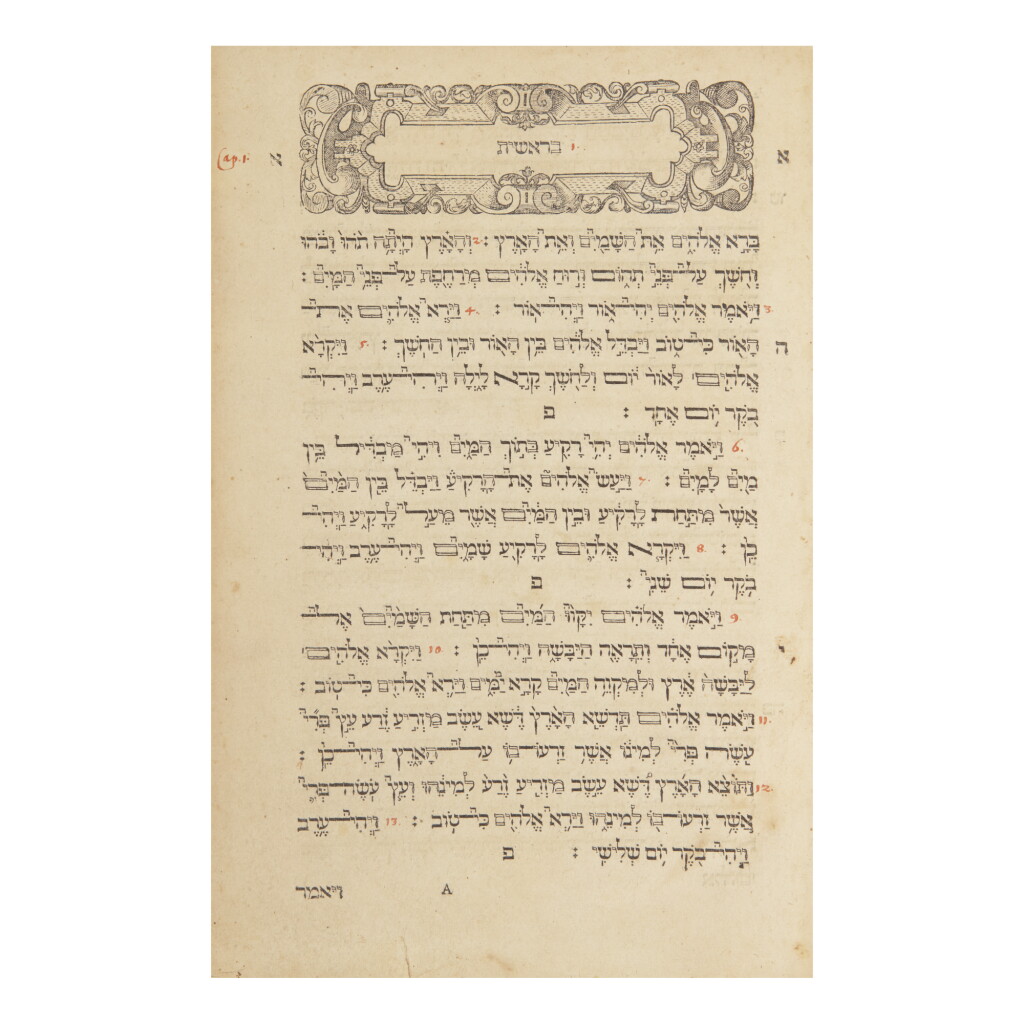
HEBREW BIBLE, EDITED BY ELIAS HUTTER, HAMBURG: JOHANN SAXO, 1587
Auction Closed
November 20, 08:47 PM GMT
Estimate
4,000 - 6,000 USD
Lot Details
Description
HEBREW BIBLE, EDITED BY ELIAS HUTTER, HAMBURG: JOHANN SAXO, 1587
1580 pages (15 x 9 1/2 in.; 383 x 248 mm) (pagination: [1-12], [1]-1136, 1141-1572) on paper. First word of most biblical books (including II Samuel and II Kings but excluding Jonah, Habakkuk, Lamentations, Ecclesiastes, and Nehemiah) within woodcut frame (pp. [1], 104, 193, 257, 347, 425, 477, 527, 593, 648, 713, 774, 859, 968, 1063, 1074, 1079, 1090, 1094, 1102, 1112, 1115, 1131, 1136, 1244, 1280, 1319, 1326, 1355, 1371, 1401, 1449); initial of introduction within elaborate woodcut; separate title pages for the books of Isaiah (p. [773]) and Ezekiel (p. [967]); verse and chapter numeration in red (and sometimes brown) ink on pp. [1]-341, 527-541, 555, 774-908 (midway), 1136-1279, 1319-1370; episodic Latin marginalia in pen; table of contents in pen on rear flyleaf. Slight scattered staining, dogearing, and dampstaining; some foxing and/or browning; edges a bit frayed toward front of volume; small hole on title page; short tears in lower edges of pp. [1], 811-812, 1391-1392, 1491-1492, 1565-1566 and in upper edge of pp. [773]-774; puncture on pp. 195-196, affecting a few words; natural holes on pp. 263-264; small repair in upper-outer corner of pp. 823-824. Original elaborately blind-tooled pigskin over heavy boards, soiled and worn around edges, with some later repairs; spine in seven compartments with raised bands; title, place, date, and editor name lettered in ink on spine; tear at head of spine; two intact brass clasps catching on fore-edge; original paper flyleaves and pastedowns.
A handsome copy of Hutter’s Bible bound in contemporary elaborately blind-tooled pigskin.
Elias Hutter (ca. 1553-1609), Professor of Hebrew at Leipzig University, is probably best known for a series of biblical works he published at the end of the sixteenth century. Seeing the study of Hebrew as a theological necessity for every faithful Christian, he devised an ingenious method by which to help students learn the Holy Tongue while reading the biblical text: for each word, root letters were heavily inked in, while inflectional letters (prefixes and suffixes) were hollowed out. (If not all the root letters appeared in a given form, the missing ones were added in small font above the line.) The first use of Hutter’s “open and closed” types can be found in the Psalms he printed in 1586, presumably as a trial run before issuing the entire Hebrew Bible, under the title Derekh ha-kodesh (The Holy Path), the following year. Hutter’s Hebrew Bibles were apparently viewed positively in some Jewish circles. Joseph Teomim (1727-1792), chief rabbi of Frankfurt an der Oder and author of the classic Shulhan arukh commentary Peri megadim, writes in one of the introductory “letters” to his magnum opus that “it is very good for a lad to study from [the Hutter Bibles] in his youth.”
Provenance
Bernhard Wagner, 1625 (title page)
Jeremias Ruoff, 1704 (pastedown of upper board)
Elias Andreas Prenger, 1709 (title page)
Jeremias Hoslin (pastedown of upper board)
G.H. Palmer, 1868 (title page)
Frederic Palmer, D.D. (bookplate on pastedown of upper board)
Library of the Episcopal Theological School, Cambridge (bookplate on pastedown of upper board and title page)
Literature
David Sandler Berkowitz, In Remembrance of Creation: Evolution of Art and Scholarship in the Medieval and Renaissance Bible (Waltham, MA: Brandeis University Press, 1968), 99-100 (no. 171).
Marvin J. Heller, The Sixteenth Century Hebrew Book: An Abridged Thesaurus, vol. 2 (Leiden; Boston: Brill, 2004), 740-741.
Shnayer Z. Leiman, “Two Cases of Non-Jews with Rabbinic Ordination: One Real and One Imaginary,” Seforim Blog (November 16, 2006), available at: https://seforimblog.com/2006/11/dr-leimans-post-two-cases-of-non-jews/.
Vinograd, Hamburg 6
Herbert Z. Zafren, “Elias Hutter’s Hebrew Bibles,” in Abraham Berger, Lawrence Marwick, and Isidore S. Meyer (eds.), The Joshua Bloch Memorial Volume: Studies in Booklore and History (New York: The New York Public Library, 1960), 29-39.