
ROBERT HEINECKEN | 'INVITATION TO METAMORPHOSIS'
Auction Closed
April 5, 08:29 PM GMT
Estimate
30,000 - 50,000 USD
Lot Details
Description
ROBERT HEINECKEN
1931-2006
'INVITATION TO METAMORPHOSIS'
a unique object, 16 photo emulsion and pastel chalk panels on linen, stitched together in a grid and stretched, signed, titled, and dated in ink on the stretcher, framed, 1974
41⅝ by 41⅝ in. (105.7 by 105.7 cm.)
Christie's New York, 29 October 1987, Sale 6468, Lot 276
Oakland Museum of California,Hybrid Vigor, April - June, 1976
Chicago, Museum of Contemporary Art, Robert Heinecken, Photographist: A Thirty-Five-Year Retrospective,October - November 1999
This object:
Alma Davenport, The History of Photography: An Overview(Stoneham, 1991), p. 169
Norma Broude and Mary D. Garrard, eds., The Expanding Discourse: Feminism and Art History (New York, 1992), p. 352
Robert Heinecken’s output in the early to mid-1970s was a relentless commentary on commercialism, kitsch, gender roles, and sexuality. Producing large-scale works with photographic emulsion, pastels, and chalk, the female nude dominated Heinecken’s work. He sourced material taken from pornographic magazines and played creator in the disassembling and reassembling of figures in a disturbing, disjointed fashion.
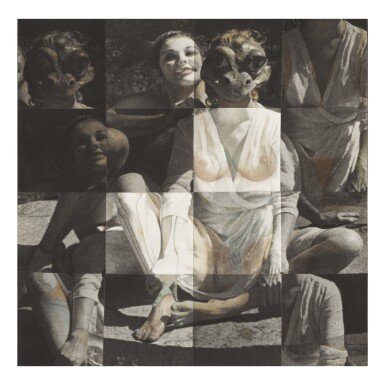
In the present work, the central figure is red-haired and clad in a diaphanous white gown that morphs into genitalia and exposes breasts. She wears an absurd yet haunting lizard mask with bulging eyes. Not only are her genitals readily visible, but so is part of her skeletal system as if she is growing or mutating before us. The skin on her thighs and breasts flushes pink, but in other areas is rendered in reptilian shades of green and blue. Strange background figures play seductive supporting roles – two women smile gleefully, one adorned with clown-like makeup – and all share attributes befitting reptiles: an arm morphs into a snake; a serpentine tongue hides in the shadows; and a human hand sports terrifying talons.
Metamorphosis is defined as a post-embryonic transition in an insect or amphibian. A classic example is the change of a tadpole into frog. New body parts are formed and organs may be remodeled, all controlled by hormonal signals. If the figures in this monumental work are portrayed in the process of metamorphosis, then the title Invitation to Metamorphosis suggests that Heinecken is asking for the viewer to join in their transformation.
Although other works by Heinecken may address sexuality more directly, few feature subjects staring so brazenly, demanding interaction from the viewer. The result is an image that defies categorization, at once erotic and perverse, funny and tongue-in-cheek, and threatening and condemning.
Although Heinecken’s work was hotly denounced by many for being misogynistic, supporters argued that his art offered critique of, not a voice in support for, pornography and female exploitation. The male gaze is here reversed on the viewer, who becomes the subject of stern observation. These female/reptilian creatures stare at the voyeur with powerful, raw sexuality.