
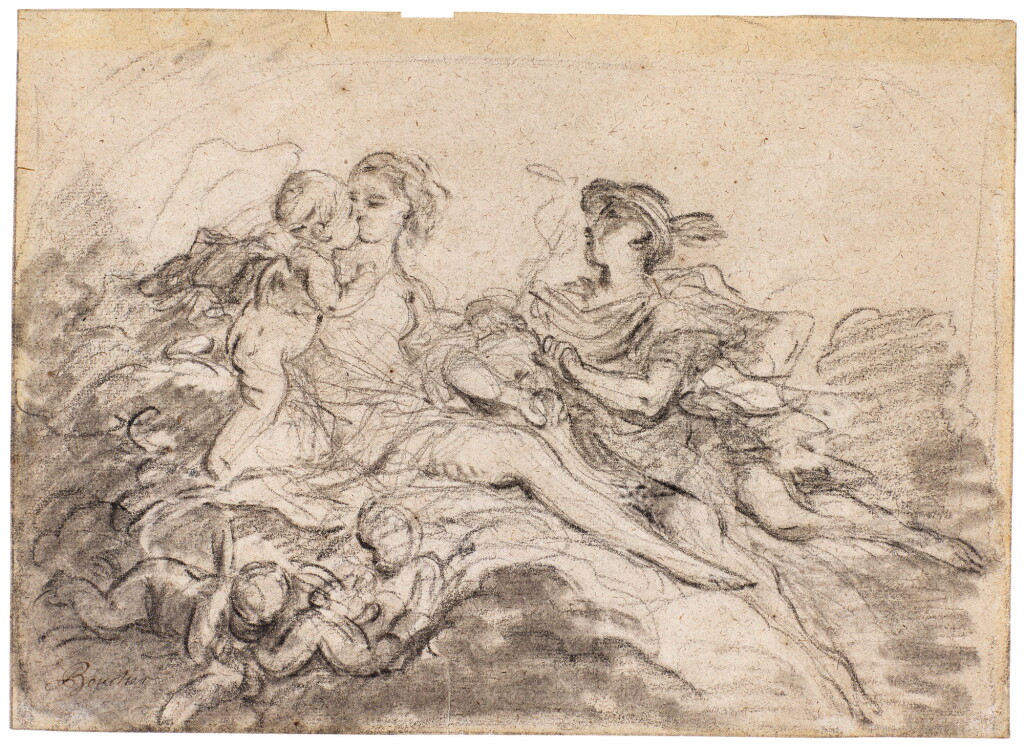
FRANÇOIS BOUCHER | VENUS, CUPID AND MERCURY
Auction Closed
January 29, 05:09 PM GMT
Estimate
15,000 - 20,000 USD
Lot Details
Description
FRANÇOIS BOUCHER
Paris 1703 - 1770
VENUS, CUPID AND MERCURY
Black chalk and gray wash within partial black chalk framing lines;
bears signature in pen and brown ink, lower left: Boucher
209 by 290 mm; 8¼ by 11⅜ in
Victor Koch, London;
with Charles E Slatkin, New York;
Private Collection, New York;
Private Collection, UK
Washington D.C., The National Gallery of Art; Chicago, The Art Institute of Chicago, François Boucher in North American Collections: 100 Drawings, 1974, no. 51;
New York, Stair Sainty Matthiesen, François Boucher, His Circle and Influence, 1987, no. 20
A. Ananoff, François Boucher, Paris 1976, p. 270-1, cat. no. 151/3, reproduced fig. 496
This vibrant and spontaneous sketch is probably a preliminary design for an overdoor painting, as suggested by the faint indications of an arched top. Boucher, with a lightness of touch, has combined black chalk and gray wash to build his composition, where the figures of Venus, Cupid and Mercury float effortlessly upon the clouds, surrounded by putti. As Alan Wintermute remarks in his cataloguing for the 1987 exhibition, the lightness of execution conveys a sense of aerial perspective which is appropriate for the subject and its intended location.1
We are most grateful to Alastair Laing, who, from an image, has kindly confirmed the attribution to François Boucher. Mr Laing shares the same doubts expressed by Alan Wintermute (see Exhibited) regarding the connection, proposed by Ananoff, between the present drawing and the painting, The Education of Cupid (signed and dated 1738), now in the Los Angeles County Museum of Art. Mr Laing believes our drawing to be more complex, and like Wintermute notes that we cannot be precise about its subject, and it does not appear to relate to any known painted commissions. On stylistic grounds, Mr Laing suggests a dating in the 1740s.
1. See François Boucher, His Circle and Influence, 1987, p. 38