
Property from the collection of the late Walter L. Strauss
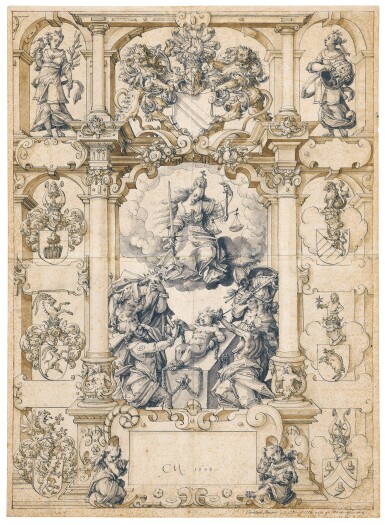
CHRISTOPH MURER | AN ALLEGORY OF INNOCENCE BESIEGED BY BLIND JUDGEMENT, AVARICE, ENVY AND PERSECUTION, WHILE JUSTICE LOOKS ON
Auction Closed
January 29, 05:09 PM GMT
Estimate
7,000 - 9,000 USD
Lot Details
Description
Property from the collection of the late Walter L. Strauss
CHRISTOPH MURER
Zürich 1558 - 1614 Winterthur
AN ALLEGORY OF INNOCENCE BESIEGED BY BLIND JUDGEMENT, AVARICE, ENVY AND PERSECUTION, WHILE JUSTICE LOOKS ON
Pen and black ink and gray and brown wash, within brown ink framing lines, on two joined sheets of paper;
signed with the artist's initials and dated, lower centre: CM. 1608.
bears old attribution in brown ink, lower right: Christoph Maurer, geb. zu Zurich 1558 gest Winterthur 1614.
638 by 465 mm; 25⅛ by 18¼ in
Max Egon Fürst zu Fürstenberg, Donaueschingen (L.2811);
Walter L. Strauss, New York (1922-1988),
thence by descent
E. Baumeister, Zeichnungen alter Meister im Fürstlich Fürstenbergischen Kupferstichkabinett in Donaueschingen, Munich 1920, tav. 9;
T. Vignau-Wilberg, Christoph Murer und die "XL. emblemata miscella nova", Bern 1982, pp. 106-7 and p. 117, note 107
This substantial sheet by the Swiss artist Christoph Murer depicts an allegory of Innocence, portrayed as a young boy, bound and besieged by Judgement, Avarice, Envy and Persecution, while Justice looks on. Signed with the artist’s monogram and dated 1608, this idiosyncratic subject was one that the artist drew on at least three occasions during his career. The first of these, dating to 1585, is today in the Kunsthaus, Zurich,1 while a second drawing, dating to circa 1598, was previously recorded in a private collection, Schaffhausen.2 Fascinatingly the Schaffhausen drawing corresponds, with some notable differences; to a surviving piece of stained glass in the Städtische Kunstsammlungen, Nuremberg,3 which is signed and dated: Christoph Maurer Tigur Fecit / 1598 – a fitting illustration of the essential role drawing played in the manufacture of stained glass.
As Vignau-Wilberg notes, the subject depicted is symbolic of the persecution, martyrdom and salvation of the innocent Christians in Edessa. Vignau-Wilberg further notes the existence of an etching of the same subject (fig.1), which she dates to the same moment in Murer’s career as the present work. The etching was never realised during the artist’s lifetime but was subsequently published posthumously by Johann Rudolf Wolf, in 1622.
1. Vignau-Wilberg, op. cit., p. 106, no. 117, p. 219, fig. 117, reproduced
2. Ibid., p. 106, no. 119, p. 221, fig. 119, reproduced
3. Ibid., p. 106, no. 118, p. 220, fig. 118, reproduced