
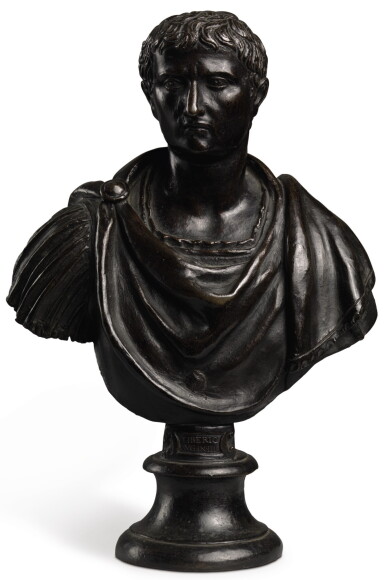
ATTRIBUTED TO WILLEM VAN TETRODE (DELFT CIRCA 1530 – AFTER 1587) SECOND HALF 16TH CENTURY | BUST OF TIBERIUS
Auction Closed
January 30, 06:45 PM GMT
Estimate
6,000 - 8,000 USD
Lot Details
Description
ATTRIBUTED TO WILLEM VAN TETRODE (DELFT CIRCA 1530 – AFTER 1587)
SECOND HALF 16TH CENTURY
BUST OF TIBERIUS
bronze
height 10 ½ in.; 26.5 cm.
This bust of Emperor Tiberius (42 BC-37 AD) is closely related to a bronze series conceived by Tetrode in Rome around 1559. A versatile artist who assisted Cellini in France, Tetrode followed him to Florence around 1548 where he executed important works in marble for the great master, including the Bust of Cosimo I de’ Medici (Fine Arts Museum, San Francisco), and the Ganymede (Bargello, Florence).
Upon leaving Cellini’s studio some years later, the sculptor moved to Rome, where he joined Guglielmo della Porta (c. 1515-1577). As noted by Fritz Scholten, Tetrode’s presence in Rome “coincided with an archaeological boom that continued more or less unabated until after the Council of Trent in 1564” (Scholten, op.cit.). The high point of which was the excavation of the Baths of Caracalla from 1545, whose many sculptures enriched the collections of Alessandro Farnese and provided work to many a sculptor-restorers.
Because of the reputation Tetrode earned for the work carried out on behalf of Cellini, he received his first independent commission to decorate a cabinet for Niccolò IV Orsini, Count of Pitigliano. The commission coincided with Tetrode’s antiquarian interests and his activity within della Porta’s studio, largely devoted to the restoration of antique marbles.
The resulting bronze reductions represented some of the most celebrated antiquities and included a set of twelve emperors. The busts were based on marble models by Tommaso della Porta, from which many details such as the socles derive. Bronzes from the cabinet, which soon after its completion passed into the hands of Cosimo I, Grand Duke of Tuscany, included a figure of the Hercules Farnese (Uffizi, Florence).
The present bust, including adept chasing in the hair and in the Emperor's pupils as well as the modeling on his right sleeve is lacking in the Bargello example which has casting flaws, perhaps due to Tetrode's lack of experience in bronze casing at that stage in his career.
RELATED LITERATURE
Frits Scholten (ed.), Willem van Tetrode, Sculptor, exhibition catalogue, New York, 2003