PROPERTY OF A DISTINGUISHED COLLECTOR
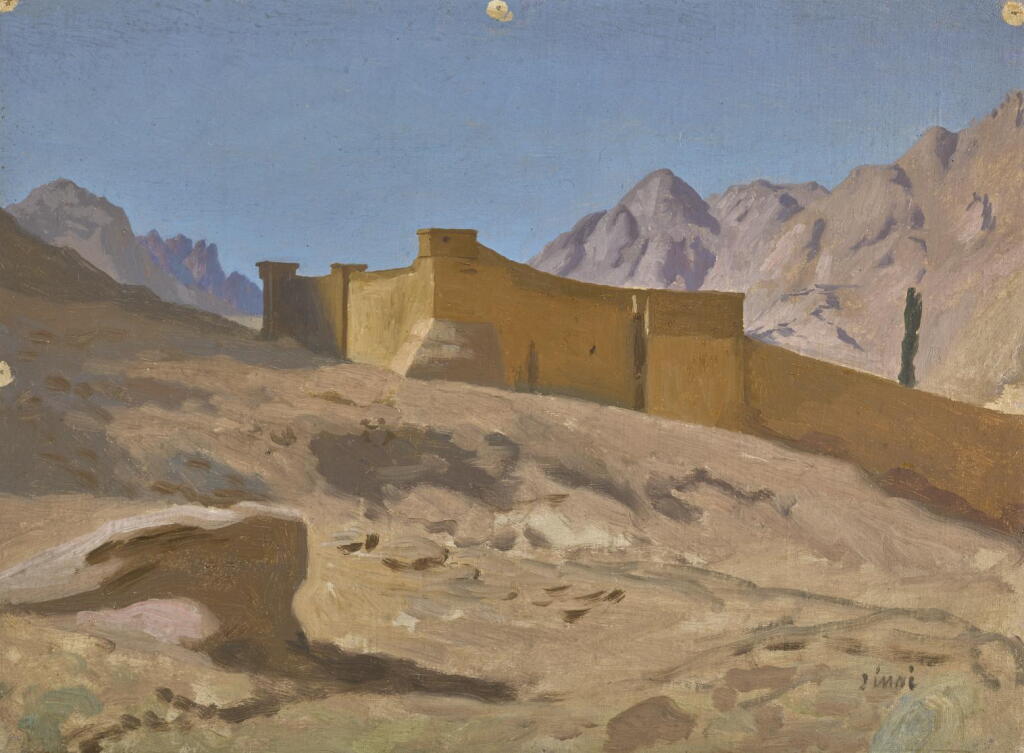
JEAN-LÉON GÉRÔME | Le monastère de Sainte-Catherine
Auction Closed
July 9, 02:03 PM GMT
Estimate
20,000 - 30,000 GBP
Lot Details
Description
Property of a Distinguished Collector
JEAN-LÉON GÉRÔME
French
1824 - 1904
Le monastère de Sainte-Catherine
inscribed sinai lower right
oil on canvas
23 by 31cm., 9 by 12¼in.
Estate of the artist
Mme Renault (daughter of the artist, by descent from the above); thence by descent until the 1960s
Private collection, Paris
Sale: Artcurial, Paris, 13 November 2013, lot 128
Purchased at the above sale by the present owner
Painted circa 1867, following the artist's visit to St Catherine's Monastery. The artist's pin holes remain visible at the margins, which is as the Gérôme scholar Dr Emily Weeks notes 'entirely in keeping with the artist’s practice of securing his canvas to a portable support while traveling. Their appearance is extremely valuable for its instructive potential, as it indicates Gérôme’s working method.'
Gérôme had earlier travelled across the Sinai Peninsula on his first visit to Egypt in 1856. Paul Lenoir, who travelled with the artist in 1867, recorded his impressions in The Fayoum; Or, Artists in Egypt: 'Like a little fortress, the convent appeared hanging on the steep sides of the mountain, and the flowering trees in its garden produced the gayest and most novel effect in this country so arid and so full of terrible souvenirs.'
As Dr Weeks also notes:
'the importance of these plein air oil sketches to Gérôme is made clear in an autobiographical essay of 1878: "[E]ven when worn out after long marches under the bright sun, as soon as our camping spot was reached I got down to work with concentration. But Oh! How many things were left behind of which I carried only the memory away! And I prefer three touches of colour on a piece of canvas to the most vivid memory, but one had to continue on with some regret."
This sketch may be productively compared with others made by Gérôme during this same period of travel.
On the representation of St. Catherine’s monastery in nineteenth-century Orientalist art more generally, see Dr Weeks' discussion in Chapter 6 of Cultures Crossed: John Frederick Lewis and the Art of Orientalism, an excerpt from which reads:
‘Between these groups of fauna and fowl, and between the figures of Sheikh Hussein and Castlereagh themselves, is the distant monastery of Saint Catherine (fig. 6.11).[i] This structure, dating from the sixth century, was originally dedicated to the Virgin Mary, but was renamed two centuries later after bones identified as belonging to the Saint were found there.[ii] Before these Christian associations had been realized, however, the site had housed a thriving mosque. In order to ensure that both religions could function harmoniously on this mutually significant site, it was believed that the Prophet Mohammed had granted the members of the monastery a letter of protection against molestation by the long-established Muslim population. Almost incredibly, given the volatile political history of the region, mosque and monastery continue to function without incident today.
By the nineteenth century, this extraordinary location had become a fashionable destination for European artists and writers.William Henry Bartlett (1809–1854), the French painter Adrien Dauzats (1804–1868), and [John Frederick] Lewis’s good friend David Roberts each executed pictures of St. Catherine’s in the late 1830s and 1840s, and Richard Beavis (1824–1896) continued the tradition well into the 1870s (fig. 6.12). Lewis’s depiction of the monastery, however, stands apart from those of his colleagues. Rather than focusing on the architecture of St. Catherine’s, Lewis turns his attention to the evocations of the site: as a bridge between Sheikh Hussein and Lord Castlereagh, centrally placed in the composition, the faint outline of the monastery becomes an affecting symbol of transcultural harmony – or at least, a hopeful sign of connectedness in this outwardly confrontational, nineteenth-century world.