/
american views people & places
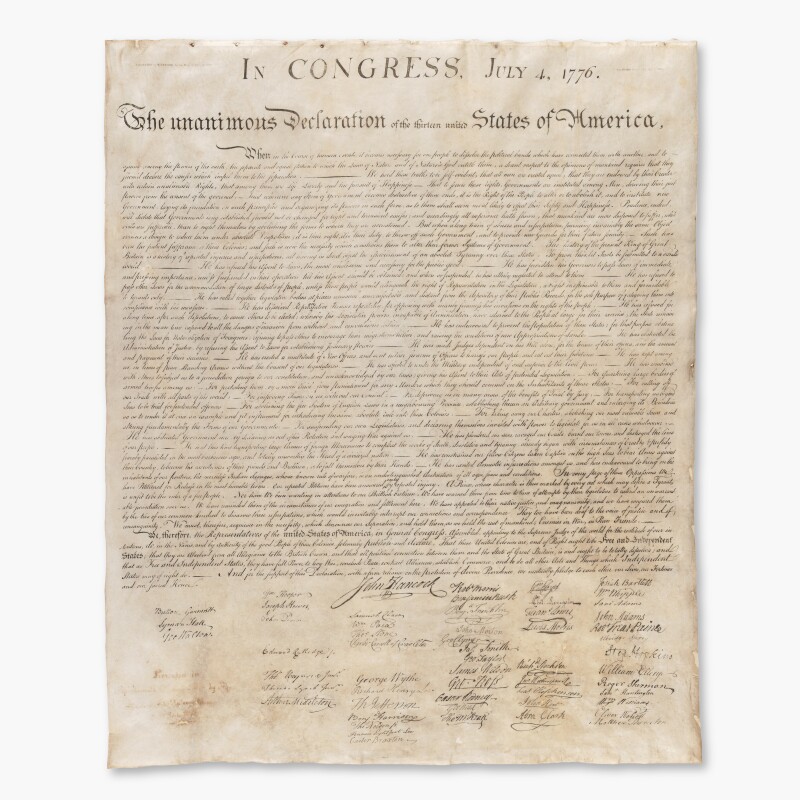
The Declaration of Independence: The Celebrated William J. Stone Facsimile, 1823
Price upon request
Taxes not included
VAT and other taxes are not reflected in the listed pricing. Read more
Details

Description
The Stone Facsimile of the Declaration of Independence
[Washington]: Willliam J. Stone for the Department of State, 1823
Copperplate engraving on vellum (approx. 29 1/2 x 23 1/4 in.; 748 x 592 mm, sight).
The first “exact” facsimile, one of 201 copies printed by William J. Stone by order of Congress and Secretary of State John Q. Adams, 1823, with a very faint inscription at bottom left penned and signed by John Quincy Adams—the man responsible for creating the Stone Declarations.
“We hold these truths to be self-evident, that all men are created equal, that they are endowed by their Creator with certain unalienable Rights, that among these are Life, Liberty and the pursuit of Happiness. — That to secure these rights, Governments are instituted among Men, deriving their just powers from the consent of the governed…”
In 1820, Secretary of State John Quincy Adams noted that the priceless engrossed and signed Declaration was already deteriorating. With Congressional approval, he commissioned William J. Stone to engrave the image onto a copper plate. The engraving is as close to an exact copy of the original manuscript as was possible at that time, before the use of photographic replication. Stone worked on the engraving for close to three years, keeping the original in his shop. On 11 April 1823, Adams noted a visit from “Stone the Engraver, who has finished his facsimile of the original Declaration of Independence.” By 10 May, the engrossed manuscript was back in Adams’s hands.
On 28 May 1823, Daniel Brent, working under John Quincy Adams in the Department of State, wrote to Stone requesting 200 copies of the facsimile “from the engraved plate…now, in your possession, and then to deliver the plate itself to this office to be afterwards occasionally used by you, when the Department may require further supplies of copies from it.” Stone proceeded to print 201 copies on vellum, one of which he kept for himself, as was customary though perhaps not authorized in this case. (His widow donated that one to the Smithsonian in 1888.)
It took a full year for Congress to decide how to distribute the Stone Declarations. On 26 May 1824, Congress ordered that the three surviving Declaration signers (John Adams, Thomas Jefferson and Charles Carroll of Carrollton) be given two copies each. Two copies each were also sent to President James Monroe, Vice President Daniel D. Thompkins, former President James Madison, and the Marquis de Lafayette. The Senate and the House of Representatives split twenty copies. The federal government departments received twelve copies apiece. Two copies were sent to the President’s house and two to the Supreme Court chamber (one of which was recently re-discovered). The remaining copies were sent to the governors and legislatures of the states and territories, and to various universities and colleges throughout the country.
Many still incorrectly believe Stone used some sort of wet or chemical process to transfer the ink to create such a perfect reproduction, thus hastening the destruction of the original manuscript. In fact, he left minute clues to distinguish the original from the copies, also providing evidence of his painstaking engraving process.
Stone’s engraving is the best representation of the Declaration as the manuscript looked prior to its nearly complete deterioration.
HISTORICAL BACKGROUND
In his early draft of the Declaration, Thomas Jefferson scraped off the word subjects, replacing it with citizens. That change shows the essence of the American story. The Signers knew that proclaiming the self-evident truth, that all men are created equal, did not make it so. Still, they put their lives on the line to support the idea that governments should work to foster unalienable personal rights to life, liberty and the pursuit of happiness. The proclamation separating America from Great Britain—the greatest break-up note in history—made no attempt to create a new government. Yet the Declaration, not the Constitution, is rightfully considered America’s founding document. As John Hancock wrote in one of his cover letters to the states, it was “the ground and foundation of a future government.”
Back to 1776. On 2 July, the Continental Congress in Philadelphia resolved that the United States were Free and Independent. This was the famous vote that Caesar Rodney rode through the night for. Two days later, the delegates approved the text of the Declaration, pledging to each other our lives, our fortunes, and our sacred honor to uphold its principles.
The original July 4th manuscript—signed only by John Hancock as President and Charles Thomson as Secretary of Congress—was immediately sent to printer John Dunlap. Over the next few days, John Hancock sent Dunlap’s broadsides (single printed pages with text on one side) to the state governments, General Washington and other military commanders, and to political leaders. From there, the text spread throughout the former colonies via broadsides and newspapers.
On 9 July, New York’s Assembly received a printed copy, and finally voted for independence. It wasn’t until 19 July 1776, after the news from New York reached Philadelphia, that Congress ordered an official copy of the Declaration to be engrossed on vellum and signed by the members, with a new title: “The Unanimous Declaration of the Thirteen United States of America” (it had been “A Declaration by the Representatives…”). Timothy Matlack, the clerk of Secretary of Congress Charles Thomson, was chosen to pen the text onto a large vellum sheet. On 2 August 1776, the Journal of Congress records that “the declaration of independence being engrossed and compared at the table was signed” by the members of Congress then assembled. Their signatures are grouped by state, ordered geographically, with the delegates from New England signing first. Several delegates not present signed later. (The last to sign was Thomas McKean, as late as 1781).
The signers names were not published at all in 1776. After the decisive battles of Trenton and Princeton, on 18 January 1777, Congress ordered new authenticated copies of the Declaration for distribution to the states, complete with signer’s names. Mary Katherine Goddard of Baltimore printed these broadsides, at least one of which was sent to every state. Only nine of the Goddard broadsides are known to exist, some signed by John Hancock and Charles Thomson. The first opportunity the public had to see any approximation of the image of the engrossed Declaration was after the War of 1812. Responding to a new patriotic fever, in 1818 John Tyler and in 1819 John Binns issued artistic prints of the Declaration with facsimile signatures.
THE INSCRIPTION AND PROVENANCE
This is one of three copies collected by William Coleman, who compiled the first census of Stone copies. He donated one to the White House in 1984, and sold another to benefit the Manuscript Society (we believe at Superior Auction May 9,1992). From 1993-2001, Coleman exhibited this copy of the Stone Declaration at Monticello.
Coleman sold this Stone Declaration at Sotheby's on 12 December 2001. Our cataloguing noted, “The present copy bears an unaccomplished presentation in a secretarial hand.” That, of course, is not quite right, as “unaccomplished” means not filled in; this had been written out, though we just cannot read to whom. The buyer’s estate sold this Stone Declaration at Christie’s, June 9, 2004, lot 369. Christie’s described “a faded ink inscription,” but nothing more.
Coleman had mentioned the inscription in his article on the Stone Declarations: “My copy bears a written presentation signed by John Quincy Adams with a space left blank for insertion of the name of the recipient.” (Manuscripts, Vol. XLIII, No. 2, Spring 1991. “Counting the Stones—A Census of the Stone Facsimiles of the Declaration of Independence, By William R. Coleman.”)
In 2008, the present owner initiated research into the John Quincy Adams inscription. After seeing parts of the inscription much more clearly under UV and infrared light, they found that it matches John Quincy Adams’ very distinctive handwriting, as Coleman had previously claimed. They also confirmed that the space was not “left blank for insertion of the name of the recipient” as Coleman had written, but rather the recipient’s name had been rubbed out. The scraping off is much deeper where the name of the recipient was; it has yet to be deciphered.
It is fair to expect that John Quincy Adams would only have personally inscribed the document to someone of great importance. Thomas Jefferson and James Madison first come to mind. Neither of Jefferson’s two Stone copies are known to survive. (“Thomas Jefferson” fits in the space here, but we can’t see enough to determine the name “Jefferson). One of Madison’s copies of the Stone Declaration survives, without any inscription. Both of John Adams’ copies were delivered to him uninscribed. After his death, when John Quincy Adams was organizing his late father’s estate, he added a note on the back of both of his father’s Stone Declaration copies which are now owned by the Massachusetts Historical Society.
PROVENANCE
William Coleman, who compiled the first census of Stone copies — Sotheby's New York, 21 December 2001 — Christie's, 9 June 2004, lot 369 — privately purchased by the present owner in 2007