


Peggy Guggenheim
Original Interzone Correspondence Card From Vichy France
1941
Complimentary Shipping
Price:
International shipping available
Customs duties and taxes may apply.
Ships from: Maryland, United States
Taxes not included
VAT and other taxes are not reflected in the listed pricing. Read more
Authenticity guaranteed
We guarantee the authenticity of this item.
Details

Description
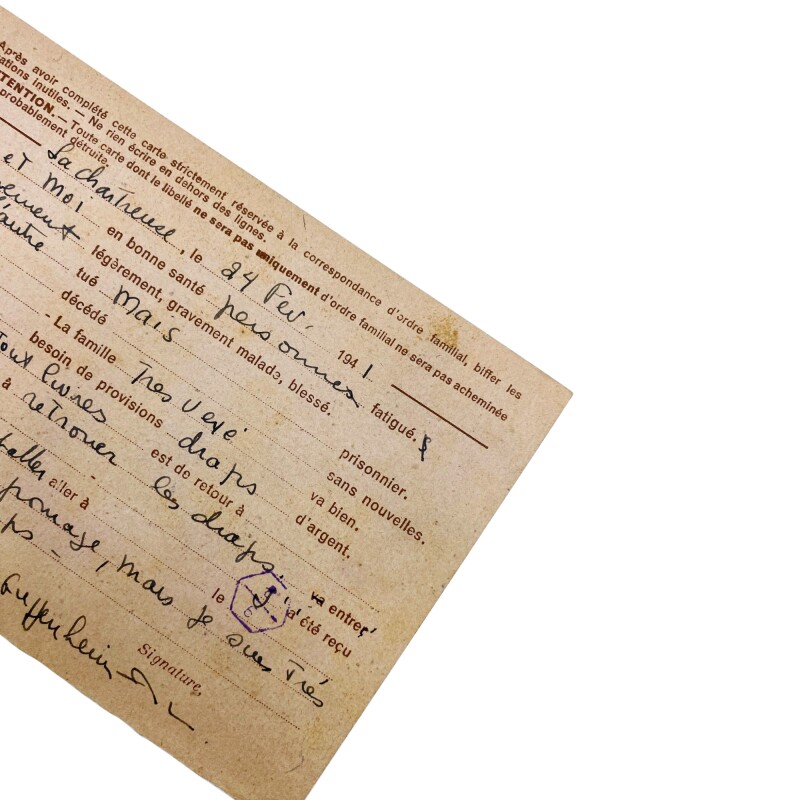
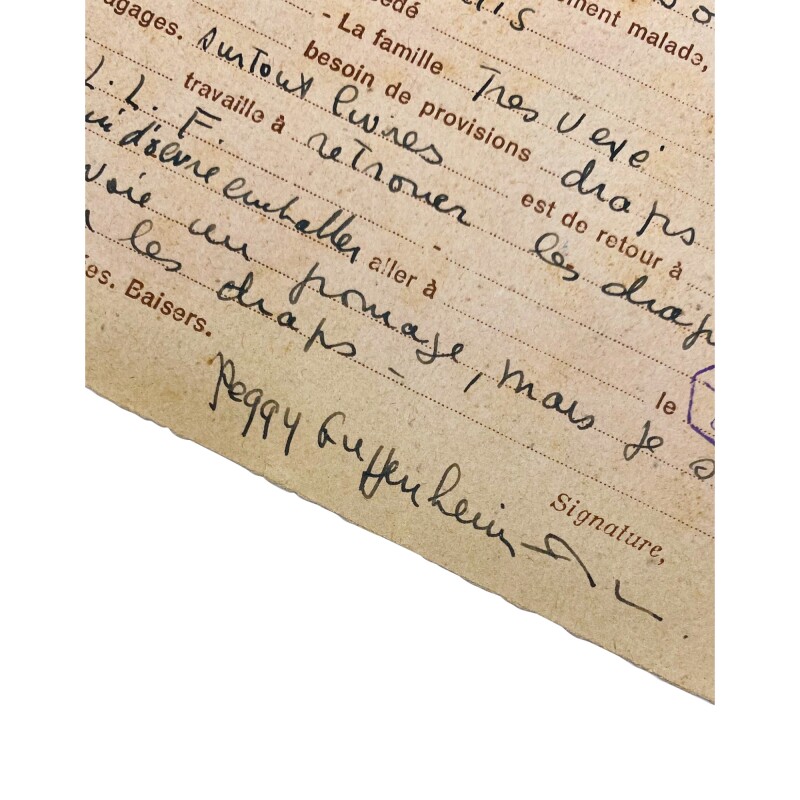
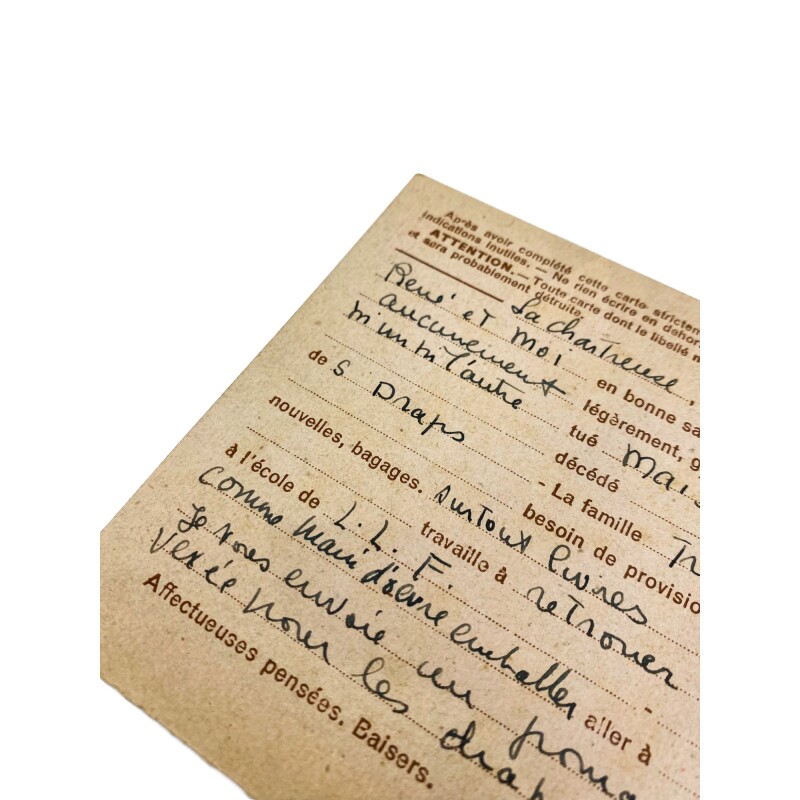
A spectacular relic of a legendary episode in 20th-century art collecting and preservation: original carte postale sent to occupied Paris by a vexed Guggenheim, demanding draperies with which to wrap and disguise her priceless modern art collection.
- Peggy Guggenheim (American).
- [Grenoble]: n.p., 1941.
- Original printed postcard, blanks filled in by Guggenheim in pen with her signature.
- Addressed from the Hotel Moderne in Grenoble to Monsieur M. Lefebvre, 19 rue Vavin, Paris.
“The day Hitler walked into Norway I walked into Leger’s studio and bought a wonderful 1919 painting from him. He never got over the fact that I should be buying paintings on such a day....My motto was ‘buy a picture a day’ and I lived up to it.” – Guggenheim, Out of this Century.
Peggy Guggenheim saves “art of this century” from Hitler; “I got rather bored,” she explains: this handwritten postcard was sent by Guggenheim from her temporary abode in Grenoble to M. [Maurice] Lefebvre’s art supply shop in Paris, requesting the textiles used to smuggle her priceless collection of 20th-century art out of France to the United States, where it would be exhibited in 1942. Lefebvre was the brother of “René,” of the postcard’s “René et moi,” described therein as neither wounded nor killed but in dire need of draperies, books, and more draperies. In return, she offers, “I will send you a cheese” (”Je vois envoie un fromage”) — but the draperies were essential: No drapes, no cheese.
The famous episode from which this card survives was told by Guggenheim in her own memoirs: after she had spent a decade-plus of collecting art and fine living in Europe, the Nazis had invaded, at a most inconvenient time for her. The Louvre refused to share any of its secret storage space, judging the pictures “too modern and not worth saving.” In any case, “being Jewish, I could not go back to Paris, but I wanted to exhibit the pictures somewhere.” In a stroke of luck, the director of the Musée de Grenoble, Pierre-André Farcy, offered to shelter them: “He gave me perfect freedom in the museum, where I unpacked my paintings and had them photographed.” Knowing that permission to exhibit in France would never be granted by the Vichy authorities, Guggenheim declared her intentions of moving self and art collection out of the country, despite Farcy’s protests: “I hadn’t the slightest intention of leaving them with him and I also had no idea how I could send them to America, but I knew that I would never go without them.” Just then, as if “fallen from heaven, René Lefebvre arrived in Grenoble.”
R. Lefebvre, a partner in the Paris firm of art handlers to which the postcard is addressed, offered not only personal diversions but also practical solutions: “I told him my troubles, and to my great surprise he said nothing could be easier than to ship my collection from Grenoble to America as household objects, provided I could send some personal belongings too...M. Farcy had to give us his authority to remove the paintings, and then René and I set to work and together we packed them up in five cases with my linens and blankets. This, of course, was a great favor René conferred on me, but by this time we were having an affair, so he was very happy to render me any service.” Guggenheim writes, as was her custom, with the sort of studied carelessness that might incline a reader to suspect her indifferent to the risks she ran, though she was well aware of the danger to the art and to her own person as well as to her loved ones; at the time she recalls buying three of his paintings, Max Ernst (later incorporated into her husband collection) was imprisoned in a concentration camp.
In 1942 the Art of This Century gallery opened in New York, sharing a name with the collection catalogue that Guggenheim first began working on in France in 1940, when her collection was still hidden and in jeopardy; augmented by more recent American purchases, that first exhibition centered on the period 1910 to 1939 and included paintings and sculpture by Picasso, Mondrian, Ernst, Chagall, Dali, Man Ray, Klee, Kandinsky, Brancusi, Giacometti, Jean Arp, Picabia, Gris, Braque, and Léger — among others.
Literature
Guggenheim, Out of This Century.
Davidson & Rylands, Peggy Guggenheim & Frederick Kiesler: The Story of Art of This Century.
Rotwein, Art, Sex, and Jewishness: Peggy Guggenheim as a Modern Art Object.
Condition Report
 Good
GoodModerate toning.
A few touches of soil and light edgewear.
Product is used.
Dimensions
Feature(s)
Language
Subject
Conditions of Business
Please note that the cancellation right for EU/UK purchasers applies to this item. Please read Condition 19 of the Buy Now Marketplace Conditions of Business for buyers for more information. Read more here.