

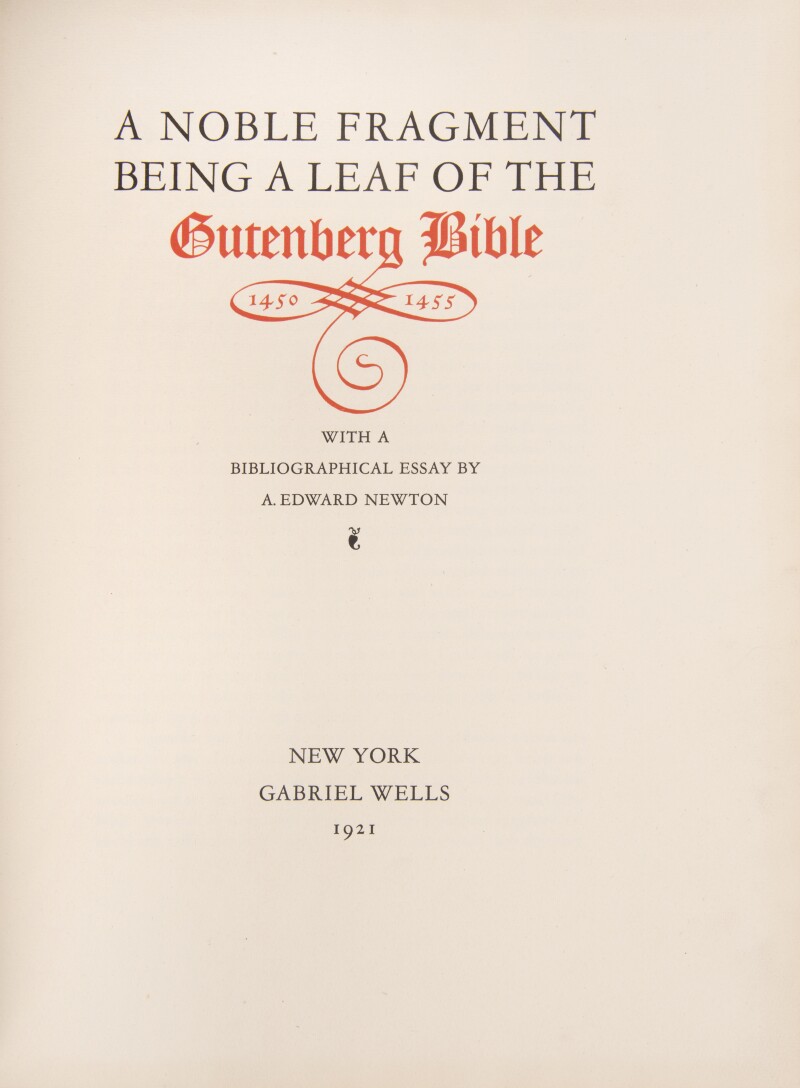


A Leaf Of The Gutenberg Bible
Johann Gutenberg and Johann Fust
Complimentary Shipping
Price:
International shipping available
Customs duties and taxes may apply.
Ships from: London, United Kingdom
Taxes not included
VAT and other taxes are not reflected in the listed pricing. Read more
Authenticity guaranteed
We guarantee the authenticity of this item.
Details

Description
A leaf from The Gutenberg Bible -- an extraordinary survival from the dawn of the printing press.
- Johann Gutenberg (German).
- Bibliographical essay by A. Edward Newton.
- The Gutenberg Bible. A Noble Fragment. Exodus XXXIX.
- [Mainz: Johann Gutenberg and Johann Fust, c.1455].
- Royal Folio.
- 3 pages.
- Single paper leaf comprising Exodus XXXVIII:11 to XL:4.
- Text in Latin.
- Printed in 2 columns, 42 lines per column, rubricated in red and blue (headlines in alternating lombard letters, chapter initials, numerals, and red capital strokes).
- Mounted and bound as part of Gabriel Wells’ A Noble Fragment series (New York, 1921).
- Publisher’s blind-ruled dark blue morocco by Strikeman & Co., upper cover and spine lettered in gilt, original slipcase.
- Housed in a custom-made black morocco solander box, lettered in gilt to upper cover and spine.
An excellent, well-margined leaf from the Gutenberg Bible, the first substantial book printed in the western world using moveable type.
The text of this leaf covers the final chapters of the Book of Exodus, from 38:11 ‘metalli era[n]t...’ through to 40:4 ‘...et i[n]llata mensa pones’. This is an important section of the Old Testament which describes the construction of the Tabernacle and the Holy of Holies, the inner sanctuary that housed the Ark of the Covenant, and was the means by which God descended from heaven to dwell among the Israelites during their conquest of Canaan.
The Bible was printed over the course of five years from 1450 to 1455 at the workshop of Johann Gutenberg and Johann Fust in Mainz, Germany, probably in an edition of between 150 to 180 copies, of which only 48 complete or near complete examples survive (12 printed on vellum, 36 on paper). All known copies are now in institutional collections, and no complete copy has been offered for sale since 1978. This leaf came from an incomplete copy of the Gutenberg Bible, which was acquired by the New York bookseller Gabriel Wells and dispersed as fragmentary leaves, mostly as here accompanied with an introductory monograph by the book collector A. Edward Newton (1864-1940).
This incomplete copy of Gutenberg’s Bible had previously formed part of the collection of Maria von Sulzbach (1721-1794), wife of Carl Theodore, Electoral Prince of the Palatinate and subsequently Electoral Prince of Bavaria, thence the Hofbibliothek at Mannheim, the Royal Library at Munich (sold as a duplicate in 1832), and lastly Robert Curzon, Baron Zouche (1810-1873) and his descendants. It was sold at auction in 1920 (Sotheby's, 9 November, lot 70) to Joseph Sabin, who in turn sold it to Wells. The majority of the single leaves which have been offered since come from Wells’ copy.
The Noble Fragments are the closest a dedicated bibliophile can get to acquiring an example of this monument in the history of printing.
Provenance
Roland Leslie Taylor (presentation inscription).
George McMaster Jones (bookplate).
Condition Report
 Very Good
Small pinhole to lower fore-edge margin.
Slightly spotted.
Presentation inscription by A. Edward Newton to front free endpaper recto.
Bookplate to front pastedown.
Slipcase rubbed with minor loss
Re-backed preserving the original spine.
Signs of age and handling.
Product is used.
Dimensions
Language
Subject
Conditions of Business
Please note that the cancellation right for EU/UK purchasers applies to this item. Please read Condition 19 of the Buy Now Marketplace Conditions of Business for buyers for more information. Read more here.