


Tadashi Kaminagai
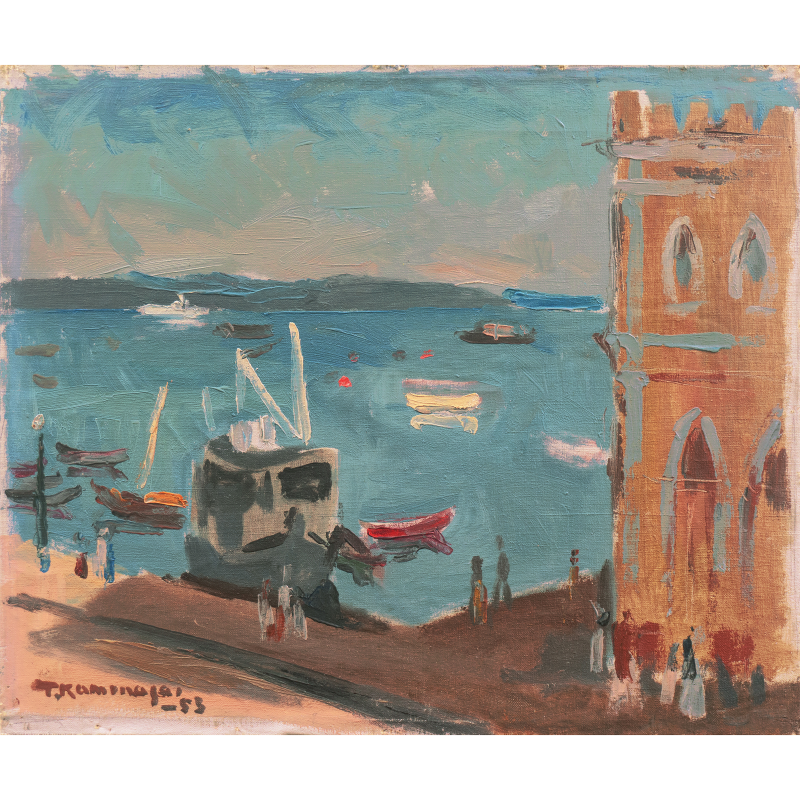
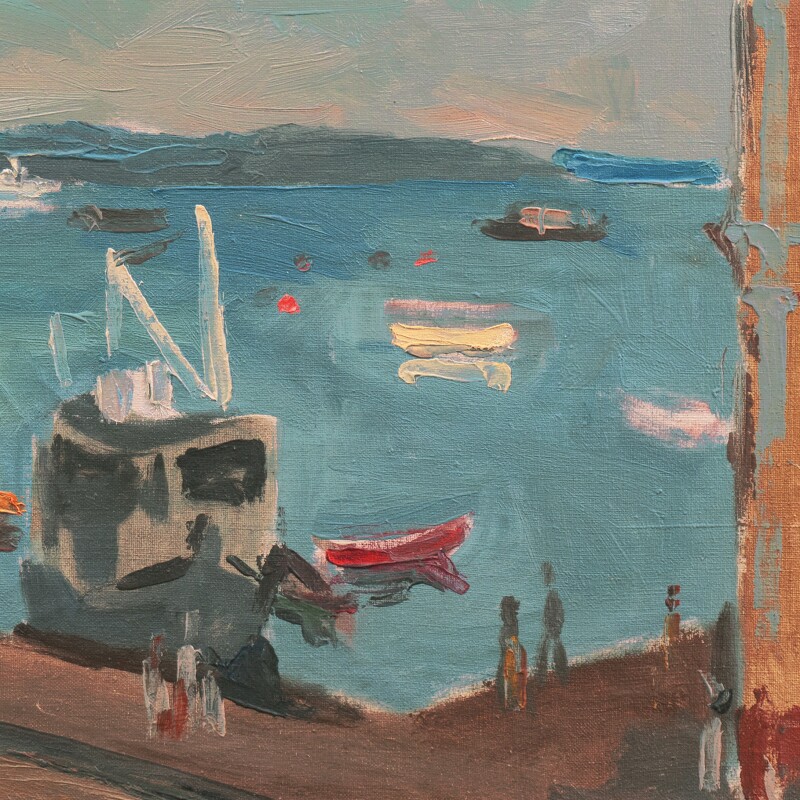
Bahia Harbor, Brazil
1953
Oil on board
Complimentary Shipping
Price:
International shipping available
Customs duties and taxes may apply.
Ships from: California, United States
Taxes not included
VAT and other taxes are not reflected in the listed pricing. Read more
Authenticity guaranteed
We guarantee the authenticity of this item.
Details

Description
Tadashi Kaminagai (Japanese-French, 1899-1982).
This work is offered unframed.
Born in Hirashima, Tadashi Kaminagai was first called to the contemplative life of a Buddhist monk before deciding to pursue a career as an artist. In 1927, following his new calling, he moved to Paris and lived in the Cité Falguière where he worked as a painter and framer. He was soon made welcome in the fashionably bohemian art circles of Montmartre, first becoming friends with his country-man, Tsuguharu Foujita, who then introduced him to other prominent members of the first generation of the School of Paris, including Henri Matisse and Pierre Bonnard.
From 1929, Kaminagi exhibited at the Japanese circle and, during the 1930s, at the Salon des Tuileries and the Salon d’Automne as a member of the École de Paris. In 1940, he returned to Japan, leaving the following year for Rio de Janeiro to escape the conflagration. While in Brazil, he continued his work as a framer and painter in the Santa Teresa neighborhood of Rio de Janeiro and also became an influential teacher known for his eloquent advocacy of the principles of Modernism in art. Among the notable Brazilian and Japanese-Brazilian painters who became his students were Inimá de Paula, Flavio-Shiró and Tikashi Fukushima among others. Kaminagai continued to exhibit with success in Brazil, including at the Salão Nacional de Belas Artes (silver medal, 1942) and the São Paulo Biennale (1951, 1953).
In 1955, Kamenagi returned to Japan before settling in Paris again in 1957, in the Cité Falguière, with his wife Mineko. With a group of Japanese artists, he exhibited in 1958 at the Cercle Volney. In 1958 and 1959, he participated with other South American artists in the Latin American Salon held in Paris and, in 1958, bought a pavilion in La Frette-sur-Seine in which he set up a workshop. Tadashi Kaminagai continued to divide his time between Japan, France and Brazil until his death, in Paris, in 1982 but it is in Brazil that he found the greatest acceptance and success. Kaminagai is listed as a Brazilian painter in the Itaú Cultural encyclopedia of Brazilian Arts and Cultures but as a Japanese painter in the Benezit Dictionary of Asian Artists.
Several major posthumous exhibitions have been devoted to Kaminagai and his work, including at the São Paulo Art Museum (1986), in Japan (1987) and at the "Círculo de Ligações: Foujita no Brasil, Kaminagai eo Jovem Mori" at the Centro Cultural Banco Do Brasil in São Paulo (2008). Over the course of long career, Kaminagai exhibited widely and with success and his work is held in private and public collections including in the permanent collections of the Arte Brasileira Museum, the São Paulo State Pinacoteca and in La Frette-sur-Seine, among others.
Brazilian critics pay homage to his sense of color, to the light and to the love of life that emanates from his paintings. They describe him as one of the last representatives of the School of Paris and insist on his influence on Japanese-Brazilian artists. His work as a framer is also recognized since his style has given rise in Brazil to a name "Moldura Kaminagai".
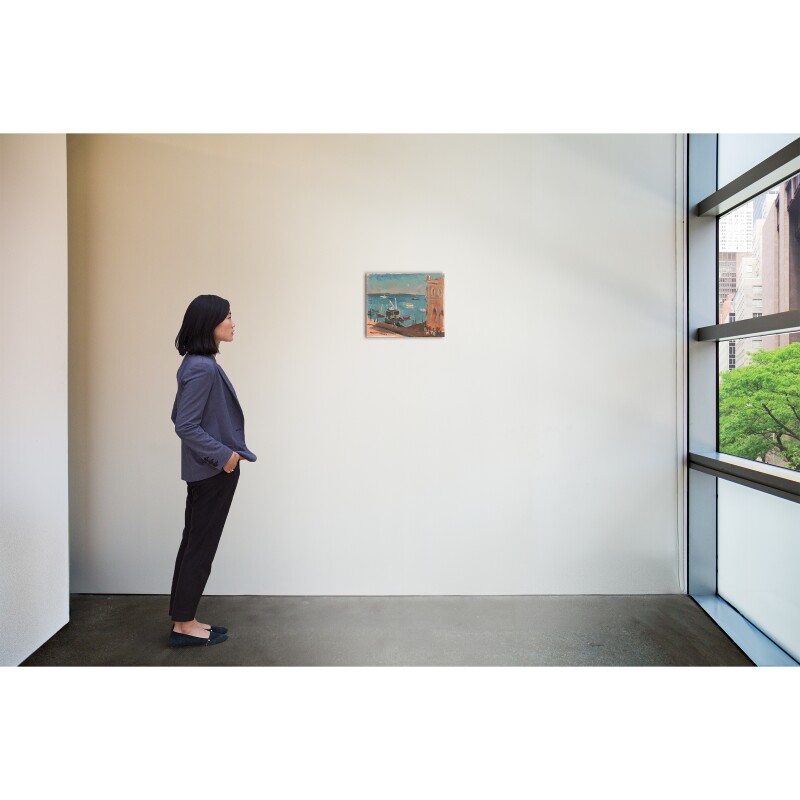
Dimensions
Signature
Signed 'T. Kaminagai' lower left; dated 1953 lower left
Condition Report
This work is in overall good condition.
Minor lifting and rubbing to edges.
Small punctures at edges inherent to artist's working method.
Minor restorations.
Product is used.
Art Period
Movement/Style
Conditions of Business
Please note that the cancellation right for EU/UK purchasers applies to this item. Please read Condition 19 of the Buy Now Marketplace Conditions of Business for buyers for more information. Read more here.