








Details
Benton, John Dean
Independence Hall: Scale Model for the 1876 US Centennial Exhibition in Philadelphia. 1875
Model to 3/8-inch scale, the interior fully furnished; the stand fitted with two plaques engraved, "Made to order / J. DEAN BENTON / for EDWARD C. KNIGHT of PHILADELPHIA, 1875" (62 x 41 ¾ in., excluding the base). Executed in "German silver" plated in copper for the brickwork and roof, silver for the ornamental details, with gilt accents; the tower fitted with a clock, with four frosted dials, striking the hours and half-hours, the dome encloses a bronze-finished bell and the roof mounted with flagstaff supported by wires, surrounded by silvered paving, on draped stand.
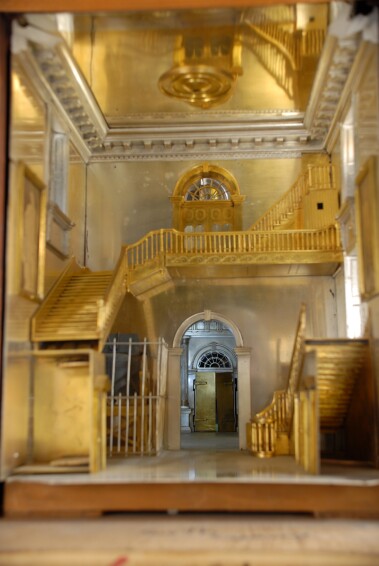
The interior, silvered throughout with gilt details, is fitted as follows:
Benton rendered the brickwork and roof in German silver plated in copper, reserving silver and gilt for the architectural ornament, and brought the structure to life as a working object: the tower clock strikes the hours and half-hours across four frosted dials, a bell hangs within the dome, and a flagstaff rises from the roof above silvered paving. Yet it is within that the model truly astonishes.
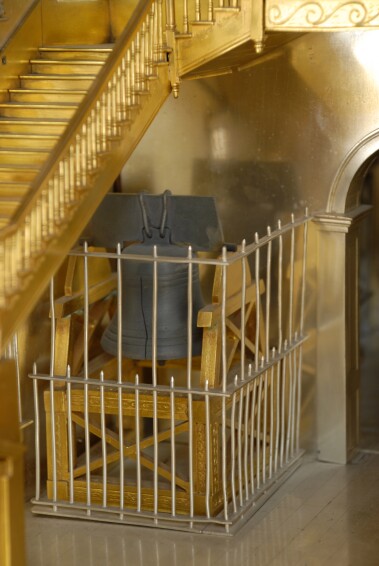
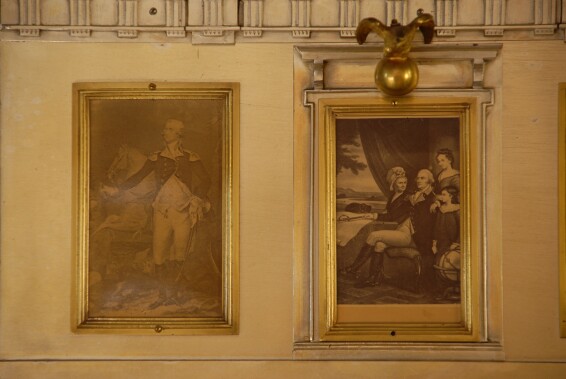
Worked to a scale of three-eighths of an inch, the interior reveals the Assembly Room, where the table of the signing of the Declaration of Independence and the chair of the President of Congress stand beneath engraved portraits of Washington and the signers; the Back Hall, where a miniature Liberty Bell hangs in its wooden frame beside a gilded stair; and an upper floor furnished in exacting detail with writing desks, cabinets, sofas, and a painted floor.
A trained jeweler who became celebrated for his finely wrought models—among them the silver model of the steamship Commonwealth, now in the Mariners’ Museum—Benton produced here a singular work, neither souvenir nor toy but a jeweler’s homage to the birthplace of American independence, made at the very moment the nation paused to look back on its first century.
In recent years, the model underwent a painstaking and comprehensive restoration under the direction of Ubaldo Vitali, the master silversmith and 2011 MacArthur Fellow widely regarded as among the foremost silver conservators working today. The multi-year campaign addressed the model in its entirety, exterior and interior alike. On the exterior, the German-silver-and-copper structure, the dome and its bell, the flagstaff, and the silvered paving were returned to full presentation condition.
Additionally, working with a small group of specialist colleagues, the restoration encompassed all the interior textiles and decorative elements—the miniature engraved portraits of the founders, the furniture, the lighting, and the Liberty Bell in its frame. The clock in the tower has likewise been fully restored and once again strikes and keeps time, so that the model functions today as Benton intended.
The impressive model now rests upon a finely crafted base, reconstructed after an amazing period photograph showing it on its original stand at the Centennial Exhibition of 1876 in Philadelphia.
EXHIBITION
Centennial Exhibition, Philadelphia, 1876
Old City Hall, Philadelphia, 1962-67, Preserving Independence Hall, under the auspices of the Department of the Interior
Colony House, Newport, R.I., 1967-75
On loan to the Smithsonian Institution, Washington, D.C., 1975-1987
PROVENANCE
Edward Collings Knight, Philadelphia (1813-1892) — Edward C. Knight Jr., Philadelphia and Newport — Given in 1934 to the Newport Historical Society — Sotheby's New York, 28-30 January 1988, lot 1062 — Sotheby’s New York, 21 January 2011, lot 147 — Private Collection
Independence Hall: Scale Model for the 1876 US Centennial Exhibition in Philadelphia. 1875
Model to 3/8-inch scale, the interior fully furnished; the stand fitted with two plaques engraved, "Made to order / J. DEAN BENTON / for EDWARD C. KNIGHT of PHILADELPHIA, 1875" (62 x 41 ¾ in., excluding the base). Executed in "German silver" plated in copper for the brickwork and roof, silver for the ornamental details, with gilt accents; the tower fitted with a clock, with four frosted dials, striking the hours and half-hours, the dome encloses a bronze-finished bell and the roof mounted with flagstaff supported by wires, surrounded by silvered paving, on draped stand.
The interior, silvered throughout with gilt details, is fitted as follows:
- The Front Entrance Hall framed by columns and paneled walls
- The East Room (Independence Hall) containing a model of the table on which the Declaration of Independence was signed, the chair of the President of Congress, half-tone engraved portraits of George Washington and the signers of the Declaration
- The West Room (State Supreme Court) with silvered chandelier, four gilt figures in costumes of the period, and similar portraits of the Chief Justices
- The Back Hall with a model of the Liberty Bell, suspended by a wooden frame and surrounded by a railing, half-tone engraved portraits and gilt staircase
- The Second Floor with carved wood writing desks with cork tops, display cabinets, upholstered sofas, gilt gallery, half-tone portraits of Revolutionary figures, and elaborately painted floor.
Benton rendered the brickwork and roof in German silver plated in copper, reserving silver and gilt for the architectural ornament, and brought the structure to life as a working object: the tower clock strikes the hours and half-hours across four frosted dials, a bell hangs within the dome, and a flagstaff rises from the roof above silvered paving. Yet it is within that the model truly astonishes.
Worked to a scale of three-eighths of an inch, the interior reveals the Assembly Room, where the table of the signing of the Declaration of Independence and the chair of the President of Congress stand beneath engraved portraits of Washington and the signers; the Back Hall, where a miniature Liberty Bell hangs in its wooden frame beside a gilded stair; and an upper floor furnished in exacting detail with writing desks, cabinets, sofas, and a painted floor.
A trained jeweler who became celebrated for his finely wrought models—among them the silver model of the steamship Commonwealth, now in the Mariners’ Museum—Benton produced here a singular work, neither souvenir nor toy but a jeweler’s homage to the birthplace of American independence, made at the very moment the nation paused to look back on its first century.
In recent years, the model underwent a painstaking and comprehensive restoration under the direction of Ubaldo Vitali, the master silversmith and 2011 MacArthur Fellow widely regarded as among the foremost silver conservators working today. The multi-year campaign addressed the model in its entirety, exterior and interior alike. On the exterior, the German-silver-and-copper structure, the dome and its bell, the flagstaff, and the silvered paving were returned to full presentation condition.
Additionally, working with a small group of specialist colleagues, the restoration encompassed all the interior textiles and decorative elements—the miniature engraved portraits of the founders, the furniture, the lighting, and the Liberty Bell in its frame. The clock in the tower has likewise been fully restored and once again strikes and keeps time, so that the model functions today as Benton intended.
The impressive model now rests upon a finely crafted base, reconstructed after an amazing period photograph showing it on its original stand at the Centennial Exhibition of 1876 in Philadelphia.
EXHIBITION
Centennial Exhibition, Philadelphia, 1876
Old City Hall, Philadelphia, 1962-67, Preserving Independence Hall, under the auspices of the Department of the Interior
Colony House, Newport, R.I., 1967-75
On loan to the Smithsonian Institution, Washington, D.C., 1975-1987
PROVENANCE
Edward Collings Knight, Philadelphia (1813-1892) — Edward C. Knight Jr., Philadelphia and Newport — Given in 1934 to the Newport Historical Society — Sotheby's New York, 28-30 January 1988, lot 1062 — Sotheby’s New York, 21 January 2011, lot 147 — Private Collection