
- 7
Benjamin Edward Spence
Description
- Benjamin Edward Spence
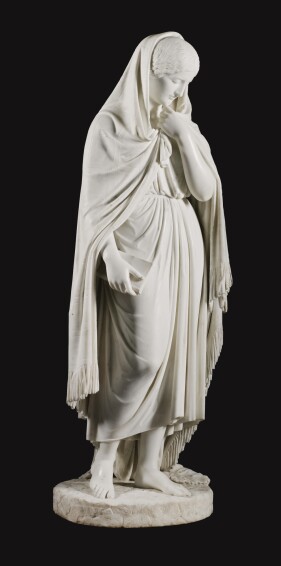
- Highland Mary
- signed and dated: B. E. SPENCE. FECIT. / ROMAE. 1859.
- white marble, on a cream and beige painted wood base
Provenance
Eugene Leone, New York;
Sotheby's New York, 23 May 1994, lot 66
Condition
"In response to your inquiry, we are pleased to provide you with a general report of the condition of the property described above. Since we are not professional conservators or restorers, we urge you to consult with a restorer or conservator of your choice who will be better able to provide a detailed, professional report. Prospective buyers should inspect each lot to satisfy themselves as to condition and must understand that any statement made by Sotheby's is merely a subjective, qualified opinion. Prospective buyers should also refer to any Important Notices regarding this sale, which are printed in the Sale Catalogue.
NOTWITHSTANDING THIS REPORT OR ANY DISCUSSIONS CONCERNING A LOT, ALL LOTS ARE OFFERED AND SOLD AS IS" IN ACCORDANCE WITH THE CONDITIONS OF BUSINESS PRINTED IN THE SALE CATALOGUE."
Catalogue Note
Ye banks and braes and streams around/ The castle o'Montgomery,/ Green be your woods, and fair your flowers/ Your waters never drumlie!/ There simmer first unfauld her robes,/ And there the longest tarry;/ For there I took the last fareweel/ O'my sweet Highland Mary.
This romantic and sorrowful tale captured the imagination of the young sculptor. Spence's marble Highland Mary remains a testament in stone to the grief-stricken poet.
Benjamin Edward Spence was born in Liverpool, the son of the sculptor William Spence (1793-1849). In his early career he was sent to Rome, where he trained with the important neoclassical sculptors John Gibson (1790-1866) and R.J. Wyatt (1795-1850), and later established his own studio.
A poetic and touching subject, Highland Mary was Spence's most popular work. At least five versions in marble were made by the artist, the earliest dating to 1852. In 1854 Prince Albert commissioned a copy as a birthday present for Queen Victoria. Another version was exhibited at the French International Exhibition of 1855 and is now in the Palm House at Sefton Park, Liverpool.
RELATED LITERATURE
T. Stevens, 'Roman Heyday of an English Sculptor', Apollo, September 1971, pp. 226-231; M. Greenwood, 'Victorian Ideal Sculpture 1830-1870', P. Curtis (ed.), Patronage & Practice. Sculpture on Merseyside, Liverpool, 1989; T. Cavanagh, Public Sculpture of Liverpool, Liverpool, 1997, pp. 206-207