
- 874
Liu Wei
Description
- Liu Wei
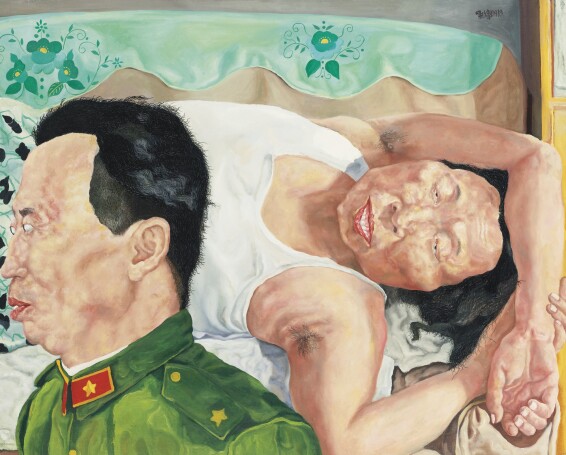
- Revolutionary Family Series -- Dad with Mum
- oil on canvas
Provenance
Exhibited
Taiwan, Taipei, Hanart Gallery, Political Pop, China’s New Art, Post-1989, 6-13 March, 1993
UK, Oxford, Museum of Modern Art, New Art From China, 4 September – 24 October, 1993
UK, London, Marlborough Fine Art, New Art from China: Post-1989, 7 December, 1993 - 12 February, 1994, cover
Literature
Time magazine, Time Inc., New York, USA, 8 February, 1993, p. 47
New Art from China: Post-1989, Marlborough Fine Art (London) Ltd., 1993, cover
Liu Wei, Red Bridge Gallery, Shanghai, China, 2008, p. 44
Condition
"In response to your inquiry, we are pleased to provide you with a general report of the condition of the property described above. Since we are not professional conservators or restorers, we urge you to consult with a restorer or conservator of your choice who will be better able to provide a detailed, professional report. Prospective buyers should inspect each lot to satisfy themselves as to condition and must understand that any statement made by Sotheby's is merely a subjective, qualified opinion. Prospective buyers should also refer to any Important Notices regarding this sale, which are printed in the Sale Catalogue.
NOTWITHSTANDING THIS REPORT OR ANY DISCUSSIONS CONCERNING A LOT, ALL LOTS ARE OFFERED AND SOLD AS IS" IN ACCORDANCE WITH THE CONDITIONS OF BUSINESS PRINTED IN THE SALE CATALOGUE."
Catalogue Note
Revolutionary Family Series: Dad with Mum
In the history of Chinese contemporary art, Liu Wei is not only similar to Fang Lijun, who is a pioneer of the “Cynical Realism” period of the 90s, creating a mental outlook of a generation of Chinese artists, but also becomes a fine example of an artist who successfully breaks away from his own stylistic framework. Taiwanese curator Hu Yongfen mentioned in his essay “Liu Wei’s” the importance of the 90s in relation to the development of Chinese art, “The Chinese art history at the time (the early 90s) had given way to a new generation, one that grew out of a collective life and the only one that could portray the independent facade of contemporary art.”1 The 1991 painting Revolutionary Family Series: Dad with Mum (Lot 874) comes from Liu Wei’s first portrait series in his creative career, and is an exemplary record of a Chinese artist’s quest to find his own unique voice and style, serving as a historical milestone in its own right. The Revolutionary Family Series was painted and finished in only three years of Liu’s oeuvre, after which he had turned to another style, making the series’ works rare and extremely precious. In recent years, Liu Wei’s art has become even more popular and pronounced. After more than twenty years of painting, his unparalleled painting style is still highly revered and sought after, exuding an everlasting influence that solidifies Liu’s position in a coterie of Chinese artists.
According to the influential Chinese art critic Li Xianting, the nineties represented two major artistic currents: “Political Pop” and “Cynical Realism”. For Achille Oliva, the organiser of “The Road to the East”, which was part of the 1993 Venice Biennale, the two currents accurately reflected the social reality of China in nineties. Just like Political Pop, Cynical Realism represented a more liberating artistic language with a social impact. Political Pop was also judgment on the political level, expressed as a
sarcastic critique of the system. Li, who had been an active curator with close connections to artists since the eighties, called the third-generation artists who emerged in the 1990’s as “rascals”, “The ‘rascals’ are fundamentally different from the two preceding generations of artists. They believe neither in the governing system of meanings nor in any effort to construct new meanings through resistance. Instead they pragmatically and realistically confront their own helplessness. If they can rescue anyone, it is themselves. And a sense of boredom is the rascals’ most effective means to undo all shackles of meanings.”2 The nonchalance of the figures in Liu Wei’s early Revolutionary Family Series is precisely a manifestation of this boredom.
Liu Wei graduated from the Central Academy of Fine Arts in 1989 and is a representative artist of the post-89’ period. Along with Fang Lijun, another representative painter of Cynical Realism, they have fully captured the ethos of the 1990’s. The two debuted together in an eponymous exhibition in 1992, earning
the attention of critics within and beyond China, including the Hong Kong gallery-owner Johnson Chang. Chang invited Liu Wei to participate in the exhibition “China’s New Art Post-89,” which toured internationally in 1993. Afterwards, Liu Wei was invited to other major international events, such as the 1993 and 1995 Venice Biennales and the 1994 São Paulo Biennial. By representing Chinese art of the 1990’s, Liu Wei has made a profound impression in the Western art world.
Liu Wei began the Revolutionary Family Series immediately after graduating. Although the series was exhibited internationally many times, it lasted only three years - from 1990 until 1992 - and is thus very rare on the market. The series is strongly autobiographical, mostly featuring people from the painter’s life. Liu’s own father, depicted in PLA uniform, is naturally the soul of the series. In technique, Liu Wei boldly departed from the official aesthetics of the time, abandoning socialist realism for an insouciant figurative style that renders his subjects bizarre or even ugly. Comparing Liu Wei’s early and late works, we find that his style, beginning in an almost complete adherence to realism, gradually became loose and free, indicative of sensibilities unusual among his contemporaries. In contrast to most contemporary Chinese art of the 1980’s, Liu Wei’s works are free of ideological baggage or an artist’s responsibilities; irreverent mischief is his attitude in life and art alike. Thus his paintings have a clear intellectual tendency towards the nonchalance of “Cynical Realism” identified by Li Xianting.
This nonchalance of the rascal spirit accentuates itself in the Revolutionary Family Series: Dad with Mum. Liu chose his own parents as the models for the piece, with his mother wearing only a white vest, her arms unfurled above her head, extending herself comfortably on the sofa and exposing her armpit hair. The oft-seen key figure of the Revolutionary Family Series, his tunic-clad father, appears on the left hand side of the piece and looks out to a world beyond the painting. Liu Wei is unwilling to adhere to
academic notions of the civilised female, and refusing to pursue ideal beauty within the confines of his studio. What he pursues is the reality, daring to unashamedly display even things otherwise considered as ugly. This cynical and playful style is borne of the artist’s rebellion against standardised painting, and demonstrates his courage to face life intuitively.
Liu Wei is unwilling to comply with the golden rule of realism, using instead slightly exaggerated and expressive brushwork to ignore any notions of traditional body proportions, the technicalities of facial muscles and skeletal composition. Liu is able to presents the details of which traditional realism is incapable of presenting, displaying instead extremely personalised brushstrokes that contribute to the ever-changing fluidity in his paintings. Revolutionary Family Series: Dad with Mum presents the importance of the artist’s personal style, and this series simultaneously solidifies the unrestrained quality to his later works marked by carefree brushwork and free-flowing paint that illustrate the beauty of decay.
The 1990’s was an era oversaturated with symbols, and it was not easy at all for Liu Wei to persevere in perfecting his painting technique. He later said, “The time before 1993 was very trying, to a large extent psychologically. I was troubled not only by worries about the future, but also by solitude in artistic creation. I have always been lonely. I am not someone who follows trends. Someone who does is not lonely.”3 Liu Wei’s insistence on the painterly aspect has turned him away from the mainstream of symbols-laden painting in the mid-1990’s, and his later works have also strayed away from Cynical Realism. Under this light, Revolutionary Family Series: Dad with Mum is very precious because it not only represents Liu’s early painting style, but also the paradigm of Cynical Realism. In depicting subjects of ordinary life, Revolutionary Family Series: Dad with Mum perfectly embodies Liu Wei’s aesthetics, as he once said, “A true artist should find beauty in the familiar things of his everyday life. Only this is lasting beauty.”
1 Hu Yongfen, “Liu Wei’s”, Liu Wei- A Solo Painter, 2012
2 Li Xianting, “’Post 89’’Art’s Meaning: ‘Cynical Realism’ and ‘Political Pop’ Analysis”, Open View: Coming Out of a National Consciousness, 2010
3 Liu Wei, Red Bridge Gallery, p. 40
4 Liu Wei, Red Bridge Gallery, p. 7