
- 266
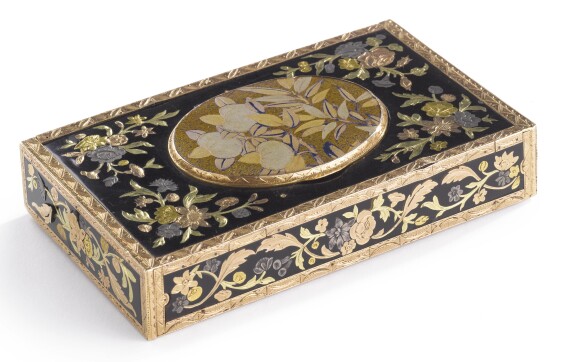
A RARE AND COMPLEX LOUIS XV VARI-COLOR GOLD AND LACQUER NÉCESSAIRE Â SECRETS, maker's mark apparently JALC, perhaps for Aimé-Joseph-Louis Couturier, Paris, 1758
Description
- charge and discharge marks of Eloi Brichard
- VARI-COLOR GOLD AND LACQUER, Turtle
- length 4 3/8in.
- 11cm.
Provenance
Baron Meyer de Rothschild, to his daughter
Hannah, Countess of Rosebery, to her husband
Archibald Primrose, 5th Earl of Rosebery, and by descent until sold
Sotheby's, London, 11 February 1999, Magnificent Silver-gilt, Objects of Vertu and Miniatures from the Rothschild and Rosebery Collection, Mentmore, lot 183
Literature
Associated Literature:
A.R. von Arneth, Maria Theresia 1756-1763, Vienna, 1875, pp.538-9;
E. & J. de Goncourt, Madame de Pompadour, Paris, 1881, pp. 197-202;
Rudolph Graf Khevenhüller-Metsch & Dr H. Schlitter, Aus der Zeit Maria Theresias 1758-1759, Vienna/ Leipzig, 1911, p.84;
J. Cordey, Inventaire des biens de Madame de Pompadour, Paris, 1939, pp. XXII & 205;
F.J.B Watson, 'Beckford, Mme de Pompadour, the duc de Bouillon and the taste for Japanese lacquer in the eighteenth century France', Gazette des Beaux-Arts, February, 1963
Condition
In response to your inquiry, we are pleased to provide you with a general report of the condition of the property described above. Since we are not professional conservators or restorers, we urge you to consult with a restorer or conservator of your choice who will be better able to provide a detailed, professional report. Prospective buyers should inspect each lot to satisfy themselves as to condition and must understand that any statement made by Sotheby's is merely a subjective qualified opinion.
NOTWITHSTANDING THIS REPORT OR ANY DISCUSSIONS CONCERNING CONDITION OF A LOT, ALL LOTS ARE OFFERED AND SOLD "AS IS" IN ACCORDANCE WITH THE CONDITIONS OF SALE PRINTED IN THE CATALOGUE.
Catalogue Note
Nécessaire à portrait et secrets
Enclosed within the box are the very necessary instructions for unveiling the secrets of the box and avoiding the decoy pressure points:
'Necessaire à portraits et Secrets. On ouvre la boete du côte milieu ou l'on voit la charniere en pressant sur un endroit de la bordure que l'on sentira ceder sous le pouce, le ressort ainsi presse permettra d'ouvrir cette porte ou se trouve une espèce de clef. Avec la pointe de cette clef on poussera sur un bouton rond presqu' imprecettible que l'on trouve sur un des cotés longs vers le bout on ouvrira ainsi une boete ou sont 2 flaccons et un antennoir d'or, de l'autre coté de la meme maniere on ouvrira une boete contenant un calendrier, enfin au milieu du même côte est un semblable bouton qui fait ouvrir toute la superficie du necessaire, on y trouve la dedans un petit bureau à écrire et un crayon d'or dans le dessus est un portrait, sous ce portrait au bas est une espèce de ressort en la pressant doucement comme un ressort de bracelet il fait sauter la dessus du necessaire du coté oppose et montre un portrait de femme difficile a trouver. Faut avoir connaissance des secrets qui l'ouvrent'.
It is the greatest good fortune that this box and its secrets still exist virtually complete and in good order as early mechanisms of the artfulness and complexity of the present example must be of the utmost rarity. Boîtes à secret where extremely prized in mid 18th century Paris. According to Maze-Sentir, certain orfèvres such as Couturier, Bellanger, Corbin, Délion, de la Salle and Porcher were specifically listed in the Almanach Dauphin as specializing in 'les bijoux de fantasie et à secret'. The type of mechanism varied from simple false bottoms containing miniatures (usually suggestive) to secret springs flipping open to reveal a miniature (often a portrait) or compartment. An example of 1770-1775 by J.C Neuber of Dresden, in the Wallace Collection, of carnelian mounted in gold, the lid carved with Leda and the Swan, is now known to conceal a secret drawer in the base, swinging open one a pin-prick and containing portraits of Voltaire and his beloved, Madame Emilie du Châtelet (illustrated A.K. Snowman, Gold Boxes of Paris, 1974, nos. 687/8). This Neuber box was included in a collection from H.I.M the Empress Eugénie, sold by Frederick David of Pall Mall, from which the Earl of Rosebery purchased a number of items in 1872.
The miniatures
The artist, Antonio Bencini, was born in Italy about 1710 and became miniaturist to Empress Maria Theresia, making portraits of numerous members of the Imperial family. An example, signed: A. Bencini pinxit, showing the Emperor Francis I with the Empress and their children on the terrace at Schonbrunn, is illustrated by G.B. Beirmann, Die Miniaturensammlung dess Grossh. v. Hessen, Leipzig, 1917, pl.131.
The maker
The maker's mark on the gold mounts appears to read JLC with a slightly raised A between. The mark cannot be that of J.A.Lecocq (JALC a cockerel différent ) who entered his mark on 16 October 1758 as there is no cockerel and Lecocq is specified by Nocq as joaillier metteur en oeuvre. It can be suggested that the mark is that of Aimé-Joseph-Louis-Couturier who had registered his mark, described as fleur de lys couronnée, deux grains, AJLC, in 1747. There are a number of examples among the hundreds of marks listed by Nocq where the orders of letters in not as officially registered (for example Edmé de Limoges, ELD for EDL, or François-Germain Tiron, FTG for FGT). Furthermore, the name of Couturier appears on Maze-Sentier's list of goldsmiths specializing in boîtes à secret. Aimé-Joseph-Louis, son of Jean Couturier, valet de chambre of the comte d'Offémont, was apprenticed to the gold-box maker Pierre-Aimé Joubert, at the age of 15 years 8 months on 28 February 1736. He was sponsored by Claude Boyer, from the rue de Roule where he remained until 1755. He is listed in the rue de la Ferronerie from 1756 until his death in 1773. No works by Couturier appear to be recorded but this would not be surprising given the fragile and ephemeral nature of a boîte à secret.
The date letter 'S' on the box was in use between July 1758 and July 1759 but even so the box must date from between July and Christmas 1758 as the almanac for 1759, which is one of the secrets, would suggest that the box was an étrenne or New Year's gift. It is evident that the necessaire must have been a special commission both because of its richness and the political nature of the concealed miniatures. Even though Madame de Pompadour had engineered the 'renversement des alliances' in 1756 this allying France with Austria rather than Prussia, and involving France in the Seven Years' War with disastrous colonial results, the Austrians were still extremely unpopular with most of the French.
By tantalizing coincidence, a celebrated necessaire with remarkable similarities to the present example was actually given to Madame de Pompadour herself by the Empress Maria Theresa in January 1759 in gratitude for her help. The Empress had considered offering some choice token to the king's favorite since the signing of the second treaty of Versailles in May 1757 and asked von Starhemberg, her envoy in Paris, whether a sum of money, a boîte à portrait, or a diamond aigrette in Viennese taste would be appreciated. He replied that the present that would give most pleasure would be 'une écritoire du prix de 4,000 ducats, jolité de mode alors très-goûtée par les dames de Paris'. The Empress felt that this was not expensive enough and suggested that her portrait framed by valuable diamonds be set into the writing-case which would be created form the choicest Japanese lacquers sent from her own extensive collection in Vienna. The final bill, including payment to the jeweller Empereur goldsmith Ducrollay, miniature painter Veneveault, an unknown designer, and for an outer case and the cost of sending the écritoire to Vienna for the Empress's approval and back to Paris for presentation, came to 77.2781.19s. Apparently Madame de Pompadour was so overwhelmed by the flattering lavishness of the gift that she took the unusual step of writing directly to the Empress to thank her. News of this reached the ears of the Prussian king, Frederick the Great, who took great pleasure in circulating widely a scurrilous parody. The ultimate fate of the écritoire is not known. La Pompadour 's'est plaint de as trop grande richesse...qui l'a nécessité d'en faire un mystère à tout le monde par la crainte des cancans'.
Certainly by the time of her death, the necessaire appears to have been denuded of the portrait and diamonds. When it was sold by her heir, the Marquis de Marigny, on 25 January 1765, it was simply described as 'une très belle et riche écritoire de lacquer, montée en or, encrier, poudrier et porte-éponge d'or, le tout ciselé et grave, garni d'une guirlande de fleurs qui entoure un cercle d'or pour recevoir un portrait et enfermé dans une belle boîte de lacquer garnie d'argent.'
The box appears in the Mentmore inventory of 1884, vol.II, no.173 (illustrated),
Piqué box, opens with secret springs and contains two scent bottles, a funnel, an almanac in manuscript of the year 1759, a pencil, the pointed key with manuscript directions for finding the secret springs, and two portraits representing a lady and a gentleman. They were probably members of the Austrian Imperial family', with added note copied from a receipted list in Mr Barker's handwriting dated 1851, 'A gold and tortoiseshell case; secrets...£80' (Blarenberghe Room)