
- 71
Joaquín Sorolla
Description
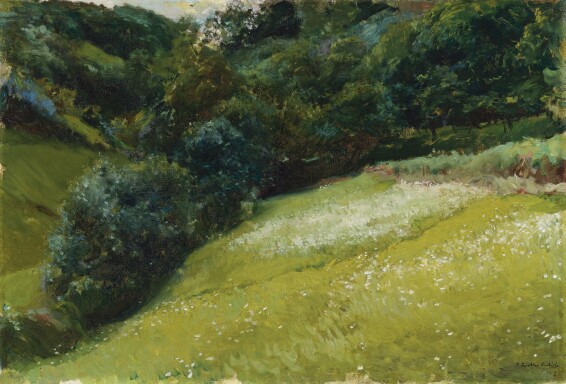
- Prado de Asturias, San Esteban de Pravia (Field in Asturias, San Esteban de Pravia)
- signed and dated J. Sorolla Bastida / 1903 lower right
- oil on canvas
- 66 by 96cm., 26 by 37¾in.
Provenance
Private Collection, Montevideo, Uruguay (by 1978)
Angel Cristóbal Gallery, Mexico, acquired from the above
Private Collection, USA (acquired from the above in 1979)
Exhibited
Berlin, Düsseldorf & Cologne, Schulte Galleries: Sorolla Solo Exhibition, 1907
London, Grafton Galleries, Exhibition of Paintings by Señor Sorolla y Bastida, 1908, no. 161, p. 76, illustrated in the catalogue
New York, The Hispanic Society of America, Paintings by Joaquín Sorolla Exhibited by the Hispanic Society of America, 1909, no. 24, illustrated in the catalogue (as Cañada, Asturias, sold after the exhibition for $800)
Madrid, Museo Nacional del Prado, Joaquín Sorolla 1863-1923, 2009, no. 36, illustrated in the catalogue (as Prado de Asturias, San Esteban de Pravia)
Dallas, Meadows Museum (on loan 2004-2011)
Literature
Aureliano de Beruete, C. Mauclair, H. Rochefort, L. Williams, E.L. Cary, J.G. Huneker, C. Brinton and W.E.B. Sterkweather, Eight Essays on Joaquín Sorolla y Bastida, New York, 1909, vol. I, no. 24, catalogued; p. 99 illustrated (as Cañada, Asturias)
Bernardino de Pantorba, La vida y obra de Joaquín Sorolla, Madrid, 1970, p. 185, no. 1468, catalogued (as Castañar de Asturias)
Blanca Pons-Sorolla, Joaquín Sorolla. Vida y obra, Madrid, 2001, p. 200, mentioned (as Campo de Asturias. San Esteben de Pravía)
Condition
"This lot is offered for sale subject to Sotheby's Conditions of Business, which are available on request and printed in Sotheby's sale catalogues. The independent reports contained in this document are provided for prospective bidders' information only and without warranty by Sotheby's or the Seller."
Catalogue Note
Painted in 1903, the year in which Sorolla 'reached his full maturity as a painter' according to Blanca Pons Sorolla, Field in Asturias belongs to a series of verdant Asturian landscapes that he painted between 1902-1904 in northern Spain.
Sorolla had first visited León and Asturias with his wife Clotilde and his three children in the spring of 1902, staying with Tomás García Sampedro - a fellow student with Sorolla during his time in Rome - at Muros de Nalón. The area had some renown among artists due to the colony that had been established at San Juan de la Arena in the late 1880s, frequented notably by Casto Plasencia and Cecilio Pla.
The plunging perspective and lack of horizon in the present work lends this 'pure landscape' a striking sense of absorption and immediacy. The limited field of vision and absence of figures focuses the observer's eye entirely on the rich study of greens, offset by the whites of the flowers executed in thick impasto. Sorolla's approach to landscape during this period was informed by discussions with his friend the law professor Rafael Altamira, a resident of San Juan de la Arena, with whom Sorolla shared a taste for 'small landscapes', with a narrow field of view.
Field in Asturias was among the paintings shown at Sorolla's exhibition in New York in 1909. A major success, the exhibition attracted some 170,000 visitors.