
- 112
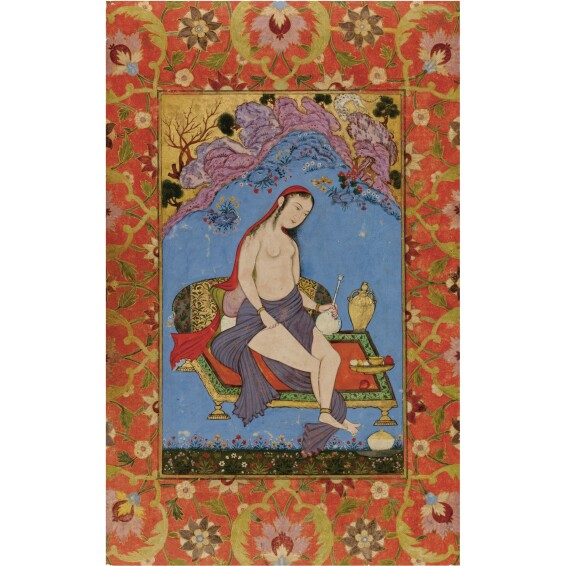
PORTRAIT OF A COURTESAN, INDIA, DECCAN, GOLCONDA, CIRCA 1630-50
Description
- Opaque watercolor
- 11 7/8 x 7 inches
Exhibited
A Flower from Every Meadow, The Asia House Gallery, New York, The Center of Asian Art and Culture: Avery Brundage Collection, San Francisco; The Albright-Knox Gallery of Art, Buffalo, New York, 1973
Literature
Welch 1959, fig.21
Welch 1963b, p.12
Welch 1973, no.77, pp.128-9
Zebrowski 1983, no.148
Condition
"In response to your inquiry, we are pleased to provide you with a general report of the condition of the property described above. Since we are not professional conservators or restorers, we urge you to consult with a restorer or conservator of your choice who will be better able to provide a detailed, professional report. Prospective buyers should inspect each lot to satisfy themselves as to condition and must understand that any statement made by Sotheby's is merely a subjective, qualified opinion. Prospective buyers should also refer to any Important Notices regarding this sale, which are printed in the Sale Catalogue.
NOTWITHSTANDING THIS REPORT OR ANY DISCUSSIONS CONCERNING A LOT, ALL LOTS ARE OFFERED AND SOLD AS IS" IN ACCORDANCE WITH THE CONDITIONS OF BUSINESS PRINTED IN THE SALE CATALOGUE."
Catalogue Note
This is an important Deccani painting, showing the continuing strong influence of Persian style at Golconda in the early to mid- 17th century. Zebrowski described the artist of this picture as "The most gifted interpreter of Persian conventions during the mid-seventeenth century..." (Zebrowski 1983, p.182).
The Persianate influence is present in almost all features, including the high horizon, the rocky hillside, the snow leopard, antelope and trees, the wide blue plane on which the courtsean is placed, the figure of the courtesan herself, and the daybed, cushion and blue-and-white ceramic bottle. The drapery of the courtesan's purple and red cloth wrappings are more Deccani in their fluttering mannerist folds, while the flowers on the grassy turf in the foreground show Mughal influence. This combination of local and outside stylistic components is typical of Decanni painting, but what marks this portrait out as definitively Deccani, as definitely not Persian, is a less definable character - an intensity and vibrancy which is only partly accounted for by the strong, bright pigments.
When this painting was exhibited in 1973 in the exhibition A Flower from Every Meadow, Cary Welch's description in the accompanying catalogue eloquently captured the presence of the painting:
"Even when they paraphrase conventional Safavid subjects, as here, Deccani pictures tend to be wild. This painting of a sweet-faced courtesan, which at first glance resembles prototypes painted at Isfahan for Shah Abbas (1587-1629), stuns us with a clash of hot red-orange and icy blue. While it lacks the calligraphic and compositional subtleties of Iranian work, these are compensated for by jaunty twists of drapery, flirtatiously upturned toes, and a tropical jungle of a border." (Welch 1973, p.128)