
- 180
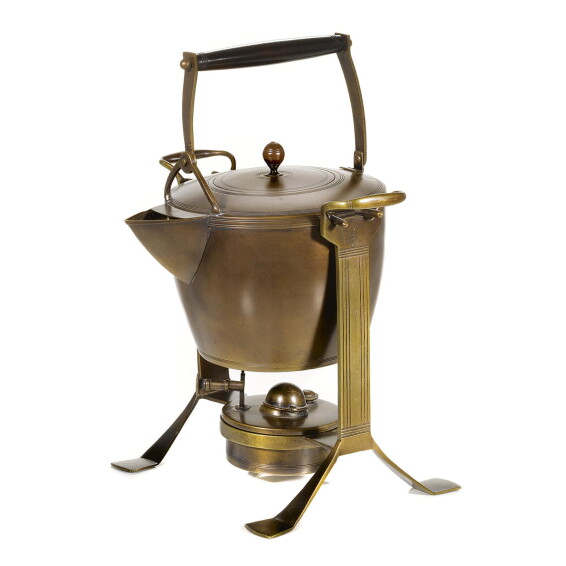
A brass bouilloire designed by Jan Eisenloeffel for De Woning, Amsterdam after 1902
Description
- kettle and stand marked with impressed designer's monogram
- height 32 cm (incl. handle)
Literature
Condition
"In response to your inquiry, we are pleased to provide you with a general report of the condition of the property described above. Since we are not professional conservators or restorers, we urge you to consult with a restorer or conservator of your choice who will be better able to provide a detailed, professional report. Prospective buyers should inspect each lot to satisfy themselves as to condition and must understand that any statement made by Sotheby's is merely a subjective, qualified opinion. Prospective buyers should also refer to any Important Notices regarding this sale, which are printed in the Sale Catalogue.
NOTWITHSTANDING THIS REPORT OR ANY DISCUSSIONS CONCERNING A LOT, ALL LOTS ARE OFFERED AND SOLD AS IS" IN ACCORDANCE WITH THE CONDITIONS OF BUSINESS PRINTED IN THE SALE CATALOGUE."
Catalogue Note
Metal worker and silver smith Jan Eisenloeffel (1876 -1957) was one of the champions of the rationalist movement within Dutch art nouveau, renowned for his machine-esthetic designs with clear forms, restrained decoration and visible constructive details such as rivets. Especially Eisenloeffel's kettles, derived from Japanese tea and sake kettles, were popular and widely imitated by firms in The Netherlands and Germany. In 1899 Eisenloeffel was appointed head of the metal workshop of the Amstelhoek cooperation, which products were sold through the 't Binnenhuis showrooms. In 1902, Eisenloeffel was amongst the artists protesting against the dominance of Berlage and Van den Bosch within 't Binnenhuis. A year later, Eisenloeffel was co-founder of De Woning, a similar cooperation led by artists who joined him in the utopic ideal of bringing good design to the common people