
- 31
Stuart Davis 1892-1964
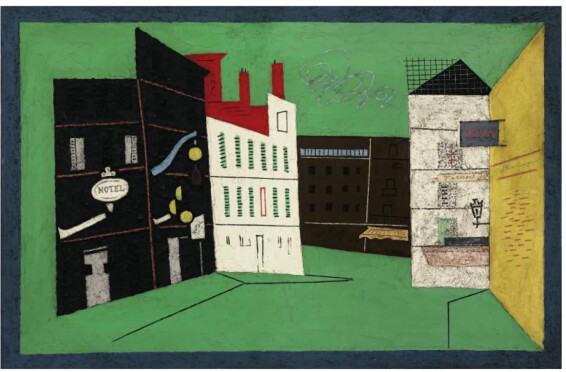
Description
- Stuart Davis
- Rue de l'Échaudé
- signed Stuart Davis, c.r.
- oil and sand on canvas
- 23 3/4 by 36 1/4 in.
- (60.3 by 92.1 cm)
- Painted in 1928.
Provenance
The artist
The Downtown Gallery, New York
Mr. and Mrs. Otto L. Spaeth, New York, by 1945
M. Knoedler & Co., New York
Acquired by the present owner from the above, 1971
Exhibited
Buffalo, New York, Albright Art Gallery, The Buffalo Fine Arts Academy, Twenty-fourth Annual Exhibition of Selected Paintings by American Artists and a Group of Water Colors by Dodge MacKnight, April-June 1930, no. 33
Philadelphia, Pennsylvania, Crillon Galleries, Inc., Stuart Davis, December 1931, no. 9
Chicago, Illinois, Katherine Kuh Galleries, Stuart Davis, January-February, 1939
New York, Primitive Arts Gallery, Exhibition of Abstract Paintings by French and American Painters, October-November 1940
Cincinnati, Ohio, Cincinnati Modern Art Society, Marsden Hartley, Stuart Davis, October-November 1941, illustrated
Bloomington, Indiana, Indiana University Art Museum, Paintings by Marsden Hartley and Stuart Davis, December 1941, pp. 58-63
New York, Museum of Modern Art, Stuart Davis, October 1945-February 1946, p. 19, illustrated
Baltimore, Maryland, The Baltimore Museum of Art, Stuart Davis Exhibition, March-April 1946
Amsterdam, the Netherlands, Stedelijk Museum, Amerika Schildert, June-September 1950, no. 75
Utica, New York, Munson-Williams-Proctor Institute, Spaeth Collection, October 1952, no. 10, illustrated (as Rue Echaude)
Washington, D.C., National Collection of the Fine Arts, Smithsonian Institution; Chicago, Illinois, Art Institute of Chicago; New York, Whitney Museum of American Art; Los Angeles, California, The Art Galleries, University of California at Los Angeles, Stuart Davis Memorial Exhibition, May-November 1965, no. 40
Literature
Robert M. Coates, "The Art Galleries: Two Americans," The New Yorker, vol. 21, October 1945, p. 52
Stuart Davis, Stuart Davis, American Artists Group, monograph no. 6, New York, 1945, illustrated
Cecelia Ager, "Stuart Davis," Vogue, vol. 107, January 1946, p. 80, illustrated in color
James Thrall Soby, "Does Our Art Impress Europe?" Saturday Review of Literature, vol. 32, August 1949, p. 143, illustrated
E.C. Goossen, Stuart Davis, New York, 1959, p. 23, illustrated in color
Rudi Blesh, Stuart Davis, New York, 1960, p. 51, illustrated
Brian O'Doherty, American Masters: The Voice and the Myth, New York, 1973, p. 54
Ellen Lawrence, et al, Graham, Gorky, Smith & Davis in the Thirties, Providence, Rhode Island, 1977, p. 28
Jane Myers, ed., Stuart Davis: Graphic Work and Related Paintings with a Catalogue Raisonné of the Prints, Forth Worth, Texas, 1986, p. 48
Lewis Kachur, Stuart Davis: An American in Paris, New York, 1987, p. 9
Catalogue Note
A: Yes. My trip to Europe in 1928.
(Stuart Davis, “Self-Interview,” Creative Art, September 1931, p. 211)
Davis painted Rue de l’Échaudé during his yearlong excursion to Paris from 1928 to 1929. His trip was funded by a sale of two paintings to Juliana Force and the financial support of Gertrude Vanderbilt Whitney. Though he had never visited the French capital, Davis was “no novice whose work was ripe for a dramatic transformation into the latest avant-garde style” (Lowrey Stokes Sims, Stuart Davis: American Painter, New York, 1991, p. 197). He had recently achieved unprecedented success with his Eggbeater series, being favorably compared by a critic to the masters of cubism, Picasso and Braque, and was heralded as arguably “the best among the Americans who paint on themes from the abstract” (Patricia Hills, Stuart Davis, New York, 1996, p. 80). Emboldened by these reviews, he took two paintings from his Eggbeater series and departed for Paris in May of 1928.
While in Paris, Davis resided in Jan Matulka’s studio at 50, rue Vercingétorix, in Montparnasse, which was in close proximity to the studios of several other American artists, including Morris Kantor, Isamu Noguchi, and Alexander Calder (figure 1). Absorbed by café culture, jazz music, and the modernist philosophies of his Parisian contemporaries, Davis’ numerous letters and sketchbooks attest to his intensely personal reaction to the French capital. He wrote to his father a few months after his arrival: “I am primarily interested in the streets. There is great variety, from the most commonplace to the unique. A street of regular French working-class homes of 100 years ago is interesting because they are all different in regard to size, surface, number of windows, etc.” (Karen Wilkin, Stuart Davis, New York, 1987, p. 112).
Davis spent much of his time observing the distinctive architecture and design that surrounded him, resuming the practice from his art school days of sketching to record his impressions of Parisian culture. In a letter to James Johnson Sweeney in 1945, he wrote: “[I]n Paris, the actuality was so interesting I found a desire to paint it just as it was” (Hills, Stuart Davis, p. 86). He felt remarkably at home in this foreign city and found his year in Paris extremely productive later writing that he “managed to produce about a dozen paintings which were decent enough to be looked at” (Hills, Stuart Davis, p. 80). In the fall of 1928, American author Elliot Paul, founder of the avant-garde magazine transition, published an article on Davis and even featured one of his Parisian scenes on the cover.
Small, literal elements appear in Davis’ work from this period. Flattened planes and broad expanses of color become animated by unmistakably French details, such as decorative signage, structurally delicate balconies, and café tables and chairs presented in a schematic format. H.H. Arnason observes: “The ubiquitous signs of the Paris scene, Vins, Tabac, Café, lent themselves to an abstract visual treatment in which the verbal significance disappeared” (Stuart Davis Memorial Exhibition, Washington, D.C., 1965, p. 20). Davis also became increasingly interested in creating a tactile surface in his painting and, like the cubists, mixed sand with pigment to create a stucco-like effect. In addition to texture, he experimented with color, at times testing the visual impact of monochromatic surfaces (figure 2) and in other cases, such as in Rue de l’Échaudé, using color to demarcate building facades, and often framing the compositions with a distinct colorful border. Working in a variety of media, he created approximately twelve lithographs during his Parisian sojourn, including one of the present composition (1929, Whitney Museum of American Art), as well as numerous line drawings. One such drawing of Rue de l’Échaudé can be seen in the right background of the photograph of Davis in his Paris studio (unlocated, figure 1).
It has been observed that Davis’ signature curving, calligraphic line first appears in these Parisian paintings. It initially emerges as a thin line of smoke from a chimney, as in Blue Café (figure 3), then later becomes increasingly abstract and stylized, almost an entity unto itself, as in Rue de l’Échaudé. This line continues to evolve, as scholar Patricia Hills notes, culminating in a robust, thickened form, which later becomes a singular element in Davis’ compositions. Davis returned from Paris in August of 1929 and exhibited his work from this period at the Downtown Gallery in January 1930. Lowrey Stokes Sims observes, “[a]lthough Davis never made it back to Paris, the particular juncture between abstraction and reality that he worked out in these paintings was to be characteristic of his art during the next decade” (Stuart Davis: American Painter, New York, 1991, p. 198).
figure 1: Stuart Davis in his studio on Rue Vercingétorix, Paris, 1928-29. Photograph by Thérèse Bonney, Copyright Estate of Stuart Davis
figure 2: Rue des Rats, No. 2, 1928, oil and sand on canvas, 20 by 29 in. (50.8 by 73 cm), Hirshhorn Museum and Sculpture Garden, Smithsonian Institution, Gift of Joseph H. Hirshhorn, 1972. Photographer: Lee Stalsworth
figure 3: Blue Café, 1928, oil on canvas, 18 1/2 by 21 3/4 in. (47 by 55.3 cm), The Phillips Collection, Washington, D.C.