
Works by Irma Stern at Sotheby's


Irma Stern Biography
An enigmatic and singular artist, Irma Stern’s legacy in the history of South African art is truly distinct in its synthesis of an avant-garde European modernist style with a largely African subject matter. Stern expanded the domain of Western art beyond a Eurocentric gaze, and in turn complicates our understanding of the European artistic tradition as having developed in a unitary space and time. Born in 1894 to German-Jewish parents at Transvaal, South Africa, Irma Stern travelled extensively between Europe and Africa, retaining and rejecting facets of the heritage of each nation she would encounter. It is this transcultural approach to her life and work which distinguishes Stern in the annals of global modernist history as one of the first truly cosmopolitan artists.
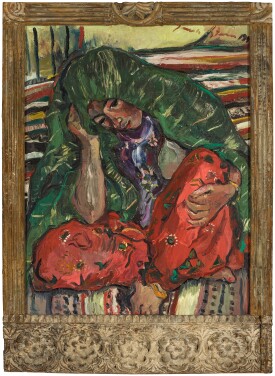
Stern gained admission to the Weimar Academy in 1913, six years before it was to be reformed into the famed Staatliches Bauhaus, where she revolted against the academicism of the curriculum, eventually developing a distinct Expressionist style (Dubow 1971, 5). This was reinforced through encounters with important contemporaries such as Max Pechstein, whose stylistic influence is observable in Stern’s oeuvre. Inspired in part by Expressionists like Pechstein and Paul Gauguin’s travels to the South Pacific, Stern grew an increasing sense of wanderlust, manifesting most notably in the production of a series of stellar works during her travel to Zanzibar. Crucially, however, where artists like Gauguin travelled to unfamiliar ‘other’ lands to explore themes of mystery, Stern’s fascination with the ‘exotic’ was rooted in her intimate experiences of Africa’s people, landscape and culture. This new body of Expressionist work brought Stern increasing acclaim from European critics, despite negative initial receptions to her work in her home country.
By her death in 1966, Stern had established herself as an indelible constituent of the modernist canon, particularly in South Africa. During her lifetime, Stern exhibited at the Venice Biennale in 1950, 1952, 1954 and 1958, going on to win the Peggy Guggenheim International Art Prize in 1960. Her work was the subject of major solo exhibitions in England, France, Holland, Belgium, Austria and Germany. Her paintings were included in the Empire Art Exhibition in 1924 and 1929; the International Jewish Exhibition in Zurich in 1929; the Exhibition of South African Art at the Tate Gallery in 1948 and later in Washington D.C. Stern’s work is held in important collections globally; her work was purchased by Queen Elizabeth in 1947 for her personal collection, as well as the collection of the National d’Art Moderne in Paris.
Once a young painter who had failed to attain the respect of her family and local audience, Stern relished the prodigious number of accolades she came to receive. She would often recount a statement offered by British sculptor Jacob Epstein, “At last a painter who can paint comes to London. Do you know that nobody living can paint flowers better than you can – that the Renoir roses I just saw look like paper against your flowers” (Berman 2003, 52). Today, Irma Stern’s work enjoys a status few other painters globally have attained, with auction records reaching $5 million and her works being among the most coveted by connoisseurs of South African art.
Sources
Berman, Mona. 2003. Remembering Irma Stern: Irma Stern: A Memoir with Letters. Cape Town: Double Storey.
Dubrow, Neville. 1971. “Irma Stern: An Evaluation” In Catalogue of the Collections in the Irma Stern Museum, Irma Stern Museum, 4-9. Cape Town: University of Cape Town.
Sotheby’s. 2020. [Catalogue Essay.] In Irma Stern: A Life Well Travelled, Sotheby’s, 4-5. London: Sotheby’s.
Wyman, Marilyn. 2000. “Irma Stern: Envisioning the “Exotic.” Woman’s Art Journal Autumn 20, no.2 (Autmn, 1999 – Winter, 2000): 18-23+35. https://doi.org/10.2307/1358980.
Read Less