
Property from the Stiltestichting Landgoed Den Bosch Collection
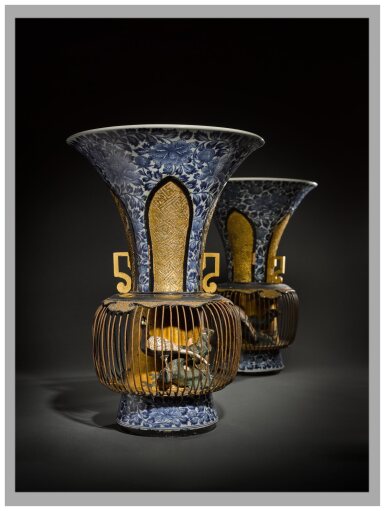
A rare and magnificent pair of Arita birdcage vases made for the European export market | Edo period, late 17th century
Lot Closed
October 5, 01:07 PM GMT
Estimate
150,000 - 250,000 GBP
Lot Details
Description
Property from the Stiltestichting Landgoed Den Bosch Collection
A rare and magnificent pair of Arita birdcage vases made for the European export market
Edo period, late 17th century
the pair of trumpet-shaped vases with tall neck, everted rim and foot, applied scroll handles, decorated in underglaze blue with a profusion of peonies and foliage, four panels left in the firing as biscuit, then over decorated in black and gold lacquer, the body applied with a cage mounted in lacquer and decorated in coloured pigments on a gold ground, with young pine (wakamatsu) and bamboo grass (sasa), each applied with Imari models of long-tailed pheasants, their details painted in iron-red and gilt, the interior of the everted necks with two three-clawed dragons in pursuit of the sacred pearl
each 52 cm., 20½ in. high
Dionysia Wilhelmina Everwijn (1923-2011)
Museum Arnhem, The Netherlands, 2004-2023.
Charlotte Wiechmann, Research into the Degradation of the Elements Inside the Cages of Two Birdcage Vases (11320222), MA Thesis Restoration & Conservation of Glass and Ceramics University (The Netherlands, 2021).
The birdcage vases are one such type of object combining Arita porcelain and urushi, being extravagant ‘Asian’ wares exported for the Western market at the start of the eighteenth century. These birdcage vases were brought to Europe and were mainly purchased by Augustus II (the Strong) Elector of Saxony (1670-1733), for prominent display in his ‘Japanisches Palais’ in Dresden, a palace that was supposed to house his extravagant collection of some twenty-four thousand porcelain objects. Historical floor plans and inventories suggest at least twenty birdcage vases were purchased for this purpose and another fifty imitation birdcage vases were commissioned from the Meissen Manufactory around 1730. It would seem as though the Meissen Manufactory, however, was unable to fulfil this order and supplied only a very limited number of these objects. Considering the Japanese policy on foreign trade the Japanese birdcage vases must have been imported by the Dutch East-India Company (VOC) and traded from the Netherlands.1
1. Charlotte Wiechmann, Research into the Degradation of the Elements Inside the Cages of Two Birdcage Vases (11320222), MA Thesis Restoration & Conservation of Glass and Ceramics University
You May Also Like


